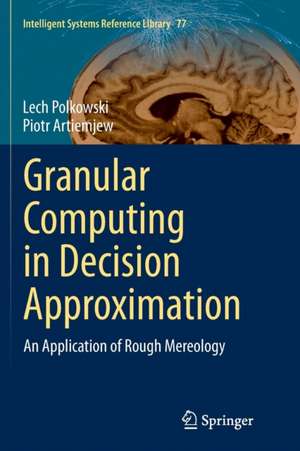
Granular Computing in Decision Approximation: Intelligent Systems Reference Library, cartea 77
Autor Lech Polkowski, Piotr Artiemjewen Limba Engleză Paperback – 6 oct 2016
Experimental results are given in detail both in tabular and visualized form for fourteen data sets from UCI data repository. A striking feature of granular classifiers obtained by this approach is that preserving the accuracy of them on original data, they reduce substantially the size of the granulated data set as well as the set of granular decision rules. This feature makes the presented approach attractive in cases where a small number of rules providing a high classification accuracy is desirable. As basic algorithms used throughout the text are explained and illustrated with hand examples, the book may also serve as a textbook.
Din seria Intelligent Systems Reference Library
- 20%
 Preț: 1199.62 lei
 - 20%
 Preț: 672.22 lei
 - 20%
 Preț: 674.97 lei
 - 20%
 Preț: 1043.12 lei
 - 20%
 Preț: 1090.74 lei
 - 20%
 Preț: 1213.04 lei
 - 20%
 Preț: 1207.79 lei
 - 20%
 Preț: 1083.76 lei
 - 20%
 Preț: 1101.63 lei
 - 20%
 Preț: 1080.01 lei
 - 20%
 Preț: 1322.83 lei
 - 20%
 Preț: 1207.79 lei
 - 20%
 Preț: 1928.55 lei
 - 20%
 Preț: 952.14 lei
 - 20%
 Preț: 674.70 lei
 - 20%
 Preț: 668.51 lei
 - 20%
 Preț: 684.20 lei
 - 20%
 Preț: 669.84 lei
 - 20%
 Preț: 677.34 lei
 - 20%
 Preț: 672.70 lei
 - 20%
 Preț: 670.94 lei
 - 20%
 Preț: 681.75 lei
 - 20%
 Preț: 680.43 lei
 - 20%
 Preț: 1686.68 lei
 - 20%
 Preț: 638.62 lei
 - 20%
 Preț: 672.48 lei
 - 20%
 Preț: 674.25 lei
 - 20%
 Preț: 676.25 lei
 - 20%
 Preț: 1039.77 lei
 - 20%
 Preț: 620.20 lei
 - 20%
 Preț: 682.21 lei
 - 20%
 Preț: 667.38 lei
 - 20%
 Preț: 669.16 lei
Preț: 632.96 lei
Preț vechi: 791.20 lei
-20%
Puncte Express: 949
Carte tipărită la comandă
Livrare economică 07-21 decembrie
Livrare prin curier în România Termenul estimat este afișat lângă disponibilitate.
Transport gratuit pentru acest produs Plată online sau ramburs, în funcție de opțiunile comenzii.
Retur gratuit în 14 zile Comandă securizată și suport în română.
Specificații
ISBN-13: 9783319366210
ISBN-10: 3319366211
Pagini: 468
Ilustrații: XV, 452 p. 230 illus.
Dimensiuni: 155 x 235 x 26 mm
Greutate: 0.7 kg
Ediția:Softcover reprint of the original 1st edition 2015
Editura: Springer
Colecția Intelligent Systems Reference Library
Seria Intelligent Systems Reference Library
Locul publicării:Cham, Switzerland
ISBN-10: 3319366211
Pagini: 468
Ilustrații: XV, 452 p. 230 illus.
Dimensiuni: 155 x 235 x 26 mm
Greutate: 0.7 kg
Ediția:Softcover reprint of the original 1st edition 2015
Editura: Springer
Colecția Intelligent Systems Reference Library
Seria Intelligent Systems Reference Library
Locul publicării:Cham, Switzerland
V-ar putea interesa
-
 -19%Preț: 92.35 lei114.22 lei
 -
 Computer VisionSimon J. D. Prince-20%Preț: 582.72 lei728.39 lei
 -
 Machine LearningPeter Flach-20%Preț: 386.84 lei483.55 lei
 -
 Multi-Agent Machine LearningH M Schwartz-20%Preț: 675.81 lei844.77 lei
 -
 Wavelet Neural NetworksAntonios K Alexandridis-20%Preț: 634.18 lei792.72 lei
 -
 Practical Introduction to CompDawson-Howe-20%Preț: 518.21 lei647.76 lei
 -
 Machine Learning: An Algorithmic Perspective, Second EditionStephen Marsland-20%Preț: 625.22 lei781.53 lei
 -
 Natural Language Processing and Computational LinguisticsMohamed Zakaria Kurdi-9%Preț: 1021.06 lei1122.04 lei
 -
 Thriving Rough SetsGuoyin Wang-20%Preț: 680.72 lei850.89 lei
 -
 Rough Sets and Current Trends in ComputingLech Polkowski-20%Preț: 353.77 lei442.21 lei
 -
 -20%Preț: 575.02 lei718.78 lei
 -
 -15%Preț: 635.00 lei747.05 lei
 -
 -20%Preț: 1225.27 lei1531.59 lei
 -
 Rough Sets and Current Trends in ComputingJingtao Yao-20%Preț: 345.68 lei432.09 lei
 -
 Believable BotsPhilip Hingston-20%Preț: 676.70 lei845.88 lei
 -
 Algorithmic Foundations of Robotics XEmilio Frazzoli-18%Preț: 1279.87 lei1560.83 lei
 -
 The Metaphysical Nature of the Non-adequacy ClaimCarlotta Piscopo-20%Preț: 616.53 lei770.66 lei
 -
 Policies and Research in Identity ManagementSimone Fischer-Hübner-20%Preț: 339.77 lei424.72 lei
 -
 Advances in Bio-inspired Computing for Combinatorial Optimization ProblemsCamelia-Mihaela Pintea-20%Preț: 643.63 lei804.54 lei
 -
 -20%Preț: 646.40 lei808.00 lei
 -
 Rough Set Methods and ApplicationsLech Polkowski-20%Preț: 356.10 lei445.12 lei
Cuprins
Similarity and Granulation.- Mereology and Rough Mereology. Rough Mereological Granulation.- Learning data Classification. Classifiers in General and in Decision Systems.- Methodologies for Granular Reflections.- Covering Strategies.- Layered Granulation.- Naive Bayes Classifier on Granular Reflections.- The Case of Concept-Dependent Granulation.- Granular Computing in the Problem of Missing Values.- Granular Classifiers Based on Weak Rough Inclusions.- Effects of Granulation on Entropy and Noise in Data. - Conclusions.- Appendix. Data Characteristics Bearing on Classification.
Recenzii
“The book provides an extended presentation of granular computing, focusing on applications in classification/decision theory. … the book is intended to students and researchers interested in granular computing.” (Florin Gorunescu, zbMATH 1314.68006, 2015)
Textul de pe ultima copertă
This book presents a study in knowledge discovery in data with knowledge understood as a set of relations among objects and their properties. Relations in this case are implicative decision rules and the paradigm in which they are induced is that of computing with granules defined by rough inclusions, the latter introduced and studied within rough mereology, the fuzzified version of mereology. In this book basic classes of rough inclusions are defined and based on them methods for inducing granular structures from data are highlighted. The resulting granular structures are subjected to classifying algorithms, notably k—nearest neighbors and bayesian classifiers.
Experimental results are given in detail both in tabular and visualized form for fourteen data sets from UCI data repository. A striking feature of granular classifiers obtained by this approach is that preserving the accuracy of them on original data, they reduce substantially the size of the granulated data set as well as the set of granular decision rules. This feature makes the presented approach attractive in cases where a small number of rules providing a high classification accuracy is desirable. As basic algorithms used throughout the text are explained and illustrated with hand examples, the book may also serve as a textbook.
Experimental results are given in detail both in tabular and visualized form for fourteen data sets from UCI data repository. A striking feature of granular classifiers obtained by this approach is that preserving the accuracy of them on original data, they reduce substantially the size of the granulated data set as well as the set of granular decision rules. This feature makes the presented approach attractive in cases where a small number of rules providing a high classification accuracy is desirable. As basic algorithms used throughout the text are explained and illustrated with hand examples, the book may also serve as a textbook.
Caracteristici
Recent research on Granular Computing in Decision Approximation Fully develops the topic of granular computing in classifier synthesis Presents applied algorithms which are illustrated with simple hand examples Includes supplementary material: sn.pub/extras