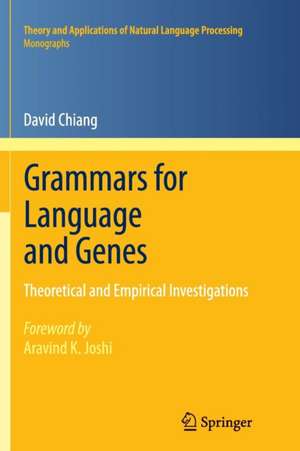
Grammars for Language and Genes: Theory and Applications of Natural Language Processing
Autor David Chiangen Limba Engleză Paperback – 26 noi 2013

Preț: 511.63 lei
Preț vechi: 968.57 lei
-47%
Puncte Express: 767
Carte indisponibilă temporar
Livrare prin curier în România Termenul estimat este afișat lângă disponibilitate.
Transport gratuit pentru acest produs Plată online sau ramburs, în funcție de opțiunile comenzii.
Retur gratuit în 14 zile Comandă securizată și suport în română.
Specificații
ISBN-13: 9783642270802
ISBN-10: 3642270808
Pagini: 132
Ilustrații: XII, 120 p.
Dimensiuni: 155 x 235 x 8 mm
Greutate: 0.21 kg
Ediția:2012
Editura: Springer
Colecția Theory and Applications of Natural Language Processing
Seria Theory and Applications of Natural Language Processing
Locul publicării:Berlin, Heidelberg, Germany
ISBN-10: 3642270808
Pagini: 132
Ilustrații: XII, 120 p.
Dimensiuni: 155 x 235 x 8 mm
Greutate: 0.21 kg
Ediția:2012
Editura: Springer
Colecția Theory and Applications of Natural Language Processing
Seria Theory and Applications of Natural Language Processing
Locul publicării:Berlin, Heidelberg, Germany
V-ar putea interesa
-
 Simplicity TheoryByunghan Kim-31%Preț: 740.46 lei1080.15 lei
 -
 In Defence of Objective BayesianismJon Williamson-31%Preț: 692.16 lei1006.15 lei
 -
 Computability and RandomnessAndré Nies-21%Preț: 418.44 lei529.70 lei
 -
 A Course in Model TheoryBruno Poizat-15%Preț: 612.43 lei720.50 lei
 -
 Inductive LogicDov M. Gabbay-26%Preț: 1245.09 lei1677.70 lei
 -
 Lectures in Logic and Set TheoryGeorge TourlakisPreț: 438.01 lei
 -
 A Course in Model TheoryKatrin Tent-11%Preț: 520.25 lei584.55 lei
 -
 Lambda Calculus with TypesHenk Barendregt-11%Preț: 698.84 lei785.21 lei
 -
 Logic and Discrete Mathematics - A ConciseIntroductionWillem ConradiePreț: 545.64 lei
 -
 Mathematical Logic for Computer ScienceMordechai Ben-Ari-20%Preț: 395.53 lei494.41 lei
 -
 The Joy of SetsKeith Devlin-15%Preț: 443.91 lei522.24 lei
 -
 Preț: 497.59 lei
 -
 Introducing InfinityBrian CleggPreț: 63.40 lei
 -
 Sets, Logic and CategoriesPeter J. CameronPreț: 280.57 lei
 -
 Lattice Theory: Special Topics and ApplicationsGeorge Grätzer-15%Preț: 656.38 lei772.20 lei
 -
 -15%Preț: 735.59 lei865.39 lei
 -
 Preț: 419.31 lei
Public țintă
ResearchCuprins
1.Introduction.- 2.Foundation.- 3.Statistical Parsing.- 4.Machine Translation.- 5.Biological Sequence Analysis: Basics.- 6.Biological Sequence Analysis: Intersection.- 7.Conclusion.- References.- Index.
Textul de pe ultima copertă
Grammars are gaining importance in natural language processing and computational biology as a means of encoding theories and structuring algorithms. But one serious obstacle to applications of grammars is that formal language theory traditionally classifies grammars according to their weak generative capacity (what sets of strings they generate) and tends to ignore strong generative capacity (what sets of structural descriptions they generate) even though the latter is more relevant to applications.
This book develops and demonstrates a framework for carrying out rigorous comparisons of grammar formalisms in terms of their usefulness for applications, focusing on three areas of application: statistical parsing, natural language translation, and biological sequence analysis. These results should pave the way for theoretical research to pursue results that are more directed towards applications, and for practical research to explore the use of advanced grammar formalisms more easily.
This book develops and demonstrates a framework for carrying out rigorous comparisons of grammar formalisms in terms of their usefulness for applications, focusing on three areas of application: statistical parsing, natural language translation, and biological sequence analysis. These results should pave the way for theoretical research to pursue results that are more directed towards applications, and for practical research to explore the use of advanced grammar formalisms more easily.
Caracteristici
Foreword written by Prof. Dr. Aravind Joshi This book develops and demonstrates, for the first time, a framework for carrying out rigorous comparisons of grammar formalisms in terms of their usefulness for applications Three areas of application are considered