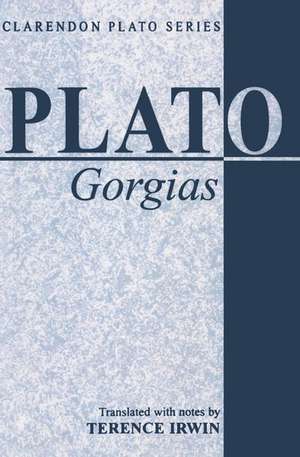
Gorgias: Clarendon Plato Series
Autor Plato Traducere de Terence Irwinen Limba Engleză Paperback – 28 feb 1979
Preț: 345.62 lei
Preț vechi: 421.21 lei
-18%
Puncte Express: 518
Carte tipărită la comandă
Livrare economică 20 noiembrie-01 decembrie
Livrare prin curier în România Termenul estimat este afișat lângă disponibilitate.
Transport gratuit de la 400.00 lei Plată online sau ramburs, în funcție de opțiunile comenzii.
Retur gratuit în 14 zile Comandă securizată și suport în română.
Specificații
ISBN-13: 9780198720911
ISBN-10: 0198720912
Pagini: 280
Dimensiuni: 135 x 202 x 16 mm
Greutate: 0.3 kg
Editura: OUP OXFORD
Colecția OUP Oxford
Seria Clarendon Plato Series
Locul publicării:Oxford, United Kingdom
ISBN-10: 0198720912
Pagini: 280
Dimensiuni: 135 x 202 x 16 mm
Greutate: 0.3 kg
Editura: OUP OXFORD
Colecția OUP Oxford
Seria Clarendon Plato Series
Locul publicării:Oxford, United Kingdom
V-ar putea interesa
-
 RepublicPlatoPreț: 30.76 lei
 -
 -25%Preț: 218.86 lei290.91 lei
 -
 Talking and Knowing: Essays on Plato's GorgiasCasey Perin-30%Preț: 529.56 lei753.16 lei
 -
 -20%Preț: 50.18 lei63.10 lei
 -
 Ten Philosophical Essays in the Christian TraditionFrederick J. CrossonPreț: 260.76 lei
 -
 Christian Philosophy of ReligionC. P. RuloffPreț: 455.52 lei
 -
 Icons of Danish ModernityJulie K. AllenPreț: 250.96 lei
 -
 Preț: 85.97 lei
 -
 MeditationsMarcus AureliusPreț: 33.99 lei
 -
 AristotleAristotlePreț: 193.55 lei
 -
 Preț: 229.26 lei
 -
 -14%Preț: 515.26 lei599.14 lei
 -
 -27%Preț: 766.12 lei1049.48 lei
 -
 Preț: 155.10 lei
 -
 Children, Sexuality, and the LawSacha M CoupetPreț: 483.77 lei
 -
 ProtagorasPlato-19%Preț: 84.88 lei104.32 lei
 -
 Why Plato Matters NowAngie Hobbs-25%Preț: 92.15 lei122.47 lei
 -
 The Racial MundaneJu Yon KimPreț: 291.50 lei
 -
 Ghosts of Jim CrowF Michael HigginbothamPreț: 272.42 lei
 -
 Keywords for Asian American StudiesCathy J. Schlund–vials-23%Preț: 612.54 lei795.51 lei
 -
 PhaedrusPlatoPreț: 43.00 lei
 -
 ParmenidesPlatoPreț: 43.40 lei
 -
 ProtagorasPlatoPreț: 39.22 lei
 -
 CritoPlatoPreț: 42.00 lei
 -
 Nicomachean EthicsAristotlePreț: 44.60 lei
 -
 Preț: 58.05 lei
 -
 Letter CarvingAndrew HibberdPreț: 125.06 lei
 -
 The PrinceNiccolò MachiavelliPreț: 33.48 lei
 -
 Alfred FlechtheimAndrea BambiPreț: 239.45 lei
 -
 UtopiaThomas MorePreț: 33.19 lei
Notă biografică
Plato was an ancient Greek philosopher born in Athens during the Classical period in Ancient Greece. In Athens, Plato founded the Academy, a philosophical school where he taught the philosophical doctrines that would later become known as Platonism. Plato (or Platon) was a pen name derived, apparently, from the nickname given to him by his wrestling coach - allegedly a reference to his physical broadness. According to Alexander of Miletus quoted by Diogenes of Sinope his actual name was Aristocles, son of Ariston, of the deme Collytus (Collytus being a district of Athens).Plato was an innovator of the written dialogue and dialectic forms in philosophy. He raised problems for what later became all the major areas of both theoretical philosophy and practical philosophy. His most famous contribution is the Theory of forms, which has been interpreted as advancing a solution to what is now known as the problem of universals. He is also the namesake of Platonic love and the Platonic solids.His own most decisive philosophical influences are usually thought to have been, along with Socrates, the pre-Socratics Pythagoras, Heraclitus, and Parmenides, although few of his predecessors' works remain extant and much of what we know about these figures today derives from Plato himself.[a]Along with his teacher, Socrates, and his student, Aristotle, Plato is a central figure in the history of philosophy.[b] Unlike the work of nearly all of his contemporaries, Plato's entire body of work is believed to have survived intact for over 2,400 years.[6] Although their popularity has fluctuated, Plato's works have consistently been read and studied. Through Neoplatonism Plato also greatly influenced both Christian and Islamic philosophy (through e.g. Al-Farabi). In modern times, Alfred North Whitehead famously said: "the safest general characterization of the European philosophical tradition is that it consists of a series of footnotes to Plato.
Cuprins
GorgiasAcknowledgments
Reference System Used in this Edition
Chronolgy
Introduction
Further Reading
A Note on the Text
Gorgias
A: Dialogue with Gorgias
B: Dialogue with Polus
C: Dialogue with Callicles
Notes
Glossary of Greek Terms
Index
Reference System Used in this Edition
Chronolgy
Introduction
Further Reading
A Note on the Text
Gorgias
A: Dialogue with Gorgias
B: Dialogue with Polus
C: Dialogue with Callicles
Notes
Glossary of Greek Terms
Index
Recenzii
`Professor Dodds's fine edition (which both fairly overhauls the manuscript tradition and supplies a commentary as wide-ranging as it is perspicacious) fills a gap untouched in this country since 1890 ... The Gorgias should have a special appeal to contemporary students, and to historians no less than philosophers.'Times Literary Supplement`The admired qualities of [Dodd's works], a scholarship both exact and deep, an economy and lucidity in exposition (Dodds has few rivals in saying much in the fewest words with absolute clarity), and an immense level-headedness and sobriety which - combined with the sharpest acumen and independence of judgement in the handling of evidence - is never seduced by the charm of fantasy, all these once more characterize his edition of the Gorgias.'Philosophical Quarterly