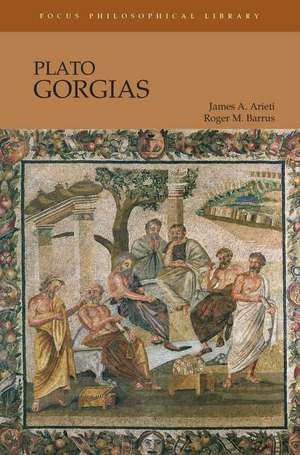
Gorgias
Autor Plato Editat de James A. Arieti, Roger M. Barrusen Limba Engleză Paperback – apr 2006
This is an English translation of Plato’s dialogue of Socrates seeking the true definition of rhetoric, with an attempt to show the flaws of the sophistic orators. Includes speeches from Thucydides’ History of the Peloponnesian Wars that reflect Plato’s themes.
Focus Philosophical Library translations are close to and are non-interpretative of the original text, with the notes and a glossary intending to provide the reader with some sense of the terms and the concepts as they were understood by Plato’s immediate audience.
Preț: 94.59 lei
Preț vechi: 114.25 lei
-17%
Puncte Express: 142
Carte disponibilă
Livrare economică 28 octombrie-11 noiembrie
Livrare express 14-20 octombrie pentru 42.07 lei
Livrare prin curier în România Termenul estimat este afișat lângă disponibilitate.
Transport gratuit de la 400.00 lei Plată online sau ramburs, în funcție de opțiunile comenzii.
Retur gratuit în 14 zile Comandă securizată și suport în română.
Specificații
ISBN-13: 9781585102433
ISBN-10: 1585102431
Pagini: 256
Ilustrații: none
Dimensiuni: 140 x 216 x 15 mm
Greutate: 0.27 kg
Ediția:First Edition
Editura: Hackett Publishing Company,Inc
Colecția Focus
Locul publicării:United States
ISBN-10: 1585102431
Pagini: 256
Ilustrații: none
Dimensiuni: 140 x 216 x 15 mm
Greutate: 0.27 kg
Ediția:First Edition
Editura: Hackett Publishing Company,Inc
Colecția Focus
Locul publicării:United States
V-ar putea interesa
-
 RepublicPlatoPreț: 30.33 lei
 -
 -25%Preț: 218.86 lei290.91 lei
 -
 Talking and Knowing: Essays on Plato's GorgiasCasey Perin-30%Preț: 525.64 lei752.05 lei
 -
 -20%Preț: 50.18 lei63.10 lei
 -
 Ten Philosophical Essays in the Christian TraditionFrederick J. CrossonPreț: 260.76 lei
 -
 Christian Philosophy of ReligionC. P. RuloffPreț: 455.52 lei
 -
 Icons of Danish ModernityJulie K. AllenPreț: 243.52 lei
 -
 Preț: 83.76 lei
 -
 MeditationsMarcus AureliusPreț: 33.79 lei
 -
 AristotleAristotlePreț: 193.55 lei
 -
 Preț: 229.26 lei
 -
 -14%Preț: 515.26 lei599.14 lei
 -
 -27%Preț: 766.12 lei1049.48 lei
 -
 Preț: 155.10 lei
 -
 Children, Sexuality, and the LawSacha M CoupetPreț: 483.77 lei
 -
 ProtagorasPlato-19%Preț: 84.88 lei104.32 lei
 -
 Why Plato Matters NowAngie Hobbs-25%Preț: 91.65 lei122.28 lei
 -
 The Racial MundaneJu Yon KimPreț: 291.50 lei
 -
 Ghosts of Jim CrowF Michael HigginbothamPreț: 272.42 lei
 -
 Keywords for Asian American StudiesCathy J. Schlund–vials-23%Preț: 612.54 lei795.51 lei
 -
 PhaedrusPlatoPreț: 43.00 lei
 -
 ParmenidesPlatoPreț: 43.40 lei
 -
 ProtagorasPlatoPreț: 39.22 lei
 -
 CritoPlatoPreț: 42.00 lei
 -
 Nicomachean EthicsAristotlePreț: 44.60 lei
 -
 Preț: 58.05 lei
 -
 Letter CarvingAndrew HibberdPreț: 125.06 lei
 -
 The PrinceNiccolò MachiavelliPreț: 33.48 lei
 -
 Alfred FlechtheimAndrea BambiPreț: 239.45 lei
 -
 UtopiaThomas MorePreț: 33.19 lei
Recenzii
Arieti and Barrus have provided us with a fine contribution to the literature on Plato’s Gorgias. This text includes a literal translation of the Gorgias with a helpful introductory essay, and copious notes. It includes a priceless appendix of the only literal translations available today of several key speeches from Thucydides, as well as a valuable glossary and appendices on the rules of dialectic that may be derived from the arguments of the Gorgias, and on Plato’s use of the terms mythos and logos, with which not all scholars may agree, but which I think all should find of interest.
- Michael Palmer, University of Maine
English translation with introductory essay, notes.
Notă biografică
Plato was an ancient Greek philosopher born in Athens during the Classical period in Ancient Greece. In Athens, Plato founded the Academy, a philosophical school where he taught the philosophical doctrines that would later become known as Platonism. Plato (or Platon) was a pen name derived, apparently, from the nickname given to him by his wrestling coach - allegedly a reference to his physical broadness. According to Alexander of Miletus quoted by Diogenes of Sinope his actual name was Aristocles, son of Ariston, of the deme Collytus (Collytus being a district of Athens).Plato was an innovator of the written dialogue and dialectic forms in philosophy. He raised problems for what later became all the major areas of both theoretical philosophy and practical philosophy. His most famous contribution is the Theory of forms, which has been interpreted as advancing a solution to what is now known as the problem of universals. He is also the namesake of Platonic love and the Platonic solids.His own most decisive philosophical influences are usually thought to have been, along with Socrates, the pre-Socratics Pythagoras, Heraclitus, and Parmenides, although few of his predecessors' works remain extant and much of what we know about these figures today derives from Plato himself.[a]Along with his teacher, Socrates, and his student, Aristotle, Plato is a central figure in the history of philosophy.[b] Unlike the work of nearly all of his contemporaries, Plato's entire body of work is believed to have survived intact for over 2,400 years.[6] Although their popularity has fluctuated, Plato's works have consistently been read and studied. Through Neoplatonism Plato also greatly influenced both Christian and Islamic philosophy (through e.g. Al-Farabi). In modern times, Alfred North Whitehead famously said: "the safest general characterization of the European philosophical tradition is that it consists of a series of footnotes to Plato.
Cuprins
GorgiasAcknowledgments
Reference System Used in this Edition
Chronolgy
Introduction
Further Reading
A Note on the Text
Gorgias
A: Dialogue with Gorgias
B: Dialogue with Polus
C: Dialogue with Callicles
Notes
Glossary of Greek Terms
Index
Reference System Used in this Edition
Chronolgy
Introduction
Further Reading
A Note on the Text
Gorgias
A: Dialogue with Gorgias
B: Dialogue with Polus
C: Dialogue with Callicles
Notes
Glossary of Greek Terms
Index