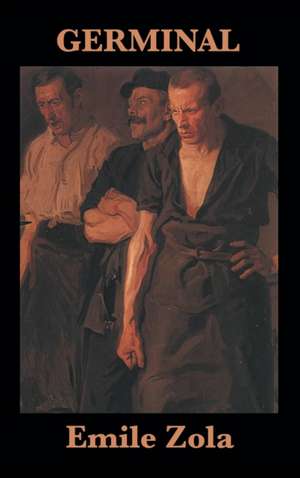
Germinal
Autor Emile Zolaen Limba Engleză Hardback – 3 apr 2018
Preț: 242.21 lei
Puncte Express: 363
Carte tipărită la comandă
Livrare economică 07-21 decembrie
Livrare prin curier în România Termenul estimat este afișat lângă disponibilitate.
Transport gratuit de la 400.00 lei Plată online sau ramburs, în funcție de opțiunile comenzii.
Retur gratuit în 14 zile Comandă securizată și suport în română.
Specificații
ISBN-13: 9781515432982
ISBN-10: 151543298X
Pagini: 272
Dimensiuni: 157 x 235 x 21 mm
Greutate: 0.55 kg
Editura: SMK Books
ISBN-10: 151543298X
Pagini: 272
Dimensiuni: 157 x 235 x 21 mm
Greutate: 0.55 kg
Editura: SMK Books
V-ar putea interesa
-
 The DebacleEmile ZolaPreț: 92.40 lei
 -
 Au Bonheur des DamesEmile Zola-35%Preț: 61.74 lei94.29 lei
 -
 The Drinking DenEmile Zola-35%Preț: 60.98 lei94.37 lei
 -
 The Beast WithinÉmile Zola-28%Preț: 67.73 lei94.63 lei
 -
 La Débâcle: (reissue)Ãmile ZolaPreț: 80.09 lei
 -
 The AssommoirÃmile ZolaPreț: 61.38 lei
 -
 Ãmile Zola: A Very Short IntroductionBrian Nelson-20%Preț: 56.97 lei70.82 lei
 -
 Émile Zola: Writing Modern LifeRachel Bowlby-15%Preț: 141.40 lei166.90 lei
 -
 Thérèse RaquinÉmile ZolaPreț: 53.18 lei
 -
 GerminalÉmile ZolaPreț: 62.18 lei
 -
 The MasterpieceÉmile ZolaPreț: 60.12 lei
 -
 La Bête humaineÉmile ZolaPreț: 55.39 lei
 -
 The Belly of ParisÉmile ZolaPreț: 64.92 lei
 -
 The Fortune of the RougonsÉmile ZolaPreț: 65.16 lei
 -
 EarthÉmile Zola-17%Preț: 78.08 lei94.27 lei
 -
 Preț: 108.70 lei
 -
 Émile Zola: A Determined LifeRobert LethbridgePreț: 193.65 lei
 -
 Classics Illustrated 7Victor HugoPreț: 57.23 lei
Descriere
Descriere de la o altă ediție sau format:
Coal mines have become rare, but the miners of Germinal are immortal. This new edition of the novel, with a translation by Raymond MacKenzie, is an exquisite tribute to their work, their misery and their eventual revolt. In his introduction, David Baguley--one of the most respected authorities on the work of Zola--brilliantly illuminates the genetic, historical and aesthetic aspects of the novel. His lucid, sensitive and critical gaze highlights the real secrets of the work: its underlying anthropological and social investigation, the dark power of the tragic imagination and the brightness of symbolic and mythic intuitions. --Henri Mitterand, Professor Emeritus, Columbia University
Recenzii
Raymond MacKenzie's elegant new translation of Emile Zola’s Germinal captures the diction of the novel's colorful characters and the restrained voice of a naturalist narrator. David Baguley’s introduction analyzes Zola’s personal background, his literary and scientific influences, and the historical circumstances of French workers in the 1860s as well as a spectrum of political acts and deeds in the 1880s when the novel was written. These features plus Zola’s notes on the town of Anzin that he studied prior to writing the novel, make this the edition of choice for course adoptions in history and literature. --Stephen Kern, Humanities Distinguished Professor, Department of History, Ohio State University
Notă biografică
Émile Zola (1840-1902) was a French novelist, journalist, critic, and one of the central figures of literary naturalism. Best known for the twenty-volume Rougon-Macquart cycle, Zola brought an ambitious social, political, and scientific seriousness to the nineteenth-century novel, examining how heredity, environment, class, labour, money, sexuality, and institutions shape human life. His fiction often focused on the forces that polite society preferred not to see: poverty, exploitation, alcoholism, prostitution, industrial danger, political corruption, and the pressure of economic power on ordinary families.Born in Paris and raised partly in Aix-en-Provence, Zola became one of the most influential and controversial writers of modern France. Novels such as Thérèse Raquin, L'Assommoir, Nana, Germinal, La Bête humaine, and La Débâcle helped define naturalist fiction through their detailed social observation, unsentimental realism, and willingness to confront the physical and moral conditions of modern life. Germinal, his great novel of coal miners and class struggle, is among his most enduring works and remains a cornerstone of French literature, labour fiction, and the European realist tradition. Zola was also a major public intellectual, famously intervening in the Dreyfus Affair with "J'Accuse...!", an act that confirmed his place not only in literary history but in the history of political conscience.