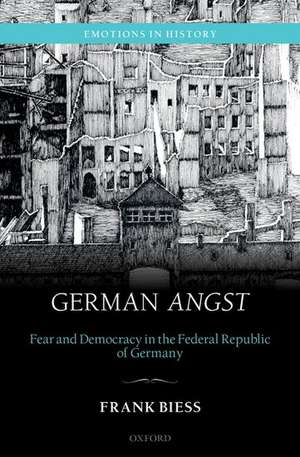
German Angst: Fear and Democracy in the Federal Republic of Germany: Emotions in History
Autor Frank Biessen Limba Engleză Paperback – 22 iun 2022
Din seria Emotions in History
- 26%
 Preț: 856.94 lei
 - 19%
 Preț: 681.87 lei
 - 18%
 Preț: 240.08 lei
 - 23%
 Preț: 605.13 lei
 - 20%
 Preț: 207.63 lei
 - 16%
 Preț: 229.19 lei
 - 31%
 Preț: 694.23 lei
 - 17%
 Preț: 277.23 lei
 - 31%
 Preț: 727.52 lei
 - 31%
 Preț: 712.53 lei
 - 21%
 Preț: 620.98 lei
 - 29%
 Preț: 596.78 lei
 - 29%
 Preț: 621.60 lei
 - 31%
 Preț: 722.91 lei
 - 31%
 Preț: 620.39 lei
 - 31%
 Preț: 619.89 lei
Preț: 285.44 lei
Preț vechi: 340.78 lei
-16%
Puncte Express: 428
Carte disponibilă
Livrare economică 06-11 noiembrie
Livrare prin curier în România Termenul estimat este afișat lângă disponibilitate.
Transport gratuit de la 400.00 lei Plată online sau ramburs, în funcție de opțiunile comenzii.
Retur gratuit în 14 zile Comandă securizată și suport în română.
Specificații
ISBN-13: 9780192867872
ISBN-10: 0192867873
Pagini: 432
Ilustrații: 24 black and white images
Dimensiuni: 156 x 233 x 24 mm
Greutate: 0.63 kg
Editura: OUP OXFORD
Colecția OUP Oxford
Seria Emotions in History
Locul publicării:Oxford, United Kingdom
ISBN-10: 0192867873
Pagini: 432
Ilustrații: 24 black and white images
Dimensiuni: 156 x 233 x 24 mm
Greutate: 0.63 kg
Editura: OUP OXFORD
Colecția OUP Oxford
Seria Emotions in History
Locul publicării:Oxford, United Kingdom
V-ar putea interesa
-
 Rural Inventions: The French Countryside after 1945Sarah Farmer-19%Preț: 543.98 lei671.58 lei
 -
 -23%Preț: 664.82 lei863.40 lei
 -
 -23%Preț: 559.58 lei726.73 lei
 -
 People's China: A Brief HistoryCraig Dietrich-23%Preț: 609.59 lei791.67 lei
 -
 Europe, 1945 to the PresentRobin W Winks-23%Preț: 657.40 lei853.76 lei
 -
 -14%Preț: 105.64 lei122.97 lei
 -
 -31%Preț: 664.47 lei962.26 lei
 -
 HomecomingsFrank BiessPreț: 414.44 lei
 -
 The Vietnamese Boat People, 1954 and 1975-1992Nghia M. VoPreț: 224.71 lei
 -
 Suicide & the HolocaustDavid Lester Ph.D.-27%Preț: 1520.53 lei2074.07 lei
 -
 Explorations and EntanglementsHartmut Berghoff-23%Preț: 764.61 lei993.01 lei
 -
 Conflict, Catastrophe and ContinuityFrank Biess-23%Preț: 846.10 lei1098.83 lei
 -
 Histories of the AftermathFrank Biess-23%Preț: 765.38 lei993.99 lei
 -
 Seemacht unter rot-weiß-roter Flagge Band 2Karl GruberPreț: 151.61 lei
Recenzii
Winner of the 2021 Norris and Carol Hundley Award of the Pacifc Coast Branch of the American Historical Association
A historical book that hits the nerve of our present. . .Biess casts new light on the history of the Federal Republic. . .and gives back to the Federal Republic its emotional drama.
A fresh view of the history of the Federal Republic. . .and a critical corrective to the existing historiography.
Republik der Angst offers a compelling alternative narrative of West German democratization as a project that succeeded not because its participants were rational liberal subjects, but because they were in touch with their subjective fears. While chronic fear certainly had the potential to cause paralysis, fear also functioned as a warning system for the risks of modernization.
Biess has written an excellent book, which is a welcome addition to the historiography of postwar Germany.
German Angst is ambitious in its scope and its methodology. In the first half, it does what good history should do-it challenges us to reapproach familiar narratives from a different perspective. And in the second half, it offers a stimulating interpretation of the new social movements and our contemporary moment. . .In any case, there can be no doubt that Frank Biess returns contingency and previously sidelined “irrational” forces to the historical narrative as well as offering us a narrative of democracy's fragility befitting the current moment.
It is the kind of book with which historians can teach, offering students a bold, new interpretive framework for understanding postwar German history and the potency of political emotions.
A historical book that hits the nerve of our present. . .Biess casts new light on the history of the Federal Republic. . .and gives back to the Federal Republic its emotional drama.
A fresh view of the history of the Federal Republic. . .and a critical corrective to the existing historiography.
Republik der Angst offers a compelling alternative narrative of West German democratization as a project that succeeded not because its participants were rational liberal subjects, but because they were in touch with their subjective fears. While chronic fear certainly had the potential to cause paralysis, fear also functioned as a warning system for the risks of modernization.
Biess has written an excellent book, which is a welcome addition to the historiography of postwar Germany.
German Angst is ambitious in its scope and its methodology. In the first half, it does what good history should do-it challenges us to reapproach familiar narratives from a different perspective. And in the second half, it offers a stimulating interpretation of the new social movements and our contemporary moment. . .In any case, there can be no doubt that Frank Biess returns contingency and previously sidelined “irrational” forces to the historical narrative as well as offering us a narrative of democracy's fragility befitting the current moment.
It is the kind of book with which historians can teach, offering students a bold, new interpretive framework for understanding postwar German history and the potency of political emotions.
Notă biografică
Frank Biess is Professor of History at the University of California-San Diego. He started his academic career at the Universities of Marburg and Tübingen in Germany. He earned two M.A. degrees at Washington University in St. Louis, and he received his PhD from Brown University in 2000. He has published extensively on the history of 20th-century Germany, with a focus on the post-1945 period. In 2021, he published Homecomings: Returning POWs and the Legacies of Defeat in Postwar Germany with Princeton University Press. He is currently working on a set of projects relating to the global history of the interwar Weimar Republic.