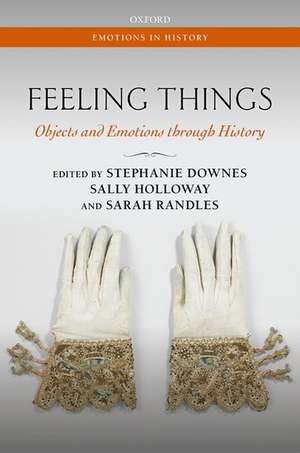
Feeling Things: Objects and Emotions through History: Emotions in History
Editat de Stephanie Downes, Sally Holloway, Sarah Randlesen Limba Engleză Hardback – 18 ian 2018
Din seria Emotions in History
- 26%
 Preț: 856.94 lei
 - 16%
 Preț: 285.71 lei
 - 19%
 Preț: 681.87 lei
 - 18%
 Preț: 240.08 lei
 - 23%
 Preț: 605.13 lei
 - 20%
 Preț: 207.63 lei
 - 15%
 Preț: 237.21 lei
 - 30%
 Preț: 717.63 lei
 - 17%
 Preț: 277.23 lei
 - 31%
 Preț: 712.53 lei
 - 21%
 Preț: 620.98 lei
 - 29%
 Preț: 596.78 lei
 - 29%
 Preț: 621.60 lei
 - 31%
 Preț: 722.91 lei
 - 30%
 Preț: 641.31 lei
 - 31%
 Preț: 635.02 lei
Preț: 727.52 lei
Preț vechi: 1049.15 lei
-31%
Puncte Express: 1091
Carte tipărită la comandă
Livrare economică 04-15 decembrie
Livrare prin curier în România Termenul estimat este afișat lângă disponibilitate.
Transport gratuit pentru acest produs Plată online sau ramburs, în funcție de opțiunile comenzii.
Retur gratuit în 14 zile Comandă securizată și suport în română.
Specificații
ISBN-13: 9780198802648
ISBN-10: 0198802641
Pagini: 270
Ilustrații: 31 black and white illustrations
Dimensiuni: 165 x 236 x 22 mm
Greutate: 0.58 kg
Editura: OUP OXFORD
Colecția OUP Oxford
Seria Emotions in History
Locul publicării:Oxford, United Kingdom
ISBN-10: 0198802641
Pagini: 270
Ilustrații: 31 black and white illustrations
Dimensiuni: 165 x 236 x 22 mm
Greutate: 0.58 kg
Editura: OUP OXFORD
Colecția OUP Oxford
Seria Emotions in History
Locul publicării:Oxford, United Kingdom
Recenzii
...constantly challenges the reader to consider yet another perspective on what thinking with materiality might do for the emotions scholar. It is interesting as a whole, but it is also a collection that has produced some essays of remarkable quality, a pleasure to read.
The historians in this volume represent an exemplary range of skills and array of methodological tools for the analysis of historical stuff. Dynamics of power, presences of historical bodies, traces of historical selves, all emerge from material evidence and the ways in which it has been marked, used or applied. As an advertisement for the importance of material history, this book could not have done a finer job. The editors' introduction alone is an essential primer on work in this field, and recommended as a good place to begin for anyone seeking exposure to the variety of methods historians use to handle the physical stuff of history.
This excellent volume is a must-read for all emotions students and scholars. In the hands of three insightful editors, the book makes an important methodological statement about the field of emotions history, and maps future research trajectories by successfully intertwining the field with theories and methods from material culture studies.
Feeling Things is a welcome and timely addition to scholarship in the fields of both material culture studies and the history of emotions.
The chapters in this collection are engaging and fascinating. Although all the objects examined are from the medieval or early modern period, the arguments the authors make regarding the way objects can affect our lives, and the way our lives affect objects, resonate with other time periods and disciplines.
The historians in this volume represent an exemplary range of skills and array of methodological tools for the analysis of historical stuff. Dynamics of power, presences of historical bodies, traces of historical selves, all emerge from material evidence and the ways in which it has been marked, used or applied. As an advertisement for the importance of material history, this book could not have done a finer job. The editors' introduction alone is an essential primer on work in this field, and recommended as a good place to begin for anyone seeking exposure to the variety of methods historians use to handle the physical stuff of history.
This excellent volume is a must-read for all emotions students and scholars. In the hands of three insightful editors, the book makes an important methodological statement about the field of emotions history, and maps future research trajectories by successfully intertwining the field with theories and methods from material culture studies.
Feeling Things is a welcome and timely addition to scholarship in the fields of both material culture studies and the history of emotions.
The chapters in this collection are engaging and fascinating. Although all the objects examined are from the medieval or early modern period, the arguments the authors make regarding the way objects can affect our lives, and the way our lives affect objects, resonate with other time periods and disciplines.
Notă biografică
Stephanie Downes is a research fellow at the University of Melbourne. Her current research on the representation of human facial expression in late medieval textual culture is funded by the Australian Research Council's Centre of Excellence for the History of Emotions, 1100-1800. With Andrew Lynch and Katrina O'Loughlin, she has edited Emotions and War: Medieval to Romantic Literature (2016), and with Stephanie Trigg, a special issue of the journal postmedieval, 'Facing Up to the History of Emotions' (April 2017). Her monograph, Reading Christine de Pizan in England, 1399-1929, is forthcoming.Sally Holloway is Vice-Chancellor's Research Fellow in History at Oxford Brookes University. She completed her PhD at Royal Holloway, University of London in 2013, funded by the Arts and Humanities Research Council, and is currently converting the thesis into a book on romantic love in Georgian England. Recent articles include '"You know I am all on fire": Writing the Adulterous Affair in England, c. 1740-1830', Historical Research 89 (2016), pp. 317-39, and with Alice Dolan, a special issue of the journal Textile on 'Emotional Textiles'. Sally is an Affiliated Research Scholar at the Centre for the History of the Emotions, Queen Mary, University of London. In 2016 she was an Early Career International Visiting Research Fellow at the Australian Research Council Centre of Excellence for the History of Emotions.Sarah Randles is an Honorary Research Fellow in the School of Historical and Philosophical Studies at the University of Melbourne and an Adjunct Researcher in the School of Humanities at the University of Tasmania. She was formerly a Postdoctoral Fellow in the Australian Research Council Centre of Excellence for the History of Emotions. Her current research project explores the relationship between materiality and the emotions of pilgrimage and sacred place, focusing on the relics and other aspects of material culture in Chartres Cathedral. She has also published on medieval and later textiles, supernatural beliefs and their attendant practices, and on medievalism in Australia.
Cuprins
- Introduction
- 1: Stephanie Downes, Sally Holloway and Sarah Randles: A Feeling for Things: Past and Present
- 2: Elina Gertsman: Matter Matters
- 3: Sarah Randles: Signs of Emotion: Pilgrimage Tokens from the Cathedral of Notre Dame of Chartres
- 4: Helen M. Hickey: Capturing Christ's Tears: La Sainte Larme in Medieval and Early Modern France
- 5: Hilary Davidson: Holding the Sole: Shoes, Emotions, and the Supernatural
- 6: Lara Farina: Get a Grip? The Tactile Object of Handlyng Synne
- 7: Diana G. Barnes: Emotional Debris in Early Modern Letters
- 8: John Gagne: Emotional Attachments: Iron Hands, their Makers, and their Wearers, 1450-1600
- 9: Sally Holloway: Materialising Maternal Emotions: Birth, Celebration and Renunciation in England c. 1688-1830
- 10: Susan Broomhall: Dirk Hartog's Sea Chest: An Affective Archaeology of VOC Objects in Australia
- 11: Alicia Marchant: Romancing the Stone: (E)motion and the Affective History of the Stone of Scone
- 12: Carolyn Steedman: Lord Mansfield's Voices. In The Archive, Hearing Things
- 13: Joanne Begiato: Afterword: Moving Objects: Emotional Transformation, Tangibility, and Time-Travel
- Bibliography