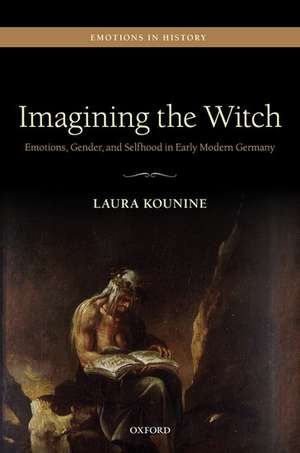
Imagining the Witch: Emotions, Gender, and Selfhood in Early Modern Germany: Emotions in History
Autor Laura Kounineen Limba Engleză Hardback – 13 noi 2018
Din seria Emotions in History
- 26%
 Preț: 856.94 lei
 - 18%
 Preț: 275.01 lei
 - 19%
 Preț: 681.87 lei
 - 18%
 Preț: 240.08 lei
 - 23%
 Preț: 605.13 lei
 - 21%
 Preț: 202.76 lei
 - 16%
 Preț: 229.19 lei
 - 31%
 Preț: 694.23 lei
 - 17%
 Preț: 277.23 lei
 - 31%
 Preț: 710.59 lei
 - 21%
 Preț: 620.98 lei
 - 29%
 Preț: 596.78 lei
 - 29%
 Preț: 621.60 lei
 - 31%
 Preț: 709.89 lei
 - 31%
 Preț: 620.39 lei
 - 31%
 Preț: 619.89 lei
Preț: 680.36 lei
Preț vechi: 839.96 lei
-19%
Puncte Express: 1021
Carte disponibilă
Livrare economică 26 octombrie-09 noiembrie
Livrare prin curier în România Termenul estimat este afișat lângă disponibilitate.
Transport gratuit pentru acest produs Plată online sau ramburs, în funcție de opțiunile comenzii.
Retur gratuit în 14 zile Comandă securizată și suport în română.
Specificații
ISBN-13: 9780198799085
ISBN-10: 019879908X
Pagini: 292
Ilustrații: 15 black and white figures/illustrations
Dimensiuni: 164 x 237 x 24 mm
Greutate: 0.61 kg
Editura: OUP OXFORD
Colecția OUP Oxford
Seria Emotions in History
Locul publicării:Oxford, United Kingdom
ISBN-10: 019879908X
Pagini: 292
Ilustrații: 15 black and white figures/illustrations
Dimensiuni: 164 x 237 x 24 mm
Greutate: 0.61 kg
Editura: OUP OXFORD
Colecția OUP Oxford
Seria Emotions in History
Locul publicării:Oxford, United Kingdom
V-ar putea interesa
-
 -5%Preț: 793.31 lei838.13 lei
 -
 -16%Preț: 173.78 lei206.77 lei
 -
 The Dream that Failed: Reflections on the Soviet UnionWalter Laqueur-16%Preț: 171.88 lei205.72 lei
 -
 -31%Preț: 860.95 lei1244.31 lei
 -
 A History of Europe in the Twentieth CenturyEric Dorn Brose-27%Preț: 725.21 lei993.44 lei
 -
 A History of RussiaNicholas V. RiasanovskyPreț: 430.06 lei
 -
 The Grand Strategy of the Russian Empire, 1650-1831John P. LeDonne-31%Preț: 773.12 lei1123.14 lei
 -
 Cold Peace: Stalin and the Soviet Ruling Circle, 1945-1953Yoram Gorlizki-13%Preț: 302.35 lei346.75 lei
 -
 The Athenian EmpireRussell Meiggs-32%Preț: 716.05 lei1057.39 lei
 -
 -33%Preț: 1404.02 lei2095.06 lei
 -
 -18%Preț: 379.11 lei463.40 lei
 -
 The History of Emotions: An IntroductionJan Plamper-17%Preț: 277.23 lei334.51 lei
 -
 -24%Preț: 789.12 lei1031.82 lei
 -
 Roman Patrons of Greek CitiesClaude Eilers-33%Preț: 1484.09 lei2214.18 lei
 -
 Germany: The Long Road West: Volume 2: 1933-1990Heinrich August Winkler-20%Preț: 505.63 lei633.88 lei
 -
 Melusine; or, The Noble History of LusignanJean D'ArrasPreț: 239.07 lei
 -
 The Yellow CrossRene WeisPreț: 113.41 lei
 -
 Love Thy NeighborPeter MaassPreț: 107.33 lei
 -
 A Companion to SpinozaYitzhak Y. MelamedPreț: 353.89 lei
 -
 Emotions in the History of WitchcraftLaura Kounine-18%Preț: 864.96 lei1054.82 lei
 -
 A History of Fascism in France: From the First World War to the National FrontDr Chris Millington-20%Preț: 179.72 lei223.69 lei
 -
 Cultures of Conflict Resolution in Early Modern EuropeStephen Cummins-18%Preț: 1258.47 lei1534.73 lei
Recenzii
Kounine has produced a series of excellent case histories that reveal how difficult it was to detect or prove the guilt of someone whose crime, if any, was internal.
...her book deserves attention for her insightful and intriguing views. Kounine combines innovative approaches to key issues in the witch hunt literature with a careful reading of archival sources. This work also does a remarkable job of leading readers through the main theories on witchcraft such as those of Midelfort, Clark and Roper (many others are mentioned).
In these connections lie the book's main significance, not just as a piece of exemplary scholarship in its own right, but as a contribution to several overlapping fields simultaneously: predominantly, and most obviously, the history of witchcraft and history of emotions, but at least three other areas are also illuminated: first, enquiries into selfhood, subjectivity, and phenomenology; secondly, the history of gender and the body; and thirdly, literary and cultural historical investigation of criminal legal records... Laura amplifies the voices of her subjects, and adapts them for our ears, but she doesn't ventriloquize them to suit her purposes. At the same time, she never hesitates or equivocates, and so inspires absolute confidence as a writer. This is intrepid stuff. It's the sort of book that makes the reader wonder whether anyone else could have written such a book in the same nuanced, sophisticated way.
...her book deserves attention for her insightful and intriguing views. Kounine combines innovative approaches to key issues in the witch hunt literature with a careful reading of archival sources. This work also does a remarkable job of leading readers through the main theories on witchcraft such as those of Midelfort, Clark and Roper (many others are mentioned).
In these connections lie the book's main significance, not just as a piece of exemplary scholarship in its own right, but as a contribution to several overlapping fields simultaneously: predominantly, and most obviously, the history of witchcraft and history of emotions, but at least three other areas are also illuminated: first, enquiries into selfhood, subjectivity, and phenomenology; secondly, the history of gender and the body; and thirdly, literary and cultural historical investigation of criminal legal records... Laura amplifies the voices of her subjects, and adapts them for our ears, but she doesn't ventriloquize them to suit her purposes. At the same time, she never hesitates or equivocates, and so inspires absolute confidence as a writer. This is intrepid stuff. It's the sort of book that makes the reader wonder whether anyone else could have written such a book in the same nuanced, sophisticated way.
Notă biografică
Laura Kounine is Lecturer in Early Modern History at the University of Sussex, and was previously a research fellow at the Centre for the History of Emotions, Max Planck Institute for Human Development, Berlin. She is the co-editor of Cultures of Conflict Resolution in Early Modern Europe (2015), and Emotions in the History of Witchcraft (2016).
Cuprins
- Introduction
- 1: Being on Trial: Interrogating Mind and Body
- 2: Languages of Defence
- 3: Confession, Conscience, and Selfhood on Trial
- 4: Gender and Emotions in the Visual and Intellectual Imagination
- Conclusion
- Appendix