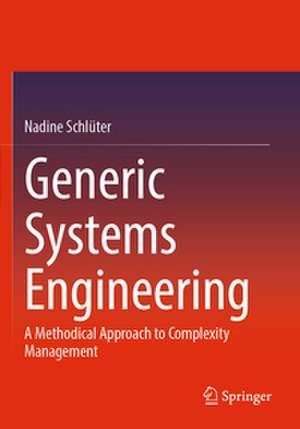
Generic Systems Engineering
Autor Nadine Schlüteren Limba Engleză Paperback – 4 ian 2025
| Toate formatele și edițiile | Preț | Express |
|---|---|---|
| Paperback (1) | 616.64 lei 39-44 zile | |
| Springer – 4 ian 2025 | 616.64 lei 39-44 zile | |
| Hardback (1) | 884.34 lei 3-5 săpt. | |
| Springer Berlin, Heidelberg – 3 ian 2024 | 884.34 lei 3-5 săpt. |
Preț: 616.64 lei
Preț vechi: 761.28 lei
-19%
Puncte Express: 925
Preț estimativ în valută:
108.95€ • 124.94$ • 94.56£
108.95€ • 124.94$ • 94.56£
Carte tipărită la comandă
Livrare economică 11-16 mai
Specificații
ISBN-13: 9783662679968
ISBN-10: 3662679965
Pagini: 408
Dimensiuni: 168 x 240 x 23 mm
Greutate: 0.68 kg
Editura: Springer
ISBN-10: 3662679965
Pagini: 408
Dimensiuni: 168 x 240 x 23 mm
Greutate: 0.68 kg
Editura: Springer
V-ar putea interesa
-
 -24%Preț: 373.19 lei494.03 lei
 -
 Modern Software EngineeringDavid Farley-20%Preț: 207.60 lei259.51 lei
 -
 Systems EngineeringDerek K Hitchins-23%Preț: 741.50 lei962.99 lei
 -
 System of Systems Modeling and AnalysisDaniel A. DeLaurentis-20%Preț: 883.80 lei1104.76 lei
 -
 Systems Engineering Principles and PracticeAlexander Kossiakoff-23%Preț: 817.55 lei1061.75 lei
 -
 -19%Preț: 479.00 lei591.35 lei
 -
 -20%Preț: 607.51 lei759.40 lei
 -
 Critical Systems ThinkingMichael C JacksonPreț: 305.32 lei
 -
 Project ManagementHarold R. Kerzner-23%Preț: 661.44 lei859.01 lei
 -
 Advances in Systems Engineering ResearchElena Fermi-30%Preț: 817.18 lei1170.23 lei
 -
 Practical Model-Based Systems EngineeringCarl Hernandez-18%Preț: 641.62 lei782.47 lei
 -
 A Systems Engineering Approach to Better, Less Expensive Health CareAdeline Peaterson-30%Preț: 489.42 lei701.53 lei
 -
 -23%Preț: 583.57 lei757.89 lei
 -
 Preț: 89.19 lei
 -
 -20%Preț: 361.02 lei451.27 lei
 -
 Handbook of Engineering Systems DesignAnja Maier-18%Preț: 4254.37 lei5188.26 lei
 -
 -24%Preț: 1600.96 lei2106.54 lei
 -
 Components Operationally: Reversibility and System EngineeringClaudio Antares Mezzina-20%Preț: 374.36 lei467.95 lei
 -
 -24%Preț: 1242.47 lei1634.83 lei
 -
 Strategic Software EngineeringFilipe Ximenes-20%Preț: 204.78 lei255.98 lei
Cuprins
Introduction.- Systems Engineering (SE) - old thinking in a new guise.- Generic Systems Engineering - An approach to mastering complexity in a new dimension.- Systems modeling in the GSE approach.- The building blocks of the GSE approach - mastering complexity using simple rules.- Case studies - mastering new dimensions of complexity with GSE.- The new guise of SE - GSE as a solution variant.
Notă biografică
Dr.-Ing. Nadine Schlüter has been working at the Faculty of Mechanical Engineering and Safety Engineering at the University of Wuppertal in the field of product safety and quality since 2009. Here she habilitated in 2017 in the subject "Generic Systems Engineering". After numerous successful national and international research projects, she is currently leading basic research projects of the German Research Foundation (DFG) in the field of Systems Engineering. She has over 100 scientific publications and won the Walter Masing Award for outstanding research activities in the field of quality science in 2014. She is a member of INCOSE and the Society for Systems Engineering (GfSE), among others.
Textul de pe ultima copertă
The work gives a historical outline of the development trends in systems engineering (SE) up to the present. This includes a systematic examination of the various models and process concepts of SE. Based on this, the Generic Systems Engineering (GSE) is developed, consisting of a new meta-model, which can be combined with a project management-integrated process concept in a problem-solving-oriented manner and can be permanently updated or supplemented. Eight test examples show possible fields of application of the GSE, which range from virtual product development to field data feedback into it. Furthermore, examples for the transfer of GSE to socio-technical systems, i.e. enterprises and enterprise networks, are presented.
The 3rd edition is dedicated to the increased requirements for sustainability and addresses the higher dynamics as a result of the agile system development that is widespread today. The application of the methods to technical systems is also extended to include socio-technical systems.
The target groups
Dr.-Ing. Nadine Schlüter has been working at the Faculty of Mechanical and Safety Engineering at the University of Wuppertal since 2009 in the field of product safety and quality. Here she habilitated in 2017 in the subject "Generic Systems Engineering". After successfully conducting numerous national and international research projects, she is currently leading basic research projects of the German Research Foundation (DFG) in the field of Systems Engineering. She has over 100 scientific publications and won the Walter Masing Award for outstanding research activities in the field of quality science in 2014. She is a member of INCOSE and the Society for Systems Engineering (GfSE), among others.
The translation was done with the help of artificial intelligence. A subsequent human revision was done primarily in terms of content.
The 3rd edition is dedicated to the increased requirements for sustainability and addresses the higher dynamics as a result of the agile system development that is widespread today. The application of the methods to technical systems is also extended to include socio-technical systems.
The target groups
- University teachers, scientists and students of engineering
- Product and system developers, designers
- Product and variant managers
- Quality managers
Dr.-Ing. Nadine Schlüter has been working at the Faculty of Mechanical and Safety Engineering at the University of Wuppertal since 2009 in the field of product safety and quality. Here she habilitated in 2017 in the subject "Generic Systems Engineering". After successfully conducting numerous national and international research projects, she is currently leading basic research projects of the German Research Foundation (DFG) in the field of Systems Engineering. She has over 100 scientific publications and won the Walter Masing Award for outstanding research activities in the field of quality science in 2014. She is a member of INCOSE and the Society for Systems Engineering (GfSE), among others.
The translation was done with the help of artificial intelligence. A subsequent human revision was done primarily in terms of content.
Caracteristici
Methods for complexity control in technical system development are presented Theoretical approaches are underpinned with practical examples For the first time, sustainability, agile system design and socio-technical systems are taken into account