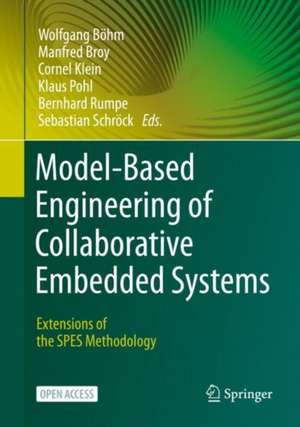
Model-Based Engineering of Collaborative Embedded Systems: Extensions of the SPES Methodology
Editat de Wolfgang Böhm, Manfred Broy, Cornel Klein, Klaus Pohl, Bernhard Rumpe, Sebastian Schröcken Limba Engleză Hardback – 15 dec 2020
Adresată arhitecților de sisteme, inginerilor software avansați și cercetătorilor din domeniul sistemelor cyber-physicale, această lucrare prezintă rezultatele proiectului de cercetare CrESt (Collaborative Embedded Systems). Subliniem faptul că volumul nu se rezumă la teorie, ci extinde metodologia consacrată SPES pentru a răspunde provocărilor impuse de structurile dinamice care se formează la runtime. Găsim în această carte soluții metodologice pentru gestionarea complexității în contexte incerte, cu un accent deosebit pe variabilitatea și fiabilitatea sistemelor individuale care interacționează în rețele complexe.
Structura progresivă a celor 17 capitole ghidează cititorul de la definirea cazurilor de utilizare în industrii precum cea auto sau robotică, până la aspecte tehnice de finețe, cum ar fi arhitecturile pentru sisteme cuplate dinamic și ingineria limbajelor pentru sisteme eterogene. Suntem de părere că includerea capitolelor dedicate Twins-urilor Digitale (Digital Twins) și învățării adaptative bazate pe experimente online oferă o perspectivă tehnică actuală asupra inițiativei Industry 4.0. Abordarea diferă de Advanced Model-Based Engineering of Embedded Systems de Klaus Pohl prin focusul specific pe colaborarea dinamică și incertitudinea mediului de execuție, trecând dincolo de cadrul SPES XT tradițional către o metodologie adaptată sistemelor care evoluează după instalare.
În contextul operei editorilor, acest volum completează lucrările fundamentale precum Model-Based Systems Engineering with the SPES Modeling Language coordonat de Wolfgang Böhm, oferind puntea necesară între modelarea statică SysML și nevoile de adaptabilitate ale sistemelor moderne. Cartea detaliază instrumentele de suport pentru co-simulare și verificare compozițională, fiind un manual tehnic esențial pentru implementarea strategiei high-tech a digitalizării industriale.
Preț: 361.02 lei
Preț vechi: 451.27 lei
-20%
Carte disponibilă
Livrare economică 19 octombrie-02 noiembrie
Specificații
ISBN-10: 3030621359
Pagini: 404
Ilustrații: XIII, 404 p. 148 illus., 83 illus. in color.
Dimensiuni: 168 x 240 mm
Greutate: 0.82 kg
Ediția:1st ed. 2021
Editura: Springer International Publishing
Colecția Springer
Locul publicării:Cham, Switzerland
V-ar putea interesa
-
 Formal Methods for Multi-Agent Feedback Control SystemsDimos V. Dimarogonas-20%Preț: 600.65 lei750.82 lei
 -
 Verschure, P: Nature and Dynamics of CollaborationPaul Verschure, F.M.J.-14%Preț: 469.65 lei546.11 lei
 -
 Embedded System Design: Methodologies and IssuesLawrence J. Henschen-41%Preț: 420.85 lei709.65 lei
 -
 -19%Preț: 451.56 lei557.48 lei
 -
 -19%Preț: 515.20 lei636.04 lei
 -
 Project Management Next GenerationHarold R. Kerzner-19%Preț: 494.45 lei610.43 lei
 -
 -20%Preț: 627.14 lei783.93 lei
 -
 Model-Based Product Line Engineering (Mbple)Marco Forlingieri-20%Preț: 788.17 lei985.20 lei
 -
 Project ManagementHarold R. Kerzner-23%Preț: 684.74 lei889.27 lei
 -
 Modern C, Third EditionJens Gustedt-20%Preț: 343.37 lei429.21 lei
 -
 Shaping Collaborative Ecosystems for TomorrowAlfonso Reyes-23%Preț: 602.21 lei782.08 lei
 -
 -24%Preț: 1651.31 lei2172.78 lei
 -
 Components Operationally: Reversibility and System EngineeringClaudio Antares Mezzina-20%Preț: 389.32 lei486.66 lei
 -
 -20%Preț: 391.26 lei489.08 lei
 -
 -20%Preț: 531.38 lei664.22 lei
 -
 -20%Preț: 330.54 lei413.16 lei
 -
 -20%Preț: 340.17 lei425.21 lei
 -
 -20%Preț: 330.98 lei413.73 lei
 -
 Digital TransformationBirgit Vogel-Heuser-20%Preț: 419.84 lei524.80 lei
 -
 -24%Preț: 1338.39 lei1761.05 lei
De ce să citești această carte
Recomandăm această carte profesioniștilor care proiectează sisteme embedded complexe și au nevoie de o metodologie riguroasă pentru a gestiona interacțiunile dinamice. Cititorul câștigă acces la metode verificate de inginerie bazată pe modele, aplicabile direct în Industry 4.0. Este un ghid esențial pentru înțelegerea modului în care sistemele colaborative pot fi certificate din punct de vedere al siguranței chiar și atunci când configurația lor se schimbă la runtime.
Despre autor
Editorii volumului sunt figuri proeminente în ingineria software germană, cu o vastă experiență în metodologii de modelare. Wolfgang Böhm și Manfred Broy au contribuit fundamental la dezvoltarea cadrului SPES, o referință în proiectarea sistemelor embedded. Deși unii contributori au publicat lucrări în domenii diverse — de la matematică numerică la istoria agronomiei — expertiza lor colectivă în acest volum este concentrată strict pe arhitecturi software și sisteme cyber-physicale. Munca lor comună în cadrul proiectelor finanțate de BMBF a pus bazele standardelor actuale de digitalizare industrială în Germania, influențând direct modul în care companiile din automotive și robotică abordează complexitatea software.
Descriere scurtă
In order to manage the high complexity of the individual systems and the dynamically formed interaction structures at runtime, advanced and powerful development methods are required that extend the current state of the art in the development of embedded systems and cyber-physical systems. The methodological contributions of the project support the effective and efficient development of CESs in dynamic and uncertain contexts, with special emphasis on the reliability and variability of individual systems and the creation of networks of such systems at runtime.
The project was funded by the German Federal Ministry of Education and Research (BMBF), and the case studies are therefore selected from areas that are highly relevant for Germany’s economy (automotive, industrial production, power generation, and robotics). It also supports the digitalization of complex and transformable industrial plants in the context of the German government's "Industry 4.0" initiative, and the project results provide a solid foundation for implementing the German government's high-tech strategy "Innovations for Germany" in the coming years.
Cuprins
Notă biografică
Manfred Broy is full professor for Computer Science at the Institute for Computer Science of the Technical University of Munich. The core topic of his research is the development of complex software systems based on a solid scientific foundation, by means of well-elaborated processes, durable and flexible software architectures, and modern tools on the basis of mathematical and logical methods. He was awarded the Leibniz Preis in 1994 and bestowed the Order of Merit (Bundesverdienstkreuz) in 1996, and received the Konrad-Zuse-Medal for extraordinary services in Computer Sciencein 2007. Manfred Broy is a Max-Planck-Fellow, member of the German Academy of Science and Engineering and the German National Academy of the Sciences “Leopoldina”.
Cornel Klein is Research Program Manager within the Technology Field “Software and Systems Innovation” of Siemens Corporate Technology in Munich. He is currently leading a corporate research program on validation and engineering of intelligent and autonomous systems. Starting his career 1998 at Siemens Public Networks, he held several management and expert positions within the company and also represented Siemens in external partnerships like ITEA, ARTEMIS/ECSEL and SPES. He has gained an extensive knowledge in communications, cyber-physical and embedded systems, software- and systems engineering as well as in application domains like automotive, mobility and smart cities/smart buildings.
Klaus Pohl is full professor for Software Systems Engineering at the University of Duisburg-Essen in Germany, aswell as professor at the University of Limerick, Ireland. He is founding director of the Irish Software Engineering Research Centre Lero. His main research interests comprise Requirements Engineering, Service-Based Systems Engineering, Software Quality Assurance as well as Software Product Line Engineering. He is coordinator of the FP7 Network of Excellence S-Cube and member of a number of steering committees and boards of directors.
Bernhard Rumpe is full professor for Software Engineering at the RWTH Aachen University, Germany. Earlier he held positions at INRIA/IRISA, Rennes, Colorado State University, TU Braunschweig, Vanderbilt University, Nashville, and TU Munich. His main interests are rigorous and practical software and system development methods based on adequate modeling techniques, including their applications in areas like e.g. autonomous cars, human brain simulation, energy management, juristic contract digitalization, production automation, and cloud infrastructures. He is co-founder of SoSyM the Models conference series, the Aachen Center for Systems Engineering and several Start-Ups.
Sebastian Schröck is working as senior expert and project manager at Corporate Sector Research and Advance Engineering of the Bosch Group. After studying Mechanical Engineering in Germany and Finland, he received a doctorate in engineering from the Helmut-Schmidt-University in Hamburg. His current fields of work are versatile production systems as well as national and international publicly funded projects. Furthermore, he is working as an independent expert for the European Commission.