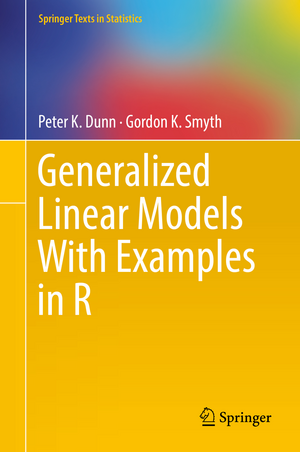
Generalized Linear Models With Examples in R: Springer Texts in Statistics
Autor Peter K. Dunn, Gordon K. Smythen Limba Engleză Hardback – 11 noi 2018
Descoperim în Generalized Linear Models With Examples in R o resursă pedagogică riguroasă, publicată în seria Springer Texts in Statistics, care reușește să echilibreze teoria matematică cu practica computațională. Această primă ediție din 2018 se distinge prin utilizarea nativă a limbajului R, oferind cititorului acces la pachetul GLMsData, ce include aproape 100 de seturi de date pentru exerciții aplicate. Suntem de părere că volumul este esențial pentru tranziția de la modelele liniare clasice la cele generalizate, acoperind variabile de răspuns care nu urmează o distribuție normală, precum numărătorile sau proporțiile. Structura cărții este progresivă: începe cu fundamentele regresiei liniare și diagnosticul acestora, avansând rapid către metoda verosimilității maxime și structura specifică a modelelor GLM. Subliniem includerea unor teme avansate, rareori tratate în manualele introductive, cum ar fi funcțiile de varianță putere, testele scorului de verosimilitate și asimptotica de dispersie mică. Această profunzime teoretică completează perspectiva oferită de Beyond Multiple Linear Regression, adăugând un fundament matematic mai dens și tehnici de diagnosticare mai sofisticate pentru modelele Poisson și binomiale. În contextul operei autorului Peter K. Dunn, lucrarea de față rafinează conceptele metodologice prezentate în Scientific Research and Methodology, mutând accentul de la designul general de cercetare către execuția statistică propriu-zisă. Dacă în lucrările anterioare accentul cădea pe procesul de colectare și sumarizare a datelor, aici Peter K. Dunn și Gordon K. Smyth oferă un instrumentar complet pentru analiză, transformând teoria în competențe practice prin exemple cross-referențiate și scripturi R gata de utilizat.
Din seria Springer Texts in Statistics
- 15%
 Preț: 641.17 lei
 - 17%
 Preț: 566.02 lei
 - 20%
 Preț: 805.16 lei
 - 15%
 Preț: 700.93 lei
 - 15%
 Preț: 581.87 lei
 - 15%
 Preț: 653.70 lei
 - 23%
 Preț: 832.83 lei
 - 18%
 Preț: 829.38 lei
 - 15%
 Preț: 606.85 lei
 -
 Preț: 443.52 lei
 -
 Preț: 415.60 lei
 - 18%
 Preț: 1039.77 lei
 - 15%
 Preț: 630.32 lei
 - 19%
 Preț: 608.59 lei
 - 18%
 Preț: 996.42 lei
 - 18%
 Preț: 785.06 lei
 - 18%
 Preț: 844.02 lei
 - 15%
 Preț: 667.29 lei
 - 15%
 Preț: 686.20 lei
 - 18%
 Preț: 1271.64 lei
 - 18%
 Preț: 853.52 lei
 - 18%
 Preț: 1159.52 lei
 -
 Preț: 429.69 lei
 - 18%
 Preț: 813.62 lei
 - 18%
 Preț: 770.24 lei
 - 18%
 Preț: 1606.27 lei
 -
 Preț: 405.09 lei
 - 15%
 Preț: 619.96 lei
 - 15%
 Preț: 725.31 lei
 -
 Preț: 418.73 lei
 - 18%
 Preț: 930.24 lei
 - 15%
 Preț: 572.89 lei
 - 18%
 Preț: 922.51 lei
 -
 Preț: 423.48 lei
 - 15%
 Preț: 534.69 lei
 -
 Preț: 421.87 lei
 - 5%
 Preț: 665.32 lei
 -
 Preț: 399.96 lei
 -
 Preț: 412.75 lei
 - 18%
 Preț: 984.21 lei
 - 23%
 Preț: 786.24 lei
 - 19%
 Preț: 677.94 lei
Preț: 788.33 lei
Preț vechi: 961.38 lei
-18%
Carte disponibilă
Livrare economică 09-23 noiembrie
Livrare express 24-30 octombrie pentru 54.76 lei
Specificații
ISBN-10: 1441901175
Pagini: 584
Ilustrații: XX, 562 p. 115 illus.
Dimensiuni: 160 x 241 x 37 mm
Greutate: 0.98 kg
Ediția:1st ed. 2018
Editura: Springer
Colecția Springer Texts in Statistics
Seria Springer Texts in Statistics
Locul publicării:New York, NY, United States
V-ar putea interesa
-
 -15%Preț: 530.47 lei624.09 lei
 -
 Methodology in Robust and Nonparametric StatisticsJana Jurečková-15%Preț: 545.18 lei641.38 lei
 -
 Statistical Learning and Data ScienceMireille Gettler Summa-15%Preț: 531.31 lei625.07 lei
 -
 Optimal Experimental Design with RDieter Rasch-15%Preț: 530.47 lei624.09 lei
 -
 -15%Preț: 530.47 lei624.09 lei
 -
 Operations Research MethodologiesA. Ravi Ravindran-15%Preț: 558.77 lei657.38 lei
 -
 -15%Preț: 594.31 lei699.18 lei
 -
 Introductory Statistical InferenceNitis Mukhopadhyay-15%Preț: 530.47 lei624.09 lei
 -
 -15%Preț: 530.47 lei624.09 lei
 -
 Advances on Models, Characterizations and ApplicationsN. Balakrishnan-15%Preț: 526.54 lei619.46 lei
 -
 -15%Preț: 533.27 lei627.37 lei
 -
 Design of Experiments: A No-Name ApproachThomas Lorenzen-15%Preț: 530.47 lei624.09 lei
 -
 Transformation and Weighting in RegressionRaymond J. Carroll-15%Preț: 548.53 lei645.33 lei
 -
 Applied Regression Analysis and Experimental DesignRichard J. Brook-15%Preț: 530.47 lei624.09 lei
 -
 Statistical Research MethodsRoy Sabo-5%Preț: 352.01 lei370.54 lei
 -
 -18%Preț: 952.24 lei1161.26 lei
 -
 -15%Preț: 637.53 lei750.04 lei
 -
 Fun with Roman Numerals Math WorkbookChris McmullenPreț: 86.10 lei
 -
 -18%Preț: 944.04 lei1151.27 lei
 -
 Stochastic Processes - Inference TheoryMalempati M. Rao-20%Preț: 641.78 lei802.22 lei
 -
 Stochastic Processes and Long Range DependenceGennady Samorodnitsky-24%Preț: 742.19 lei976.57 lei
 -
 Developments in Statistical Evaluation of Clinical TrialsKees van Montfort-20%Preț: 638.76 lei798.46 lei
 -
 Preț: 271.48 lei
 -
 Wahrscheinlichkeitsrechnung und MaßtheorieRainer OloffPreț: 222.09 lei
 -
 PROBAB MOD & APPL (REV 2ND ED)Olkin Ingram-15%Preț: 511.92 lei602.26 lei
 -
 STOCHASTIC MODELS IN LIFE SCIENCES & THEIR METHODS OF ANALSIWan Frederic Y M-15%Preț: 732.87 lei862.19 lei
De ce să citești această carte
Această carte se adresează studenților și cercetătorilor care doresc să stăpânească modelele liniare generalizate folosind R. Cititorul câștigă nu doar o înțelegere teoretică a distribuțiilor non-normale, ci și abilitatea practică de a modela date complexe prin exemple reale. Este o recomandare certă pentru cei care au depășit nivelul regresiei simple și au nevoie de un toolkit statistic robust pentru date de tip numărătoare, proporții sau cantități pozitive.
Despre autor
Peter K. Dunn este un academician recunoscut pentru contribuțiile sale în educația statistică și metodologia cercetării, fiind implicat în dezvoltarea de resurse care fac statistica accesibilă studenților din științe și sănătate. Gordon K. Smyth este un statistician de renume, membru al Walter and Eliza Hall Institute of Medical Research, cunoscut la nivel mondial pentru dezvoltarea unor metode statistice inovatoare aplicate în bioinformatică și genomică. Expertiza sa în dezvoltarea de software statistic și pachete R conferă acestei lucrări o autoritate tehnică deosebită, asigurând relevanța metodelor prezentate pentru analiza datelor moderne.
Descriere scurtă
The book is designed with the student in mind, making it suitable for self-study or a structured course. Beginning with an introduction to linear regression, the book also devotes time to advanced topics not typically included in introductory textbooks. It features chapter introductions and summaries, clear examples, and many practice problems, all carefully designed to balance theory and practice. The text also provides a working knowledge of applied statistical practice through the extensive use of R, which is integrated into the text.
Other features include:
• Advanced topics such as power variance functions, saddlepoint approximations, likelihood score tests, modified profile likelihood, small-dispersion asymptotics, and randomized quantile residuals
• Nearly 100 data sets in the companion R package GLMsData
• Examples that are cross-referenced to the companion data set, allowing readers to load the data and follow the analysis in their own R session