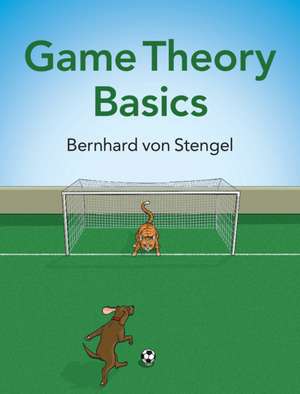
Game Theory Basics
Autor Bernhard von Stengelen Limba Engleză Paperback – 19 aug 2021
Nivel de studiu: licență. Game Theory Basics, publicat de Cambridge University Pr., reprezintă o introducere riguroasă, dar accesibilă, în matematica jocurilor non-cooperatice, fiind ideal pentru studenții de la facultățile de matematică, informatică sau economie. Ne-a atras atenția modul în care Bernhard von Stengel reușește să transforme concepte matematice complexe în explicații clare, menținând un nivel de rigoare care permite înțelegerea profundă a mecanismelor de interacțiune. Cartea este structurată progresiv în 12 capitole, începând cu analiza jocurilor combinatorii (precum Nim) și avansând spre teme fundamentale ca utilitatea așteptată, echilibrul mixt și arborii de joc cu informație imperfectă. Merită menționat că autorul include demonstrații elegante și de sine stătătoare pentru rezultate esențiale, precum teorema de punct fix a lui Brouwer și teorema minimax pentru jocurile de sumă nulă. Spre deosebire de alte manuale tehnice, volumul integrează elemente moderne de geometrie a echilibrelor și introduceri în teoria algoritmică a jocurilor. Ca alternativă la Introducing Game Theory and its Applications de Elliott Mendelson pentru cursurile de optimizări matematice, acest titlu aduce avantajul unei acoperiri mai vaste a jocurilor de congestie și a unei abordări vizuale pronunțate, susținută de numeroase diagrame și exerciții aplicate. Deși Game Theory de Michael Maschler rămâne un reper pentru amploarea sa, volumul lui von Stengel este preferabil pentru cei care caută un text mai concis, axat pe fundamentele matematice esențiale necesare unui prim curs de specialitate.
Preț: 340.81 lei
Carte disponibilă
Livrare economică 16-30 noiembrie
Livrare express 31 octombrie-06 noiembrie pentru 50.85 lei
Specificații
ISBN-10: 1108824234
Pagini: 374
Dimensiuni: 188 x 244 x 19 mm
Greutate: 0.81 kg
Ediția:Nouă
Editura: Cambridge University Press
Locul publicării:Cambridge, United Kingdom
V-ar putea interesa
-
 A Course in Game TheoryMartin J Osborne-18%Preț: 346.24 lei423.61 lei
 -
 The Puzzler's DilemmaDerrick NiedermanPreț: 134.53 lei
 -
 Game TheoryAviad Heifetz-19%Preț: 444.98 lei549.35 lei
 -
 Do You Get the Point?Dee GoldsteinPreț: 64.02 lei
 -
 Game TheoryK. H. EricksonPreț: 74.66 lei
 -
 Game Theory for BusinessK. H. EricksonPreț: 74.66 lei
 -
 Twice Magic Squares 5 by 5Kermit RosePreț: 40.13 lei
 -
 Alphametics as Expressed in Recreational Mathematics MagazineCharles AshbacherPreț: 51.06 lei
 -
 Game TheoryInformation Reso Management Association-18%Preț: 1885.45 lei2299.32 lei
 -
 Mathematical Go: Chilling Gets the Last PointElwyn Berlekamp-18%Preț: 1413.75 lei1724.09 lei
 -
 -18%Preț: 1433.19 lei1747.78 lei
 -
 -15%Preț: 429.50 lei505.29 lei
 -
 Why Do Buses Come in ThreesRobert EastawayPreț: 143.49 lei
 -
 Game Theory: Mathematical Models of ConflictA. J. Jones-24%Preț: 455.94 lei603.12 lei
 -
 New Mathematical PastimesPercy MacMahonPreț: 168.75 lei
 -
 Equals(me)Schablin, TimothyPreț: 45.20 lei
 -
 Equals(me) RadicalsSchablin, TimothyPreț: 45.20 lei
 -
 ICM Millennium Lectures on GamesLeon A. Petrosjan-15%Preț: 650.84 lei765.69 lei
 -
 Attractors, Bifurcations, & ChaosTönu Puu-18%Preț: 962.26 lei1173.48 lei
 -
 ORIGAMICSHaga KazuoPreț: 313.70 lei
 -
 Value Solutions in Cooperative GamesRoger A. McCain-15%Preț: 562.95 lei662.29 lei
De ce să citești această carte
Recomandăm această carte studenților care doresc o bază solidă în teoria jocurilor fără a fi copleșiți de un formalism excesiv. Cititorul câștigă o înțelegere clară a strategiilor de echilibru și a modelării interacțiunilor complexe. Este un instrument de studiu excelent datorită structurii sale didactice, derivate din ani de predare, oferind un echilibru perfect între demonstrații teoretice și exemple practice din informatică și economie.
Descriere scurtă
Cuprins
Recenzii
'This book is a delightful adventure into the mathematics of game theory. Without any heavy apparatus, it lets us into the secrets of a whole range of exciting results that are usually thought too advanced for the common herd. It is not only undergraduate students who will benefit from reading this book. Professional game theorists will find it very useful too.' Ken Binmore, University College London
'Bernhard von Stengel's book will enable students to become intimately familiar with game theoretic reasoning, which is mathematical by nature. The text comes at the right time: Game theory has become so popular in economics and political science that teachers could be tempted to put the cart before the horse. Here, the basic noncooperative game models are studied gradually and thoroughly, in a unified way, while providing the algorithms that can be used to solve interactive decision problems.' Françoise Forges, Université Paris-Dauphine
'This is a rather reader-friendly, engaging, and polished superior creation. It illustrates, explains, motivates every definition, theorem, proof. Interesting and unique choice of topics, such as a delightful introductory chapter on combinatorial games. Highly recommended.' Aviezri Fraenkel, Weizmann Institute of Science, Israel
'A masterful presentation of mathematical game theory in all its beauty and elegance, from basic notions to advanced techniques. It fills the gaps left by the many textbooks that cover concepts and applications, but devote only the bare minimum to the mathematical tools and insights, without which game theory would not have become the success it is today.' Sergiu Hart, The Hebrew University of Jerusalem
'Game Theory is the child of mathematicians, as this textbook demonstrates through self-contained, elegant proofs of all seminal Theorems. The lively and rigorous exposition of carefully selected models, such as bargaining, combinatorial and congestion games (the latter two rarely the stuff of textbooks) explains its success far beyond mathematics. To reach deep results on both sides of the theory, Bernhard von Stengel's marvellous learning tool uses uncompromising, yet accessible mathematics and chooses examples to maximal effect.' Hervé Moulin, University of Glasgow
'This will become a classic textbook on non-cooperative game theory. It is very useful for mathematicians, computer scientists, and economic theorists. Each chapter has a clear learning structure, with motivating examples and a central main theorem. The author's long teaching experience and expertise in game theory is apparent on every page.' Abraham Neyman, The Hebrew University of Jerusalem
'Attractively covers of a lot of important material, in particular for students of mathematics and computer science.' Eva Tardos, Cornell University
'This book is a gem. The presentation is clear and well structured, often with nice geometric illustrations. It moves step by step from basics to powerful concepts, methods and results. It is ideal for students of mathematics, computer science and economics who are curious about what game theory is and how it can be used.' Jörgen Weibull, Stockholm School of Economics
'This excellent text develops with clarity and precision the basic concepts and mathematical tools of game theory, enhanced by well-motivated examples, exercises, and practical applications.' Robert Wilson, Stanford University
'An exceptionally lucid introduction to the fundamentals of game theory, enlivened by examples that are sure to captivate students.' Peyton Young, University of Oxford
'This is a rigorous, yet accessible introduction to mathematical non-cooperative game theory. In addition to the coverage of the basic concepts and results, it includes special and advanced topics and applications usually not contained in game theory textbooks, such as combinatorial games, congestion games and inspection games. The special emphasis on algorithmic and computational techniques make this textbook, just like its author, a valuable bridge between game theory and computer sciences.' Shmuel Zamir, The Hebrew University of Jerusalem