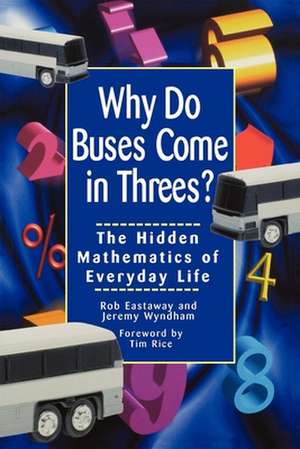
Why Do Buses Come in Threes
Autor Robert Eastaway, Jeremy Wyndhamen Limba Engleză Hardback – mar 2000
The intriguing answers to these and other questions about the curiosities of everyday life can be found in this delightfully irreverent and highly informative book. Why Do Buses Come in Threes? explains how math and the laws of probability are constantly at work in our lives, affecting everything we do, from getting a date to catching a bus to cooking dinner. With great humor and a genuine love for the subject, Rob Eastaway and Jeremy Wyndham present solutions to such conundrums as how fast one should run in the rain to stay dry and who was the greatest sportsman of all time.Discover the mathematical explanations for the strange coincidence of two.
Presidents dying on July 4, the uncanny ""accuracy"" of horoscopes, and other not-so-coincidental coincidences. Eastaway and Wyndham also reveal how television ratings work, which numbers are more likely to be big winners in the lottery, and why bad things, just like buses, always seem to happen in threes.
Whether you have a degree in astrophysics or haven't touched a math problem since high school, this book sends you on a fascinating journey through the logic of life where Newton's laws explain bar fights, exploding rabbit populations, and why showers always run either too hot or too cold. Why Do Buses Come in Threes? is a delightfully entertaining ride that reveals the relevance of math in absolutely everything we do.
Preț: 143.49 lei
Puncte Express: 215
Carte disponibilă
Livrare economică 16-30 noiembrie
Livrare prin curier în România Termenul estimat este afișat lângă disponibilitate.
Transport gratuit de la 400.00 lei Plată online sau ramburs, în funcție de opțiunile comenzii.
Retur gratuit în 14 zile Comandă securizată și suport în română.
Specificații
ISBN-13: 9781620456224
ISBN-10: 1620456222
Pagini: 170
Dimensiuni: 156 x 234 x 11 mm
Greutate: 0.42 kg
Editura: Turner Publishing Company
ISBN-10: 1620456222
Pagini: 170
Dimensiuni: 156 x 234 x 11 mm
Greutate: 0.42 kg
Editura: Turner Publishing Company
V-ar putea interesa
-
 Introduction to Game Theory: International EditionMartin J. Osborne-23%Preț: 1440.40 lei1875.92 lei
 -
 Before Sudoku: The World of Magic SquaresSeymour S Block-15%Preț: 148.74 lei174.84 lei
 -
 Game Theory and Economic ModellingDavid M. Kreps-20%Preț: 395.69 lei497.14 lei
 -
 Game Theory: A Very Short IntroductionKen Binmore-18%Preț: 58.22 lei71.42 lei
 -
 Strategic Learning and its LimitsH. Peyton Young-28%Preț: 491.93 lei678.85 lei
 -
 -16%Preț: 80.52 lei96.14 lei
 -
 The Colossal Book of MathematicsMartin GardnerPreț: 306.19 lei
 -
 Preț: 116.55 lei
 -
 The Moscow PuzzlesBoris Kordemsky-17%Preț: 86.38 lei104.66 lei
 -
 Game TheoryMorton D. DavisPreț: 80.03 lei
 -
 Mathematics and the ImaginationEdward Kasner-17%Preț: 90.96 lei110.05 lei
 -
 Infinite Dimensional Optimization and Control TheoryHector O. Fattorini-14%Preț: 811.22 lei943.28 lei
 -
 Game TheoryAviad Heifetz-19%Preț: 444.98 lei549.35 lei
 -
 Algorithmic Game TheoryNoam Nisan-11%Preț: 570.13 lei640.59 lei
 -
 Primer In Game Theory, ARobert Gibbons-9%Preț: 614.32 lei675.08 lei
 -
 -23%Preț: 659.77 lei856.84 lei
 -
 On Numbers and GamesJohn H. Conway-18%Preț: 1467.53 lei1789.68 lei
 -
 Games, Puzzles, and ComputationRobert A. Hearn-18%Preț: 894.29 lei1090.60 lei
 -
 Preț: 63.67 lei
Descriere
Descriere de la o altă ediție sau format:
"Deals in a very entertaining way with problems in normal life related to mathematics, luck, coincidence, gambling." ? The Independent (London) Why do your chances of winning the lottery increase if you buy your ticket on Friday? Why do traffic lights always seem to be red when you?re in a hurry? Is bad luck just chance, or can it be explained?
The intriguing answers to these and other questions about the curiosities of everyday life can be found in this delightfully irreverent and highly informative book. Why Do Buses Come in Threes? explains how math and the laws of probability are constantly at work in our lives, affecting everything we do, from getting a date to catching a bus to cooking dinner. With great humor and a genuine love for the subject, Rob Eastaway and Jeremy Wyndham present solutions to such conundrums as how fast one should run in the rain to stay dry and who was the greatest sportsman of all time.Discover the mathematical explanations for the strange coincidence of two.
Presidents dying on July 4, the uncanny "accuracy" of horoscopes, and other not–so–coincidental coincidences. Eastaway and Wyndham also reveal how television ratings work, which numbers are more likely to be big winners in the lottery, and why bad things, just like buses, always seem to happen in threes.
Whether you have a degree in astrophysics or haven?t touched a math problem since high school, this book sends you on a fascinating journey through the logic of life where Newton?s laws explain bar fights, exploding rabbit populations, and why showers always run either too hot or too cold. Why Do Buses Come in Threes? is a delightfully entertaining ride that reveals the relevance of math in absolutely everything we do.
"Deals in a very entertaining way with problems in normal life related to mathematics, luck, coincidence, gambling." ? The Independent (London) Why do your chances of winning the lottery increase if you buy your ticket on Friday? Why do traffic lights always seem to be red when you?re in a hurry? Is bad luck just chance, or can it be explained?
The intriguing answers to these and other questions about the curiosities of everyday life can be found in this delightfully irreverent and highly informative book. Why Do Buses Come in Threes? explains how math and the laws of probability are constantly at work in our lives, affecting everything we do, from getting a date to catching a bus to cooking dinner. With great humor and a genuine love for the subject, Rob Eastaway and Jeremy Wyndham present solutions to such conundrums as how fast one should run in the rain to stay dry and who was the greatest sportsman of all time.Discover the mathematical explanations for the strange coincidence of two.
Presidents dying on July 4, the uncanny "accuracy" of horoscopes, and other not–so–coincidental coincidences. Eastaway and Wyndham also reveal how television ratings work, which numbers are more likely to be big winners in the lottery, and why bad things, just like buses, always seem to happen in threes.
Whether you have a degree in astrophysics or haven?t touched a math problem since high school, this book sends you on a fascinating journey through the logic of life where Newton?s laws explain bar fights, exploding rabbit populations, and why showers always run either too hot or too cold. Why Do Buses Come in Threes? is a delightfully entertaining ride that reveals the relevance of math in absolutely everything we do.
Cuprins
Why Can′t I Find a Four–leafed Clover?: Links between Nature and Mathematics. Which Way Should I Go?: From Postmen to Taxi Drivers.
How Many People Watch Friends?: Most Public Statistics Come from Surveys, But How Reliable are They?
Why Do Clever People Get Things Wrong?: Sometimes Experience and Intelligence Can Be a Disadvantage.
What′s the Best Bet?: Lotteries, Horses and Casinos All Offer the Chance of a Big Prize.
How Do You Explain a Coincidence?: Coincidences Aren′t as Surprising as You Would Think.
What′s the Best View of the Statue of Liberty?: Everyday Geometries, from Snooker to Statues.
How Do You Keep a Secret?: Code–making and Breaking Isn′t Just for Spies.
Why Do Buses Come in Threes?: Travelling without a Car Leads to All Sorts of Conundrums.
What′s the Best Way to Cut a Cake?: Why Four O′Clock Can Be the Time for Some Mathematical Headaches.
How Can I Win without Cheating?: Almost Everything in Life Can Be Analysed as a Game.
Who′s the Best Player in the World?: The Mathematics Behind Sports Rankings.
What Happened to Chapter 13?: Can Bad Luck Be Explained?
Whodunnit?: Everyday Logic, From Murder Mysteries to Political Statistics.
Why Am I Always in Traffic Jams?: Motorways, Escalators and Supermarkets All Have One Thing in Common: Queues.
Why are Showers Always Too Hot or Cold?: From Squealing Microphones to Population Explosions.
How Can I Get the Meal Ready on Time?: Critical Paths and Other Scheduling Problems.
How Can I Entertain the Kids?: Numbers Can Be Magic.
References.
Index.
How Many People Watch Friends?: Most Public Statistics Come from Surveys, But How Reliable are They?
Why Do Clever People Get Things Wrong?: Sometimes Experience and Intelligence Can Be a Disadvantage.
What′s the Best Bet?: Lotteries, Horses and Casinos All Offer the Chance of a Big Prize.
How Do You Explain a Coincidence?: Coincidences Aren′t as Surprising as You Would Think.
What′s the Best View of the Statue of Liberty?: Everyday Geometries, from Snooker to Statues.
How Do You Keep a Secret?: Code–making and Breaking Isn′t Just for Spies.
Why Do Buses Come in Threes?: Travelling without a Car Leads to All Sorts of Conundrums.
What′s the Best Way to Cut a Cake?: Why Four O′Clock Can Be the Time for Some Mathematical Headaches.
How Can I Win without Cheating?: Almost Everything in Life Can Be Analysed as a Game.
Who′s the Best Player in the World?: The Mathematics Behind Sports Rankings.
What Happened to Chapter 13?: Can Bad Luck Be Explained?
Whodunnit?: Everyday Logic, From Murder Mysteries to Political Statistics.
Why Am I Always in Traffic Jams?: Motorways, Escalators and Supermarkets All Have One Thing in Common: Queues.
Why are Showers Always Too Hot or Cold?: From Squealing Microphones to Population Explosions.
How Can I Get the Meal Ready on Time?: Critical Paths and Other Scheduling Problems.
How Can I Entertain the Kids?: Numbers Can Be Magic.
References.
Index.
Notă biografică
ROB EASTAWAY is a freelance writer and lecturer. His books include The Guinness Book of Mindbenders and What Is a Googly?
JEREMY WYNDHAM, Ph.D., runs a market research company. He has a Ph.D. in physics and was a junior international bridge player.
JEREMY WYNDHAM, Ph.D., runs a market research company. He has a Ph.D. in physics and was a junior international bridge player.