
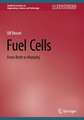
Fuel Cells: Synthesis Lectures on Engineering, Science, and Technology
Autor Ulf Bosselen Limba Engleză Paperback – 18 apr 2025
- Updated and corrected fuel cell theory
- Historic review of discovery of fuel cell effect and early development of fuel cell generators
- Complete correspondence between Schoenbein and Grove from 1838 to 1868 (first publication)
Din seria Synthesis Lectures on Engineering, Science, and Technology
-
 Preț: 365.08 lei
 -
 Preț: 416.81 lei
 - 15%
 Preț: 599.70 lei
 - 15%
 Preț: 388.98 lei
 - 15%
 Preț: 518.17 lei
 - 18%
 Preț: 751.37 lei
 -
 Preț: 211.90 lei
 - 15%
 Preț: 542.85 lei
 -
 Preț: 331.27 lei
 - 20%
 Preț: 615.94 lei
 -
 Preț: 441.46 lei
 - 20%
 Preț: 609.06 lei
 -
 Preț: 261.25 lei
 -
 Preț: 432.16 lei
 -
 Preț: 434.59 lei
 -
 Preț: 441.15 lei
 -
 Preț: 397.48 lei
 -
 Preț: 462.84 lei
 -
 Preț: 442.82 lei
 - 15%
 Preț: 546.89 lei
 - 15%
 Preț: 604.30 lei
 -
 Preț: 365.15 lei
 - 15%
 Preț: 546.89 lei
 -
 Preț: 395.83 lei
 - 15%
 Preț: 546.74 lei
 -
 Preț: 397.25 lei
 -
 Preț: 418.58 lei
 - 15%
 Preț: 548.42 lei
 -
 Preț: 398.13 lei
 -
 Preț: 434.29 lei
 - 18%
 Preț: 755.84 lei
 - 15%
 Preț: 663.81 lei
 - 15%
 Preț: 668.31 lei
 -
 Preț: 432.88 lei
 -
 Preț: 532.92 lei
 -
 Preț: 438.28 lei
 -
 Preț: 278.91 lei
 -
 Preț: 221.84 lei
 -
 Preț: 341.45 lei
 - 15%
 Preț: 550.15 lei
 - 15%
 Preț: 547.71 lei
 - 15%
 Preț: 548.23 lei
 -
 Preț: 374.96 lei
 -
 Preț: 416.83 lei
 -
 Preț: 157.99 lei
 -
 Preț: 339.13 lei
 -
 Preț: 385.66 lei
Preț: 260.12 lei
Puncte Express: 390
Carte tipărită la comandă
Livrare economică 28 noiembrie-04 decembrie
Livrare prin curier în România Termenul estimat este afișat lângă disponibilitate.
Transport gratuit de la 400.00 lei Plată online sau ramburs, în funcție de opțiunile comenzii.
Retur gratuit în 14 zile Comandă securizată și suport în română.
Specificații
ISBN-13: 9783031446771
ISBN-10: 3031446771
Pagini: 156
Dimensiuni: 168 x 240 x 9 mm
Greutate: 0.27 kg
Editura: Springer
Colecția Synthesis Lectures on Engineering, Science, and Technology
Seria Synthesis Lectures on Engineering, Science, and Technology
ISBN-10: 3031446771
Pagini: 156
Dimensiuni: 168 x 240 x 9 mm
Greutate: 0.27 kg
Editura: Springer
Colecția Synthesis Lectures on Engineering, Science, and Technology
Seria Synthesis Lectures on Engineering, Science, and Technology
V-ar putea interesa
-
 It's a GasMark MiodownikPreț: 79.10 lei
 -
 Instruments and Experimentation in the History of ChemistryFrederic HolmesPreț: 108.56 lei
 -
 Preț: 93.75 lei
 -
 -27%Preț: 68.18 lei93.03 lei
 -
 The Principles of Psychology, Vol. 1William James-23%Preț: 163.78 lei212.79 lei
 -
 Fuel Cell FundamentalsRyan O'Hayre-23%Preț: 915.53 lei1189.00 lei
 -
 Fuel Cells: Principles, Design, and AnalysisShripad T. Revankar-9%Preț: 1483.80 lei1630.56 lei
 -
 de Re MetallicaGeorgius AgricolaPreț: 205.57 lei
 -
 One Hand ClappingNikolay KukushkinPreț: 159.17 lei
 -
 Crick: A Mind in Motion – from DNA to the BrainProfessor Matthew Cobb-17%Preț: 194.13 lei234.30 lei
 -
 I SwearJohn DavidsonPreț: 86.18 lei
 -
 The Wireless OperatorDavid TuchPreț: 144.50 lei
 -
 -22%Preț: 126.93 lei162.33 lei
 -
 The Time MachineH. G. WellsPreț: 33.23 lei
 -
 Electrochemical Energy Conversion and StorageRudolf Holze-11%Preț: 520.72 lei585.08 lei
 -
 -23%Preț: 680.70 lei884.03 lei
 -
 Battery TechnologyAlexander Börger-14%Preț: 701.80 lei816.05 lei
 -
 Next-Generation Hydrogen EconomyPeeyush Phogat-23%Preț: 899.64 lei1168.37 lei
Cuprins
Chapter 1 - January 1839.- Chapter 2 - Dawning of Science.- Chapter 3 - Early Days of Electrochemistry.- Chapter 4 - The "Platinum Laboratories".- Chapter 5 - Discovery of the Fuel Cell Effect.- Chapter 6 - Schoenbein meets Grove.- Chapter 7 - Schoenbein and Faraday.- Chapter 8.- Grove's Fuel Cell Experiments of 1842.- Chapter 9 - Schoenbein's Response.- Chapter 10.- Grove's Fuel Cell Generator.
Notă biografică
Active on fuel cells since 1986. Manager of the ABB fuel cell development program. After ABB ended engagement in fuel cells (1991), free-lancing fuel cell consultant with clients in Switzerland, Germany, Netherlands, Austria, Spain, US, Japan, Italy, UK, Brazil and European Union. Founder (1994) and organizer (until 2010) of the European Fuel Cell Forum in Luzerne. Many issued (but expired) patents in the fuel cell ara. Active promotor of the energy transition (Energiewende) since 1972. Still engaged in issues involving critical assessment of hydrogen, energy efficiency of buildings, sustainable solutions for transport, overall energy balances etc. Organizer of over 20 international conferences on sustainable energy issues. Great-great grandson of Christian Friedrich Schoenbein, discoverer of the fuel cell effect.
Textul de pe ultima copertă
The book presents the scientific history of the early days of fuel cells (1838 to 1845). The fuel cell effect was discovered by the Swiss scientist Christian Friedrich Schoenbein. while the English lawyer and scientist William Robert Grove perfected the idea into a working power source. But around 1870 Siemens invented the power generator and electricity was produced by rotating shafts of water wheels, engines and turbines. The book presents for the first time the complete communication between C. F. Schoenbein and R. W. Grove (1838 to 1868). Also, the original analysis based on the physical understanding of 1850 has also been revised and corrected. The updated fuel cell analysis leads to full agreement between theory and experiment.
- Updated and corrected fuel cell theory
- Historic review of discovery of fuel cell effect and early development of fuel cell generators
- Complete correspondence between Schoenbein and Grove from 1838 to 1868 (first publication)