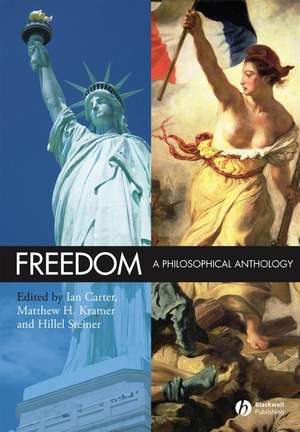
Freedom
Autor Carter, Kramer, Steineren Limba Engleză Paperback – 29 dec 2006
Publicul țintă principal al acestui volum este format din studenți și cercetători în domeniul filosofiei politice și al teoriei politice, care vor găsi aici o resursă exhaustivă pentru înțelegerea conceptului de libertate. Remarcăm efortul editorilor de a structura o antologie care nu se limitează doar la dimensiunea teoretică, ci explorează implicațiile practice ale libertății în context social și economic. Structura volumului propune o punte necesară între fundamentele istorice și dezbaterile contemporane. Apreciem includerea textelor clasice semnate de Kant, Hobbes sau Locke, care oferă baza conceptuală pentru analizele moderne. Totuși, elementul distinctiv al lucrării Freedom – A Philosophical Anthology este focalizarea pe producția intelectuală din ultimele două decenii, abordând teme stringente precum relația dintre libertate și inegalitatea economică sau măsurarea libertății în cadrul sistemelor politice actuale. Cititorii familiarizați cu Liberty Reader de David Miller vor aprecia faptul că acest volum extinde cadrul de analiză dincolo de dihotomia clasică dintre libertatea pozitivă și cea negativă, aducând în prim-plan discuții despre puterea arbitrară și coerciție. Spre deosebire de Arguing About Political Philosophy, care are o abordare interdisciplinară mai largă, antologia editată de I Carter menține un focus filosofic riguros, fiind ideală pentru cursuri universitare datorită diversității punctelor de vedere politice reprezentate. Subliniem calitatea selecției textelor, care transformă acest volum într-un instrument de lucru versatil pentru departamentele de profil.
Preț: 542.27 lei
Carte tipărită la comandă
Livrare economică 26 noiembrie-10 decembrie
Specificații
ISBN-10: 1405145048
Pagini: 528
Dimensiuni: 170 x 244 x 29 mm
Greutate: 0.91 kg
Ediția:New.
Editura: Wiley
Locul publicării:Chichester, United Kingdom
V-ar putea interesa
-
 VIAGGIO A BUENOS AIRESRoberto BombasseiPreț: 99.18 lei
 -
 Rediscovering the Integral CosmosJean BorellaPreț: 122.17 lei
 -
 Contemplación FilosóficaRan LahavPreț: 45.15 lei
 -
 The SourceBraun BernardPreț: 76.85 lei
 -
 El Método científico: una Didáctica para el aprendizaje en filosofíaMaria Teresa Ayala FigueroaPreț: 393.36 lei
 -
 La enseñanza de la Filosofía en la integración social del estudianteRicardo Andrés Ramírez BasualdoPreț: 255.10 lei
 -
 Devenir carneVanessa LariosPreț: 348.35 lei
Public țintă
undergraduates and graduates taking courses in political philosophy and theory, in both philosophy and politics departmentsDe ce să citești această carte
Recomandăm această antologie oricărui student la științe politice sau filosofie care dorește să înțeleagă evoluția conceptului de libertate de la Iluminism până în prezent. Câștigați acces la o selecție vastă de texte esențiale, de la Rousseau la autori contemporani, într-un singur volum de referință. Este un instrument critic pentru a naviga complexitatea dezbaterilor despre autonomie, stat și drepturi individuale în secolul XXI.
Descriere scurtă
- Offers a broad guide to the vast literature on social, political and economic freedom.
- Contains selections from the best scholarship of recent decades as well as classic writings from Hobbes, Locke, Rousseau and Kant among others.
- General and sectional introductions help to orient the reader.
- Compiled and edited by three important contributors to the field.
Notă biografică
Matthew H. Kramer is Professor of Legal and Political Philosophy at Cambridge University; Fellow of Churchill College, Cambridge; and Director of the Cambridge Forum for Legal and Political Philosophy.
Hillel Steiner is Professor of Political Philosophy at the University of Manchester.
Cuprins
General Introduction.
Part I. Negative and Positive Freedom.
Introduction.
1. Thomas Hobbes, Leviathan (1651).
2. Jeremy Bentham, Of Laws in General (1782).
3. Jean-Jacques Rousseau, The Social Contract (1762).
4. Immanuel Kant, The Metaphysics of Morals (1797).
5. Benjamin Constant, The Liberty of the Ancients Compared with That of the Moderns (1819).
6. G. W. F. Hegel, The Philosophy of Right (1821).
7. Karl Marx, On the Jewish Question (1844).
8. Thomas Hill Green, Of the Different Senses of "Freedom" as Applied to Will and to the Moral Progress of Man and Lectures on the Principles of Political Obligations (1882).
9. Guido De Ruggiero, The History of European Liberalism (1925).
10. Isaiah Berlin, Two Concepts of Liberty (1969).
11. J.P. Day, On Liberty and the Real Will (1970).
12. Gerald C. MacCallum, Jr., Negative and Positive Freedom (1967).
13. John Rawls, A Theory of Justice (1971).
Part II. Freedom, Government and Arbitrary Power.
Introduction.
14. Nicolò Machiavelli, Discourses (1531).
15. Thomas Hobbes, Leviathan (1651).
16. James Harrington, The Commonwealth of Oceana (1656).
17. John Locke, Two Treatises of Government (1690).
18. Charles de Secondat, Baron de Montesquieu, The Spirit of the Laws (1748).
19. Isaiah Berlin, Two Concepts of Liberty (1969).
20. F. A. Hayek, The Constitution of Liberty (1960).
21. Philip Pettit, Republicanism (1997).
22. Quentin Skinner, Liberty before Liberalism (1998).
Part III. Freedom and the Mind.
Introduction.
23. Thomas Hobbes, Leviathan (1651).
24. J. S. Mill, On Liberty (1859).
25. Isaiah Berlin, Four Essays on Liberty (1969).
26. J. P. Day, On Liberty and the Real Will (1987).
27. John Gray, On Negative and Positive Liberty (1980).
28. Richard J. Arneson, Freedom and Desire (1985).
29. John Christman, Liberalism and Individual Positive Freedom (1991).
30. Charles Taylor, What's Wrong with Negative Liberty (1979).
31. Christopher Megone, One Concept of Liberty (1987).
32. Richard Flathman, The Philosophy and Politics of Freedom (1987).
33. Matthew H. Kramer, The Quality of Freedom (2003).
Part IV. Freedom and Morality.
Introduction.
34. John Locke, Two Treatises of Government (1690).
35. Felix E. Oppenheim, Political Concepts (1981).
36. William E. Connolly, The Terms of Political Discourse (1993).
37. Robert Nozick, Anarchy, State and Utopia (1974).
38. G. A. Cohen, Illusions about Private Property and Freedom (1981).
39. S. I. Benn and W. L. Weinstein, Being Free to Act, and Being a Free Man (1971).
40. David Miller, Constraints on Freedom (1983).
41. Felix E. Oppenheim, Constraints on Freedom as a Descriptive Concept (1985).
42. David Miller, Reply to Oppenheim (1985).
43. Kristján Kristjánsson, Social Freedom (1996).
44. Richard Flathman, The Philosophy and Politics of Freedom (1987).
45. Hillel Steiner, An Essay on Rights (1994).
46. Matthew H. Kramer, The Quality of Freedom (2003).
Part V. Coercion.
Introduction.
47. F. A. Hayek, The Constitution of Liberty (1960).
48. Robert Nozick, Coercion (1969).
49. Robert Nozick, Anarchy, State and Utopia (1974).
50. G. A. Cohen, Self-ownership, Freedom and Equality (1995).
51. Hillel Steiner, An Essay on Rights (1994).
52. Christine Swanton, Freedom. A Coherence Theory (1992).
53. David Zimmerman, Coercive Wage Offers (1981).
54. Michael J. Gorr, Coercion, Freedom and Exploitation (1989).
55. Alan Wertheimer, Coercion (1987).
56. Serena Olsaretti, Liberty, Desert and the Market (2004).
Part VI. Autonomy.
Introduction.
57. Stanley I. Benn, A Theory of Freedom (1988).
58. Gerald Dworkin, The Theory and Practice of Autonomy (1988).
59. Onora O'Neill, Autonomy, Coherence and Independence (1992).
60. Janice Moulton and Francine Rainone, Women's Work and Sex Roles (1984).
61. Karl Marx and Friedrich Engels, The German Ideology (1846).
Part VII. Freedom, Ability and Economic Inequality.
Introduction.
62. F. A. Hayek, The Constitution of Liberty (1960).
63. Bruno Leoni, Freedom and the Law (1961).
64. Murray Rothbard, The Ethics of Liberty (1982).
65. John Rawls, A Theory of Justice (1971).
66. Philippe Van Parijs, Real Freedom for All (1995).
67. G. A. Cohen, Self-ownership, Freedom and Equality (1995).
68. Amartya Sen, Inequality Reexamined (1992).
Part VIII. Liberalism and the Value of Freedom.
Introduction.
69. J. S. Mill, On Liberty (1859).
70. J. S. Mill, On Liberty (1859).
71. Karl Popper, The Poverty of Historicism (1957).
72. F. A. Hayek, The Constitution of Liberty (1960).
73. Isaiah Berlin, Two Concepts of Liberty (1969).
74. John Rawls, Justice as Fairness. A Restatement (2001).
75. Joseph Raz, The Morality of Freedom (1986).
76. Amartya Sen, Inequality Reexamined (1992).
77. Thomas Hurka, Why Value Autonomy? (1987).
78. Joel Feinberg, The Interest in Liberty on the Scales (1978).
79. Ronald Dworkin, Taking Rights Seriously (1977).
80. Ian Carter, A Measure of Freedom (1999).
Part IX. The Measurement of Freedom.
Introduction.
81. Hillel Steiner, How Free: Computing Personal Liberty (1983).
82. Ian Carter, A Measure of Freedom (1999).
83. Prasanta Pattanaik and Yongsheng Xu, On Ranking Opportunity Sets in Terms of Freedom of Choice (1990).
84. Amartya Sen, Welfare, Freedom and Social Choice. A Reply (1990).
85. Robert Sugden, The Metric of Opportunity (1998).
86. Martin van Hees, Legal Reductionism and Freedom (2000).
Additional Writings.
Index.
.