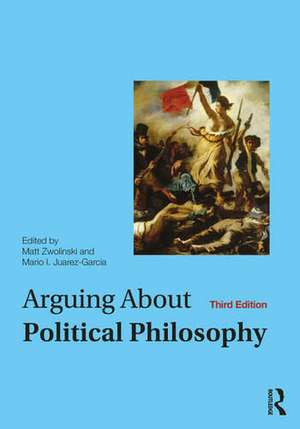
Arguing About Political Philosophy: Arguing About Philosophy
Editat de Matt Zwolinski, Mario I. Juarez-Garciaen Limba Engleză Paperback – 2 aug 2025
The third edition has been substantially revised to make it more suitable for a growing number of courses in philosophy, politics, and economics (PPE). New topics and new readings help to explore the intersection of these three disciplines at a theoretical level, and how they help us to think about challenging practical problems like regulating sweatshop labor, reconciling immigration policy with social justice, and thinking about the virtues and limits of democracy.
In addition to offering sections on foundational concepts, political economy, and contemporary debates in political philosophy, the third edition contains a brand-new section on political ideologies, with a new introduction and accessible readings setting out the main features of liberalism, socialism, conservatism, and libertarianism.
The updated Instructor and Student Resource website www.routledge.com/cw/zwolinski offers valuable resources for instructors and students alike, including sample quizzes, exams, and writing assignments, extensive study questions for each reading, and an online version of the "What’s Your Political Philosophy" self-assessment.
Key Updates to the Third Edition:
- Includes more interdisciplinary readings from economists and political scientists.
- Contains readings that make the volume a better fit for new programs in philosophy, politics, and economics (PPE).
- Offers a better representation of diverse ideological perspectives.
- Provides new coverage of emerging topics like reparations for past injustice, sweatshop labor, immigration policy, effective altruism, and the value of democracy.
- Updates the important parts on the book’s website: sample quizzes, exams, and writing assignments, extensive study questions for each reading, and an online version of the "What’s Your Political Philosophy" self-assessment.








Preț: 399.98 lei
Puncte Express: 600
Carte disponibilă
Livrare economică 17 noiembrie-01 decembrie
Livrare express 31 octombrie-06 noiembrie pentru 79.33 lei
Livrare prin curier în România Termenul estimat este afișat lângă disponibilitate.
Transport gratuit de la 400.00 lei Plată online sau ramburs, în funcție de opțiunile comenzii.
Retur gratuit în 14 zile Comandă securizată și suport în română.
Specificații
ISBN-13: 9781032630281
ISBN-10: 1032630280
Pagini: 794
Ilustrații: 10
Dimensiuni: 178 x 254 x 43 mm
Greutate: 1.35 kg
Ediția:3. Auflage
Editura: Taylor & Francis
Colecția Routledge
Seria Arguing About Philosophy
Locul publicării:Oxford, United Kingdom
ISBN-10: 1032630280
Pagini: 794
Ilustrații: 10
Dimensiuni: 178 x 254 x 43 mm
Greutate: 1.35 kg
Ediția:3. Auflage
Editura: Taylor & Francis
Colecția Routledge
Seria Arguing About Philosophy
Locul publicării:Oxford, United Kingdom
Public țintă
UndergraduateCuprins
General Introduction Part 1. Fundamental Concepts 1a. Political Authority i. Social Contract Theory 1. Thomas Hobbes, Leviathan (chapters 11, 13, 14, 15, 17, 18, 21) 2. John Locke, The Second Treatise of Civil Government (chapters 2, 3, 8, 9, 19) 3. Jean-Jacques Rousseau, The Social Contract (Book I) ii. Against the Social Contract 4. David Hume, “Of the Original Contract” 5. Michael Huemer, “The Problem of Political Authority” 6. Charles Mills, “The Racial Contract” 7. Virginia Held, “Non-Contractual Society: A Feminist View” 1b. Justice 8. David Hume, “Justice as Convention” 9. John Stuart Mill, “Justice and Utility” (Utiltarianism, chapters 2 and 5) 10. John Rawls, “A Theory of Justice” 1c. Freedom 11. John Stuart Mill, “On Liberty” 12. Isaiah Berlin, “Two Concepts of Liberty” 13. Philip Pettit, “Republican Political Theory” 1d. Equality 14. Amartya Sen, “Equality of What?” 15. Richard Arneson, “Equality and Equal Opportunity for Welfare” 16. Harry Frankfurt, “Equality as a Moral Ideal” 17. Elizabeth Anderson, “What is the point of equality?” Part 2: Political Economy 2a. Property Rights 18. John Locke, “Property” 19. Herbert Spencer, “The Right to the Use of the Earth” 20. Garrett Hardin, “The Tragedy of the Commons” 21. David Schmidtz, “The Institution of Property” 2b. Market Efficiency and Market Failure 22. Adam Smith, “The Wealth of Nations” 23. Friedrich Hayek, “The Use of Knowledge in Society” 24. Debra Satz, “The Background Conditions of Market efficiency and Market Failure” 25. Charles Wolf, Jr., “Market Failure” 26. Elinor Ostrom, “Beyond Markets and States: Polycentric Governance of Complex Economic Systems” 2c. Public Choice Theory 27. Machiavelli, “The Prince” 28. James Buchanan, “Public Choice: Politics Without Romance” 29. George Stigler, “The Theory of Economic Regulation” Part 3: Political Ideologies 3a. Liberalism 30. F.A. Hayek, “Why I am not a Conservative” 31. John Rawls, “Justice as Fairness: Political Not Metaphysical” 32. Gerald Gaus, “The Moral Foundations of Liberal Neutrality” 3b. Socialism 33. Karl Marx and Friedrich Engels, “The Communist Manifesto” 34. Karl Marx, “Critique of the Gotha Program” 35. G.A. Cohen, “Why Not Socialism?” 3c. Conservatism 36. Jerry Muller, “What is Conservative Social and Political Thought?” 37. Yoram Hazony, “The Conservative Paradigm” 3d. Libertarianism 38. Matt Zwolinski and John Tomasi, “What Is Libertarianism?” 39. Robert Nozick, “The Entitlement Theory of Justice” 40. Peter Vallentyne, “Left-Libertarianism: A Primer” Part 4: Contemporary Debates in Political Philosophy 4a. Are Sweatshops Immoral? 41. Benjamin Powell and Matt Zwolinski, “The Ethical and Economic Case Against Sweatshop Labor: A Critical Assessment” 42. Matthew Coakley and Michael Kates, “The Ethical and Economic Case for Sweatshop Regulation” 4b. Do We Owe Reparations for Past Injustices? 43. Ta-Nehisi Coates, “The Case for Reparations” 44. Jeremy Waldron, “Superseding Historic Injustice” 4c. What Do We Owe the Global Poor? 45. Peter Singer, “The Life You Can Save” 46. David Schmidtz, “After Solipsism” 4d. Are Immigration Restrictions Unjust? 47. Joseph Carens, “Aliens and Citizens” 48. Stephen Macedo, “The Moral Dilemma of US Immigration Policy” 4e. Is Democracy Overrated? 49. Jason Brennan, “Against Democracy” 50. Henry Farrell, Hugo Mercier, and Melissa Schwartzberg, “The New Libertarian Elitists”
Recenzii
Praise for the Third Edition:
"There is a renewed interest in the grand contentions of political philosophy. The problem is that students often find the traditional approach, "mastering thinkers," to be tedious at best, and daunting to many because of the amount of time required. The PPE approach, of which the editors of Arguing About are masters, allows a focus on problems rather than thinkers. This has two advantages: first, excerpts like those presented here are a way of staging debates among thinkers of different perspectives and from different eras. It's like time travel, without getting up from your desk chair. Second, it provides the students an entry point for understanding why a particular thinker is important, and gives them reasons to learn more on their own. This new edition of Arguing About Political Philosophy is a most valuable contribution to our pedagogical arsenal for the new PPE."
-- Michael Munger, Duke University, USA.
"Matt Zwolinski and Mario Juarez-Garcia have assembled a lively anthology that retains a commitment to high standards while being extremely student-friendly as well. Arguing about Political Philosophy is above all about ideas, and it is refreshing to see so many diverse ideological perspectives brought together in one teaching text. Well-organized and judiciously selected, this collection provides an ideal foundation on which to build your own world-class course in political philosophy."
-- John Tomasi, Brown University, USA.
“As social and political change comes ever more quickly, it’s becoming increasingly vital to understand the core challenges and opportunities of living together. This volume does a masterful job of showing a student of political philosophy the many tradeoffs any society has to make when choosing the rules that govern us. Zwolinski and Juarez-Garcia have embraced the PPE approach, showing to a new generation of students how questions of justice are intimately tied up in questions of the design of markets, competing models of freedom, and disagreements about how we ought to understand political equality. These debates are made real for students not just with readings that represent range of political perspectives, but also by considering case studies where liberal values can readily conflict with each other. This new edition of Arguing About Political Philosophy is a wonderful contemporary introduction to the core challenges in political philosophy.”
– Ryan Muldoon, University at Buffalo, USA.
Notă biografică
Matt Zwolinski is Professor of Philosophy at the University of San Diego, USA, founder and director of USD’s Center for Ethics, Economics, and Public Policy, and director of USD’s undergraduate program in philosophy, politics, and economics. He is the co-author, with John Tomasi, of The Individualists: Radicals, Reactionaries, and the Struggle for the Soul of Libertarianism (2023), and with Miranda Perry Fleischer, of Universal Basic Income: What Everyone Needs to Know (2023).
Mario I. Juarez-Garcia is Assistant Professor of Philosophy at Tulane University, USA. His areas of specialization are political philosophy, moral philosophy, and PPE and he has published scholarly articles in Synthese, Public Affairs Quarterly, Journal of Moral Philosophy, and Social Philosophy and Policy. He is also the author of Moral Institutions: An Introduction to Philosophy, Politics, and Economics (Routledge, 2025).
Mario I. Juarez-Garcia is Assistant Professor of Philosophy at Tulane University, USA. His areas of specialization are political philosophy, moral philosophy, and PPE and he has published scholarly articles in Synthese, Public Affairs Quarterly, Journal of Moral Philosophy, and Social Philosophy and Policy. He is also the author of Moral Institutions: An Introduction to Philosophy, Politics, and Economics (Routledge, 2025).
Descriere
This Third Edition of Arguing About Political Philosophy is the most complete, up-to-date, and interdisciplinary anthology of its kind. Its selections cover classic philosophical sources, important works in political economy, and the writing of cutting edge contemporary theorists.