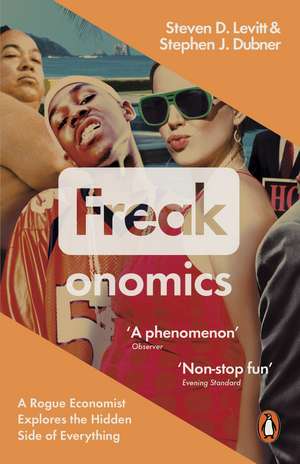
Freakonomics: A Rogue Economist Explores the Hidden Side of Everything: Freakonomics
Autor Steven D. Levitt, Stephen J. Dubneren Limba Engleză Paperback – 5 apr 2006
Putem afirma că cea mai mare eroare în înțelegerea lumii moderne este presupunerea că oamenii acționează strict pe baza moralității sau a logicii evidente, ignorând forța invizibilă a stimulentelor. În Freakonomics, Steven D. Levitt și Stephen J. Dubner demontează mitul conform căruia economia este doar o știință a indicelui bursier, demonstrând că aceasta este, în esență, studiul stimulentelor care guvernează deciziile umane, de la trișatul în sport până la dinamica criminalității. Reținem că abordarea autorilor nu este una teoretică aridă, ci una bazată pe date care răstoarnă certitudini: de ce ar trișa un luptător de sumo sau ce ne spun datele despre eficiența reală a măsurilor de siguranță cotidiană? Recomandăm acest volum pentru capacitatea sa de a extrage tipare din seturi de date aparent deconectate, oferind o perspectivă radical diferită asupra cauzalității. Complementar volumului The Logic Of Life de Tim Harford, care analizează raționalitatea din spatele comportamentelor aparent ilogice, Freakonomics acoperă zona mecanismelor ascunse și a corelațiilor statistice surprinzătoare pe care Harford le abordează mai degrabă prin prisma teoriei jocurilor. Această ediție aduce o valoare adăugată prin dialogul cu Angela Duckworth, integrând dimensiunea psihologică în analiza economică. Față de lucrările ulterioare, precum SuperFreakonomics sau ghidul practic Think Like a Freak, acest titlu rămâne fundamentul pe care autorii și-au construit întregul sistem de gândire „renegată”, fiind punctul de plecare esențial pentru oricine dorește să înțeleagă „partea ascunsă a tuturor lucrurilor”.


Preț: 61.22 lei
Preț vechi: 102.71 lei
-40%
Carte disponibilă
Livrare economică 13-24 noiembrie
Specificații
ISBN-10: 0141019018
Pagini: 336
Dimensiuni: 129 x 198 x 19 mm
Greutate: 0.27 kg
Ediția:1
Editura: Penguin Books
Colecția Penguin
Seriile Freakonomics, Recomandări Dan Berteanu -Equatorial, Bittnet, Antreprenoria
Locul publicării:London, United Kingdom
V-ar putea interesa
-
 How To Have A Beautiful MindEdward de Bono-19%Preț: 87.17 lei107.57 lei
 -
 How to Have Creative IdeasEdward de Bono-20%Preț: 85.93 lei106.80 lei
 -
 Sapiens: A Brief History of Human KindYuval Noah Harari-17%Preț: 80.04 lei95.89 lei
 -
 The Truth About MarketsJohn Kay-19%Preț: 88.06 lei108.31 lei
 -
 SuperfreakonomicsStephen J. DubnerPreț: 92.82 lei
 -
 The Black SwanNassim Nicholas Taleb-46%Preț: 58.65 lei108.67 lei
 -
 How Markets Fail: The Logic of Economic CalamitiesCassidy John-18%Preț: 77.00 lei94.06 lei
 -
 The Undercover EconomistTim Harford-26%Preț: 69.96 lei94.06 lei
 -
 Critical MassPhilip BallPreț: 219.49 lei
 -
 OriginsNeil De Grasse TysonPreț: 113.48 lei
 -
 Thinking from A to ZNigel WarburtonPreț: 214.25 lei
 -
 Preț: 106.40 lei
 -
 The Logic of LifeTim HarfordPreț: 105.12 lei
 -
 A Brief History of TimeStephen Hawking-19%Preț: 64.40 lei79.13 lei
 -
 Critical ThinkingAlec FisherPreț: 360.29 lei
 -
 -19%Preț: 98.07 lei121.73 lei
 -
 The Power of HabitCharles DuhiggPreț: 86.85 lei
 -
 Preț: 41.78 lei
De ce să citești această carte
Recomandăm această carte oricărui cititor care dorește să își antreneze gândirea critică și să înțeleagă forțele reale care mișcă societatea. Veți învăța să priviți dincolo de explicațiile oficiale și să identificați stimulentele care dictează comportamentul celor din jur. Este o lectură esențială pentru a deprinde abilitatea de a pune întrebările corecte, transformând datele brute în instrumente de înțelegere a realității.
Despre autor
Steven D. Levitt este un economist american de prestigiu, profesor la Universitatea din Chicago și laureat al medaliei John Bates Clark în 2003, distincție acordată celui mai influent economist sub 40 de ani. Expertiza sa în analiza criminalității și a fenomenelor sociale l-a propulsat în topul „100 de oameni care modelează lumea” al revistei Time. Împreună cu jurnalistul Stephen J. Dubner, a creat fenomenul global Freakonomics, care include cărți, un podcast premiat și documentare, toate dedicate aplicării instrumentelor economice asupra unor subiecte neconvenționale și provocatoare.
Notă biografică
Steven D. Levitt (Author)
Steven D. Levitt, a professor of economics at the University of Chicago, was awarded the John Bates Clark medal, given to the most influential American economist under the age of forty. He is also a founder of The Greatest Good, which applies Freakonomics-style thinking to business and philanthropy.
Stephen J. Dubner (Author)
Stephen J. Dubner is an award-winning author, journalist, and radio and TV personality. He quit his first career - as an almost-rock-star - to become a writer. He has worked for The New York Times and published three non-Freakonomics books. He lives with his family in New York City.
Descriere
Assume nothing, question everything.
This is the message at the heart of Freakonomics, Levitt and Dubner's rule-breaking, iconoclastic book about crack dealers, cheating teachers and bizarre baby names that turned everyone's view of the world upside-down and became an international multi-million-copy-selling phenomenon.
'Prepare to be dazzled' Malcolm Gladwell
'A sensation ... you'll be stimulated, provoked and entertained. Of how many books can that be said?' Sunday Telegraph
'Has you chuckling one minute and gasping in amazement the next' Wall Street Journal
'Dazzling ... a delight' Economist
'Made me laugh out loud' Scotland on Sunday
Textul de pe ultima copertă
Which is more dangerous, a gun or a swimming pool? What do schoolteachers and sumo wrestlers have in common? Why do drug dealers still live with their moms? How much do parents really matter? How did the legalization of abortion affect the rate of violent crime?
These may not sound like typical questions for an economist to ask. But Steven D. Levitt is not a typical economist. He is a much-heralded scholar who studies the riddles of everyday life—from cheating and crime to sports and child-rearing—and whose conclusions turn conventional wisdom on its head.
Freakonomics is a groundbreaking collaboration between Levitt and Stephen J. Dubner, an award-winning author and journalist. They usually begin with a mountain of data and a simple question. Some of these questions concern life-and-death issues; others have an admittedly freakish quality. Thus the new field of study contained in this book: Freakonomics.
Through forceful storytelling and wry insight, Levitt and Dubner show that economics is, at root, the study of incentives—how people get what they want, or need, especially when other people want or need the same thing. In Freakonomics, they explore the hidden side of . . . well, everything. The inner workings of a crack gang. The truth about real-estate agents. The myths of campaign finance. The telltale marks of a cheating schoolteacher. The secrets of the Ku Klux Klan.
What unites all these stories is a belief that the modern world, despite a great deal of complexity and downright deceit, is not impenetrable, is not unknowable, and—if the right questions are asked—is even more intriguing than we think. All it takes is a new way of looking.
Freakonomics establishes this unconventional premise: If morality represents how we would like the world to work, then economics represents how it actually does work. It is true that readers of this book will be armed with enough riddles and stories to last a thousand cocktail parties. But Freakonomics can provide more than that. It will literally redefine the way we view the modern world.