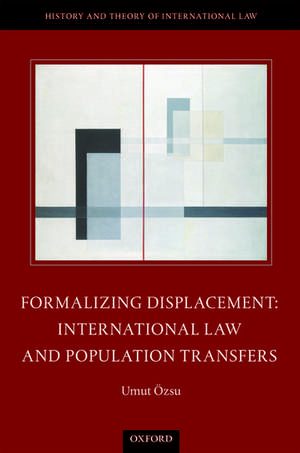
Formalizing Displacement: International Law and Population Transfers: The History and Theory of International Law
Autor Umut Özsuen Limba Engleză Hardback – 18 dec 2014
Recomandăm Formalizing Displacement pentru rigoarea cu care deconstruiește un moment de cotitură în dreptul public: transformarea strămutărilor forțate în mecanisme legale de consolidare statală. Structura lucrării este una progresivă și analitică: începe prin evaluarea protecției minorităților în secolul al XIX-lea, continuă cu examinarea detaliată a Conferinței de la Lausanne (1922-1923) și culminează cu analiza avizului consultativ al Curții Permanente de Justiție Internațională din 1925. Descoperim aici o perspectivă critică asupra modului în care peste un milion de oameni au fost dislocați sub egida legalității internaționale.
Umut Özsu propune o metodologie interdisciplinară, ancorând analiza juridică în sociologie istorică și economie politică. Autorul demonstrează cum transferul de populație a apărut ca o alternativă radicală la protecția minorităților, fiind susținut de Liga Națiunilor pentru a stabiliza regiuni considerate puncte de frontieră între Europa și restul lumii. Pe linia practică a volumului Crossing the Aegean, dar cu un focus distinct pe arhitectura juridică și pe formalizarea acestor procese în tratate internaționale, cartea oferă o înțelegere profundă a modului în care dreptul poate legitima dislocări masive de populație.
În contextul operei sale, Formalizing Displacement servește ca fundament pentru preocupările ulterioare ale autorului din Completing Humanity. Dacă în lucrările mai recente acesta explorează decolonizarea dreptului internațional, aici analizează rădăcinile controlului demografic. Această lucrare, publicată de Oxford University Press în seria The History and Theory of International Law, este esențială pentru a înțelege cum dreptul internațional a fost modelat de necesitățile politice ale statelor-națiune în formare.
Din seria The History and Theory of International Law
- 33%
 Preț: 785.23 lei
 - 33%
 Preț: 679.16 lei
 - 33%
 Preț: 734.55 lei
 - 33%
 Preț: 650.96 lei
 - 33%
 Preț: 651.43 lei
 - 33%
 Preț: 713.83 lei
 - 34%
 Preț: 607.21 lei
 - 34%
 Preț: 607.09 lei
 - 33%
 Preț: 705.75 lei
 - 34%
 Preț: 638.87 lei
 - 33%
 Preț: 639.83 lei
 - 33%
 Preț: 1058.48 lei
 - 33%
 Preț: 1086.66 lei
 - 34%
 Preț: 663.68 lei
 - 25%
 Preț: 789.05 lei
 - 23%
 Preț: 257.63 lei
 - 27%
 Preț: 776.50 lei
 - 23%
 Preț: 620.83 lei
 - 33%
 Preț: 703.44 lei
 - 14%
 Preț: 649.38 lei
 - 34%
 Preț: 701.66 lei
 - 21%
 Preț: 663.61 lei
 - 14%
 Preț: 708.96 lei
 - 33%
 Preț: 671.43 lei
 - 33%
 Preț: 926.44 lei
 - 22%
 Preț: 618.35 lei
 - 21%
 Preț: 677.79 lei
 - 9%
 Preț: 915.06 lei
 - 34%
 Preț: 686.59 lei
 - 22%
 Preț: 852.85 lei
 - 33%
 Preț: 799.36 lei
 - 33%
 Preț: 775.71 lei
 - 33%
 Preț: 608.66 lei
 - 34%
 Preț: 845.76 lei
 - 33%
 Preț: 737.40 lei
 - 34%
 Preț: 637.92 lei
 - 21%
 Preț: 234.55 lei
 - 34%
 Preț: 668.28 lei
 - nou
 Preț: 1209.20 lei
Preț: 745.74 lei
Preț vechi: 1125.61 lei
-34%
Carte tipărită la comandă
Livrare economică 03-14 iulie
Specificații
ISBN-10: 0198717431
Pagini: 190
Dimensiuni: 162 x 241 x 16 mm
Greutate: 0.44 kg
Editura: Oxford University Press
Colecția OUP Oxford
Seria The History and Theory of International Law
Locul publicării:Oxford, United Kingdom
V-ar putea interesa
-
 The Evolutionary Interpretation of TreatiesEirik Bjorge-27%Preț: 724.85 lei997.98 lei
 -
 -22%Preț: 421.52 lei542.90 lei
 -
 -13%Preț: 250.86 lei287.66 lei
 -
 -27%Preț: 604.36 lei826.94 lei
 -
 The Law of Treaties Beyond the Vienna ConventionEnzo Cannizzaro-26%Preț: 837.63 lei1134.08 lei
 -
 The Law of State ImmunityHazel Fox, QC-34%Preț: 2243.81 lei3389.70 lei
 -
 Caribbean Integration LawDavid S. Berry-27%Preț: 952.81 lei1308.14 lei
 -
 Treaties and Subsequent PracticeGeorg Nolte-34%Preț: 988.67 lei1486.99 lei
 -
 -14%Preț: 336.31 lei389.71 lei
 -
 The Project of Positivism in International LawMónica García-Salmones Rovira-9%Preț: 891.35 lei978.69 lei
 -
 Preț: 365.92 lei
De ce să citești această carte
Această carte este indispensabilă specialiștilor în drept internațional și istorie politică. Cititorul va dobândi o înțelegere clară a modului în care mecanismele legale au fost utilizate pentru a justifica strămutările forțate. Este o resursă critică pentru oricine dorește să înțeleagă precedentul periculos creat la Lausanne, care a influențat politicile de segregare și management al populației pe parcursul întregului secol XX.
Despre autor
Umut Özsu este un cercetător respectat în domeniul dreptului internațional, cunoscut pentru abordările sale care îmbină istoria juridică cu teoria critică. Lucrările sale, precum The Extraterritoriality of Law și Completing Humanity, explorează teme complexe legate de suveranitate, decolonizare și istoria instituțiilor globale. În Formalizing Displacement, Özsu își demonstrează capacitatea de a analiza documente diplomatice și juridice complexe, oferind o interpretare nouă asupra modului în care reglementările internaționale interacționează cu realitățile socio-economice ale regiunilor aflate în tranziție politică.
Descriere
Recenzii
In Formalizing Displacement, Umut Özsu provides a new and engaging analysis of the role of international law in the interwar Greek-Turkish population exchanges. Against interpretations that present the exchange of minorities as a sui generis development, Özsu situates it within the longue durée of Ottoman disintegration and traces its roots to antecedent forced migrations in the Balkans and Asia Minor. Rich historical detail provides the context within which Özsu analyses the role of international law, legal institutions and lawyers in engineering the compulsory exchange ... Rich in detail and trenchant analysis, Formalizing Displacement is an important and welcome new work.
The book is important for highlighting the intricate relationship between law and politics and reminding the reader that even the purest notions and ideals that form the basis of interstate legal relations cannot escape being entangled in the political realties of their time.
Özsu's book is based on exhaustive reading of secondary material on population change, and an extensive review of the legal documents that formed the basis of discussions and descisions in Lausanne. The book is important for highlighting the intricate relationship between law and politics and reminding the reader that even the purest notions and ideals that form the basis of interstate legal relations cannot escape being entangled in the political realities of their time. They are, after all, the products of those very political realities.
This first book by Umut Özsu reads all the more readily because the subject is fascinating and because of the legal analysis, nourished by the diplomatic background that the author has restored very well....[T]he author succeeds in presenting the context and impact of population displacements in all their complexity.