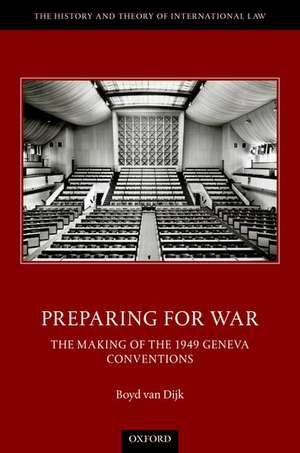
Preparing for War: The Making of the Geneva Conventions: The History and Theory of International Law
Autor Boyd van Dijken Limba Engleză Hardback – 3 feb 2022
Din seria The History and Theory of International Law
- 33%
 Preț: 775.63 lei
 - 33%
 Preț: 711.82 lei
 - 32%
 Preț: 712.18 lei
 - 32%
 Preț: 662.04 lei
 - 32%
 Preț: 661.92 lei
 - 32%
 Preț: 746.45 lei
 - 32%
 Preț: 691.19 lei
 - 32%
 Preț: 1127.05 lei
 - 32%
 Preț: 694.78 lei
 - 32%
 Preț: 861.45 lei
 - 31%
 Preț: 806.99 lei
 - 31%
 Preț: 876.11 lei
 - 17%
 Preț: 289.00 lei
 - 31%
 Preț: 873.87 lei
 - 31%
 Preț: 826.96 lei
 - 31%
 Preț: 679.75 lei
 - 30%
 Preț: 763.04 lei
 - 31%
 Preț: 709.97 lei
 - 31%
 Preț: 742.32 lei
 - 31%
 Preț: 724.44 lei
 - 14%
 Preț: 776.19 lei
 - 31%
 Preț: 711.90 lei
 - 31%
 Preț: 1003.92 lei
 - 31%
 Preț: 694.37 lei
 - 31%
 Preț: 758.33 lei
 - 17%
 Preț: 743.46 lei
 - 14%
 Preț: 1027.50 lei
 - 31%
 Preț: 744.81 lei
 - 31%
 Preț: 938.05 lei
 - 30%
 Preț: 878.89 lei
 - 29%
 Preț: 857.31 lei
 - 31%
 Preț: 658.63 lei
 - 32%
 Preț: 696.37 lei
 - 31%
 Preț: 925.85 lei
 - 30%
 Preț: 797.54 lei
 - 31%
 Preț: 677.52 lei
 - 17%
 Preț: 255.97 lei
 - 30%
 Preț: 1133.44 lei
 - 31%
 Preț: 693.02 lei
Preț: 797.60 lei
Preț vechi: 1171.59 lei
-32%
Puncte Express: 1196
Carte disponibilă
Livrare economică 13-18 noiembrie
Livrare prin curier în România Termenul estimat este afișat lângă disponibilitate.
Transport gratuit pentru acest produs Plată online sau ramburs, în funcție de opțiunile comenzii.
Retur gratuit în 14 zile Comandă securizată și suport în română.
Specificații
ISBN-13: 9780198868071
ISBN-10: 0198868073
Pagini: 400
Dimensiuni: 162 x 240 x 25 mm
Greutate: 0.79 kg
Editura: OUP OXFORD
Colecția OUP Oxford
Seria The History and Theory of International Law
Locul publicării:Oxford, United Kingdom
ISBN-10: 0198868073
Pagini: 400
Dimensiuni: 162 x 240 x 25 mm
Greutate: 0.79 kg
Editura: OUP OXFORD
Colecția OUP Oxford
Seria The History and Theory of International Law
Locul publicării:Oxford, United Kingdom
Recenzii
Preparing for War. The Making of the Geneva Conventions offers us a thick historical contextualization of pressing issues.
In sum, van Dijk's reverse-weaving provides us a much more nuanced picture of not only what was included but also of what was excluded from the fabric of the 1949 Conventions. It offers, I suggest, an illustrative template of what contemporary international legal history should look like as it brings together the lessons learned from more than two decades of rich scholarship on the relationship between comparative legal history, on the one hand, and politics, the theory and history of international law, and imperialism, on the other.
The best legal history illuminates outcomes while resisting celebratory or cynical determinism. Dr van Dijk's new history of the Geneva Conventions and humanitarianism in war is a masterpiece of methodological and conceptual sophistication. Through meticulous archival research and critical analysis, van Dijk recovers a multitude of voices and possibilities in the making of the law of war we have, and the ways we might imagine its unrealized potential.
In Preparing for War, Boyd van Dijk provides a most welcome update to the history of international humanitarian law. The hallmark of this deeply researched analysis of the 1949 Geneva Conventions is its simultaneous attention to politics and history. In exposing the constant tension between politics and humanitarianism, van Dijk reminds us of the perpetually unfinished nature of the project of humanizing war.
Van Dijk's riveting book is the culmination of a decade of new histories of international law, marking the arrival of professional research methods and independent critical analysis to the study of international law's most hallowed texts: the Geneva Conventions. Van Dijk's account of the drafting of the Conventions reveals them to be the products not merely of humanitarian ideals inspired by the horrors of war, but also of fierce Cold War contests and colonial rivalries. Highly recommended.
Nothing was inevitable in the drafting of the Geneva Conventions, Boyd van Dijk argues in this important and exciting revisionist work. The author's expansive multi-lingual archival research enables him to reconceive this history by tracing the genealogy of the drafting, revealing the Articles' contingency. Drafters had directly experienced the brutality of total war, and this informed their efforts to protect civilians. Women, like French resistance fighter Andrée Jacob, played crucial roles. Cold War politics mattered, but adversaries nevertheless collaborated on matters that served their common interests. This outstanding work will influence the next generation of writing on the Geneva Conventions.
Boyd van Dijk has written a superb political and legal history of the making of the four Geneva Conventions.
Preparing for War is a fascinating read. Dr Boyd van Dijk takes us to the heart of the negotiations and lets us see into the minds of the key players.
Van Dijk's book is excellent for exposing this dynamic in relation to the geneva conventions and for unearthing some of the politics behind those crucial treaties. Preparing for War is a compelling read. It is powerfully written and offers us the richest and most nuanced account of the negotiations leading to adoption of the Geneva Conventions currently on offer.
Preparing for War - The Making of the Geneva Conventions is a book no international humanitarian law scholar should miss. It is a truly interdisciplinary piece of scholarship, which masterfully handles history, political science and international law in telling the story of the drafting and negotiation of the 1949 Geneva Conventions.
Boyd van Dijk's Preparing for War offers a rich historical account of the drafting process of the 1949 Geneva Conventions which goes beyond the usual triumphalist rhetoric and uncovers the behind the scenes strategies, struggles and coincidences.
Boyd van Dijk has done an invaluable job. He presents in detail the diverse controversies and opposing opinions amongst different states, whether in or outside the Western, Eastern, or 'Third World' blocs, that arose during the discussion and writing of the fourth Convention and rewriting the first, second and third. In doing so he made his book a priceless contribution to the history of humanitarianism, the laws of warfare, the Red Cross, and international relations.
In sum, van Dijk's reverse-weaving provides us a much more nuanced picture of not only what was included but also of what was excluded from the fabric of the 1949 Conventions. It offers, I suggest, an illustrative template of what contemporary international legal history should look like as it brings together the lessons learned from more than two decades of rich scholarship on the relationship between comparative legal history, on the one hand, and politics, the theory and history of international law, and imperialism, on the other.
The best legal history illuminates outcomes while resisting celebratory or cynical determinism. Dr van Dijk's new history of the Geneva Conventions and humanitarianism in war is a masterpiece of methodological and conceptual sophistication. Through meticulous archival research and critical analysis, van Dijk recovers a multitude of voices and possibilities in the making of the law of war we have, and the ways we might imagine its unrealized potential.
In Preparing for War, Boyd van Dijk provides a most welcome update to the history of international humanitarian law. The hallmark of this deeply researched analysis of the 1949 Geneva Conventions is its simultaneous attention to politics and history. In exposing the constant tension between politics and humanitarianism, van Dijk reminds us of the perpetually unfinished nature of the project of humanizing war.
Van Dijk's riveting book is the culmination of a decade of new histories of international law, marking the arrival of professional research methods and independent critical analysis to the study of international law's most hallowed texts: the Geneva Conventions. Van Dijk's account of the drafting of the Conventions reveals them to be the products not merely of humanitarian ideals inspired by the horrors of war, but also of fierce Cold War contests and colonial rivalries. Highly recommended.
Nothing was inevitable in the drafting of the Geneva Conventions, Boyd van Dijk argues in this important and exciting revisionist work. The author's expansive multi-lingual archival research enables him to reconceive this history by tracing the genealogy of the drafting, revealing the Articles' contingency. Drafters had directly experienced the brutality of total war, and this informed their efforts to protect civilians. Women, like French resistance fighter Andrée Jacob, played crucial roles. Cold War politics mattered, but adversaries nevertheless collaborated on matters that served their common interests. This outstanding work will influence the next generation of writing on the Geneva Conventions.
Boyd van Dijk has written a superb political and legal history of the making of the four Geneva Conventions.
Preparing for War is a fascinating read. Dr Boyd van Dijk takes us to the heart of the negotiations and lets us see into the minds of the key players.
Van Dijk's book is excellent for exposing this dynamic in relation to the geneva conventions and for unearthing some of the politics behind those crucial treaties. Preparing for War is a compelling read. It is powerfully written and offers us the richest and most nuanced account of the negotiations leading to adoption of the Geneva Conventions currently on offer.
Preparing for War - The Making of the Geneva Conventions is a book no international humanitarian law scholar should miss. It is a truly interdisciplinary piece of scholarship, which masterfully handles history, political science and international law in telling the story of the drafting and negotiation of the 1949 Geneva Conventions.
Boyd van Dijk's Preparing for War offers a rich historical account of the drafting process of the 1949 Geneva Conventions which goes beyond the usual triumphalist rhetoric and uncovers the behind the scenes strategies, struggles and coincidences.
Boyd van Dijk has done an invaluable job. He presents in detail the diverse controversies and opposing opinions amongst different states, whether in or outside the Western, Eastern, or 'Third World' blocs, that arose during the discussion and writing of the fourth Convention and rewriting the first, second and third. In doing so he made his book a priceless contribution to the history of humanitarianism, the laws of warfare, the Red Cross, and international relations.
Notă biografică
Boyd van Dijk is a McKenzie Fellow at the University of Melbourne, Australia. He taught previously at the London School of Economics, King's College London, Queen Mary, and the University of Amsterdam.