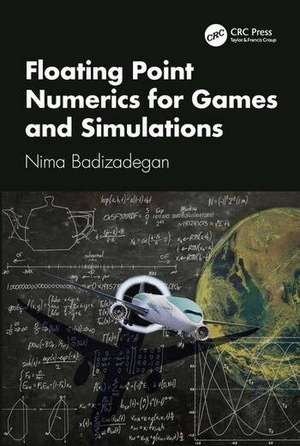
Floating Point Numerics for Games and Simulations
Autor Nima Badizadeganen Limba Engleză Paperback – 29 mai 2025
This book pulls back the veil on floating point and shows how this number system we program with every day works. It discusses how to leverage the number system for common calculations, particularly in graphics and simulations, and avoid pitfalls. Further, we will review methods that can give you either better performance or better accuracy on tasks like numerical integration and function approximation, so you can learn to make the right tradeoffs in your programs.
This book builds upon a basic knowledge of calculus and linear algebra, working with illustrative examples that demonstrate concepts rather than relying on theoretical proofs. Along the way, we will learn why Minecraft has struggled with boat physics and what the heck John Carmack was thinking with Quake III’s infamous fast reciprocal square root algorithm. By the end of the book, you will be able to understand how to work with floating point in a practical sense, from tracking down and preventing error in small calculations to choosing numerical building blocks for complex 3D simulations.
- Gives insight into how and why floating-point math works
- Describes how floating-point error arises and how to avoid it
- Surveys numerical methods important to graphics and numerical simulations
- Includes modern techniques to apply to your numerical problems
- Shows how to hack the floating-point numbers to compute faster and more accurately
Preț: 463.29 lei
Preț vechi: 579.12 lei
-20%
Puncte Express: 695
Carte disponibilă
Livrare economică 27 octombrie-10 noiembrie
Livrare express 10-16 octombrie pentru 30.26 lei
Livrare prin curier în România Termenul estimat este afișat lângă disponibilitate.
Transport gratuit pentru acest produs Plată online sau ramburs, în funcție de opțiunile comenzii.
Retur gratuit în 14 zile Comandă securizată și suport în română.
Specificații
ISBN-13: 9781032933559
ISBN-10: 1032933550
Pagini: 230
Ilustrații: 122
Dimensiuni: 156 x 234 x 13 mm
Greutate: 0.43 kg
Ediția:1
Editura: CRC Press
Colecția CRC Press
ISBN-10: 1032933550
Pagini: 230
Ilustrații: 122
Dimensiuni: 156 x 234 x 13 mm
Greutate: 0.43 kg
Ediția:1
Editura: CRC Press
Colecția CRC Press
V-ar putea interesa
-
 -28%Preț: 585.31 lei816.83 lei
 -
 Humble PiMatt Parker-31%Preț: 63.54 lei92.14 lei
 -
 Concrete MathematicsRonald Graham-20%Preț: 548.51 lei685.64 lei
 -
 Hacker's DelightHenry Warren-20%Preț: 334.52 lei418.15 lei
 -
 SimulationSheldon M. Ross-33%Preț: 498.61 lei738.95 lei
 -
 How to Calculate QuicklyHenry StickerPreț: 71.63 lei
 -
 The ScoreC. Thi NguyenPreț: 192.98 lei
 -
 Success Is a Numbers GameKyle Austin Young-19%Preț: 119.49 lei148.16 lei
 -
 Preț: 81.02 lei
 -
 Maths All Around You: MeasurementsRob Colson-38%Preț: 50.75 lei81.26 lei
 -
 -35%Preț: 118.65 lei182.87 lei
 -
 Math for ProgrammingRonald T. Kneusel-35%Preț: 242.38 lei372.72 lei
 -
 The Nature of Code: Simulating Natural Systems with JavaScriptDaniel Shiffman-34%Preț: 210.97 lei321.56 lei
 -
 Preț: 350.43 lei
 -
 Preț: 325.09 lei
 -
 A Year in NumbersKyle D. EvansPreț: 78.92 lei
 -
 -20%Preț: 393.93 lei492.41 lei
 -
 Robin Hood MathNoah GiansiracusaPreț: 133.06 lei
Public țintă
Professional Practice & Development and Professional ReferenceCuprins
1 Computing with Numbers, 2 Numbers in Floating Point, 3 Sources of Error, 4 The Basic Arithmetic Operations, 5 Comparing Floating-Point Numbers, 6 Conversion to and from Floating Point, 7 Numerical Operations, 8 Bitwise Manipulations, 9 Working with Error in Floating Point, 10 Function Approximation, 11 Geometry in Floating Point, 12 Numerical Integration
Notă biografică
Nima Badizadegan is an engineer who works at the intersection of computer systems and mathematics. His past experience includes work at Google and on Wall Street, as well as being a consultant and startup founder. Badizadegan has several publications in the fields of simulation and computer arithmetic and is the inventor of over 10 patents. He is a member of the IEEE and ACM and contributes to the IEEE 754 floating point standard. He is the author of the popular technical blog Speculative Branches (https://specbranch.com), where he writes about computer systems, software engineering, and math.
Descriere
Floating point is ubiquitous in computers, where it is the default way to represent non-integer numbers. However, few people understand it. We all see weird behavior sometimes, and many programmers treat it as a mystical and imprecise system of math that just works until it sometimes doesn’t.