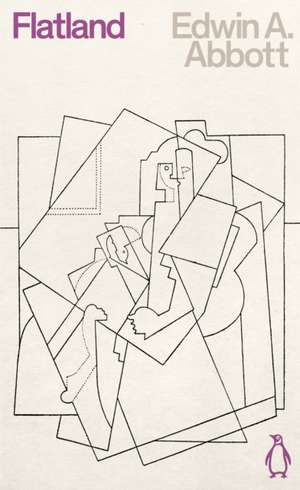
Flatland: Penguin Science Fiction
Autor Edwin Abbotten Limba Engleză Paperback – 6 aug 2020
'At once a playful brainteaser about geometry, a pointed satire of Victorian manners - and a strangely compelling argument about the greatest mysteries of the Universe' Wall Street Journal
'Flatland could lead to very profound thought about our Universe and ourselves' Isaac Asimov
Din seria Penguin Science Fiction
- 26%
 Preț: 53.72 lei
 - 25%
 Preț: 53.85 lei
 - 26%
 Preț: 53.42 lei
 - 26%
 Preț: 52.78 lei
 - 27%
 Preț: 51.87 lei
 - 26%
 Preț: 53.52 lei
 - 27%
 Preț: 52.03 lei
 - 18%
 Preț: 53.39 lei
 - 27%
 Preț: 52.05 lei
 - 27%
 Preț: 51.58 lei
 - 26%
 Preț: 52.90 lei
 - 26%
 Preț: 53.07 lei
 - 26%
 Preț: 52.78 lei
 - 26%
 Preț: 53.26 lei
 - 19%
 Preț: 52.26 lei
 - 26%
 Preț: 52.39 lei
Preț: 51.48 lei
Preț vechi: 70.66 lei
-27%
Puncte Express: 77
Carte disponibilă
Livrare economică 19-25 noiembrie
Livrare express 30 octombrie-05 noiembrie pentru 33.90 lei
Livrare prin curier în România Termenul estimat este afișat lângă disponibilitate.
Transport gratuit de la 400.00 lei Plată online sau ramburs, în funcție de opțiunile comenzii.
Retur gratuit în 14 zile Comandă securizată și suport în română.
Specificații
ISBN-13: 9780241441572
ISBN-10: 0241441579
Pagini: 137
Dimensiuni: 113 x 179 x 15 mm
Greutate: 0.1 kg
Editura: Penguin Books
Colecția Penguin Classics
Seria Penguin Science Fiction
Locul publicării:London, United Kingdom
ISBN-10: 0241441579
Pagini: 137
Dimensiuni: 113 x 179 x 15 mm
Greutate: 0.1 kg
Editura: Penguin Books
Colecția Penguin Classics
Seria Penguin Science Fiction
Locul publicării:London, United Kingdom
V-ar putea interesa
-
 Brave New WorldAldous HuxleyPreț: 58.71 lei
 -
 Aspects of the NovelE. M. Forster-26%Preț: 57.92 lei78.50 lei
 -
 Preț: 203.40 lei
 -
 FlatlandEdwin A. AbbottPreț: 38.49 lei
 -
 -14%Preț: 136.85 lei159.03 lei
 -
 -24%Preț: 146.90 lei192.22 lei
 -
 -34%Preț: 149.68 lei227.27 lei
 -
 Einstein's Theory of RelativityMax BornPreț: 89.74 lei
 -
 Preț: 90.82 lei
 -
 CandideVoltairePreț: 32.48 lei
 -
 FlatterlandIan StewartPreț: 154.05 lei
 -
 A Modern UtopiaH. G. WellsPreț: 51.18 lei
 -
 FlatlandEdwin Abbott AbbottPreț: 46.70 lei
 -
 Science and HypothesisHenri PoincarPreț: 116.46 lei
 -
 The Book of RevelationsJuliet NicolsonPreț: 159.06 lei
 -
 Once Upon a Time in SpaceJames BluemelPreț: 215.96 lei
 -
 Unequal: The Maths of When Things Do and Don’t Add UpEugenia ChengPreț: 138.27 lei
 -
 The MultiverseBrian CleggPreț: 77.29 lei
 -
 Man's Search For MeaningViktor E. Frankl-26%Preț: 62.83 lei84.79 lei
 -
 Preț: 63.54 lei
 -
 Preț: 34.20 lei
 -
 The Time MachineH. G. WellsPreț: 33.23 lei
 -
 The Man Who Was ThursdayG. K. ChestertonPreț: 38.95 lei
 -
 UtopiaThomas MorePreț: 33.19 lei
 -
 Relativity: The Special and the General TheoryAlbert EinsteinPreț: 39.70 lei
Notă biografică
Edwin A. Abbott (1838 - 1926) was a leading scholar of the Victorian period. A schoolmaster from the age of 26, Abbott oversaw the education of many luminaries of the Edwardian era and beyond, including Prime Minister H. H. Asquith. In his retirement, Abbott devoted himself to writing theological discussions and biographies. In 1884, he wrote Flatland, a highly original work of satirical science-fiction that is now considered a canonical example of the genre.
Recenzii
At once a classic of science fiction, a playful brainteaser about geometry, a pointed satire of Victorian manners - and, finally, a strangely compelling argument about reason, faith, and the greatest mysteries of the universe
Descriere
Descriere de la o altă ediție sau format:
Flatland (1884) is an influential mathematical fantasy that simultaneously provides an introduction to non-Euclidean geometry and a satire on the Victorian class structure, issues of science and faith, and the role of women. A classic of early science fiction, the novel takes place in a world of two dimensions where all the characters are geometric shapes. The narrator, A Square, is a naïve, respectable citizen who is faced with proof of the existence of three dimensions when he is visited by a sphere and is forced to see the limitations of his world.
The introduction to this Broadview Edition provides context for the book’s references to Victorian culture and religion, mathematical history, and the history of philosophy. The appendices contain contemporary reviews; extracts from the work of fellow mathematical fantasy writer/mathematician Charles Hinton; Hermann von Helmboltz’s “The Axioms of Geometry” (1870); and autobiographical passages from Abbott’s The Kernel and the Husk (1886).
Flatland (1884) is an influential mathematical fantasy that simultaneously provides an introduction to non-Euclidean geometry and a satire on the Victorian class structure, issues of science and faith, and the role of women. A classic of early science fiction, the novel takes place in a world of two dimensions where all the characters are geometric shapes. The narrator, A Square, is a naïve, respectable citizen who is faced with proof of the existence of three dimensions when he is visited by a sphere and is forced to see the limitations of his world.
The introduction to this Broadview Edition provides context for the book’s references to Victorian culture and religion, mathematical history, and the history of philosophy. The appendices contain contemporary reviews; extracts from the work of fellow mathematical fantasy writer/mathematician Charles Hinton; Hermann von Helmboltz’s “The Axioms of Geometry” (1870); and autobiographical passages from Abbott’s The Kernel and the Husk (1886).
Cuprins
Acknowledgements
Introduction
Edwin Abbott Abbott: A Brief Chronology
A Note on the Text
Flatland: A Romance of Many Dimensions
Appendix A: Contemporary Reviews
Introduction
Edwin Abbott Abbott: A Brief Chronology
A Note on the Text
Flatland: A Romance of Many Dimensions
Appendix A: Contemporary Reviews
- The Oxford Magazine (5 November 1884)
- From The Literary World (14 November 1884)
- The Exchange with The Athenaeum (November-December 1884)
- The Architect (15 November 1884)
- R.Tucker, Nature (27 November 1884)
- New York Times (23 February 1885)
- From the New York Tribune (6 March 1885)
- Advertisement Run by Robert Brothers Publishers in The Literary World (21 March 1885)
- From Benjamin Jowett’s Translation of Plato’s Republic (1871)
- From Hermann von Helmholtz, “The Axioms of Geometry” (1870)
- From Fyodor Dostoyevsky, The Brothers Karamazov(1879-80)
- From C.H. Hinton, “What is the Fourth Dimension?” (1884)
- From The Kernel and the Husk (1886)
- From The Spirit on the Water:The Evolution of the Divine From the Human (1897)
- From A.T. Schofield, Another World (1905)
- From C.H. Hinton, The Fourth Dimension (1904)
- From C.H. Hinton, An Episode of Flatland: or How a Plane Folk Discovered the Third Dimension (1907)
- Macmillan’s Catalog of Geometry Textbooks (1884)
- From Euclid’s Elements
- The T.H. Huxley–J.J. Sylvester Debate (1869-77)