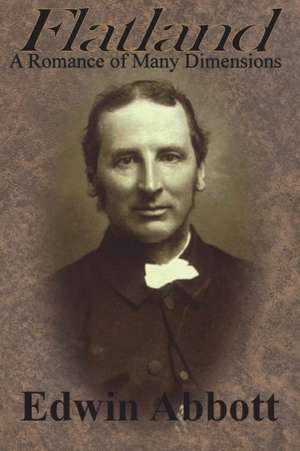
Flatland
Autor Edwin Abbotten Limba Engleză Paperback – 18 oct 2017
Preț: 31.81 lei
Puncte Express: 48
Carte tipărită la comandă
Livrare economică 05-19 septembrie
Livrare prin curier în România Termenul estimat este afișat lângă disponibilitate.
Transport gratuit de la 400.00 lei Plată online sau ramburs, în funcție de opțiunile comenzii.
Retur gratuit în 14 zile Comandă securizată și suport în română.
Specificații
ISBN-13: 9781640320833
ISBN-10: 1640320830
Pagini: 46
Dimensiuni: 156 x 234 x 4 mm
Greutate: 0.09 kg
Editura: Chump Change
ISBN-10: 1640320830
Pagini: 46
Dimensiuni: 156 x 234 x 4 mm
Greutate: 0.09 kg
Editura: Chump Change
V-ar putea interesa
-
 Brave New WorldAldous HuxleyPreț: 57.28 lei
 -
 Aspects of the NovelE. M. Forster-27%Preț: 56.53 lei77.28 lei
 -
 Preț: 195.33 lei
 -
 FlatlandEdwin A. AbbottPreț: 36.59 lei
 -
 -15%Preț: 133.27 lei156.71 lei
 -
 Geometry, Relativity and the Fourth DimensionRudolf RuckerPreț: 87.51 lei
 -
 -24%Preț: 142.96 lei189.22 lei
 -
 -24%Preț: 144.80 lei190.94 lei
 -
 Preț: 89.74 lei
 -
 Preț: 89.39 lei
 -
 CandideVoltairePreț: 31.40 lei
 -
 FlatterlandIan StewartPreț: 147.59 lei
 -
 A Modern UtopiaH. G. WellsPreț: 51.18 lei
 -
 FlatlandEdwin Abbott AbbottPreț: 46.70 lei
 -
 Science and HypothesisHenri PoincarPreț: 112.62 lei
 -
 The Book of RevelationsJuliet NicolsonPreț: 156.57 lei
 -
 Once Upon a Time in SpaceJames BluemelPreț: 212.89 lei
 -
 Unequal: The Maths of When Things Do and Don’t Add UpEugenia Cheng-19%Preț: 110.68 lei136.15 lei
 -
 The MultiverseBrian CleggPreț: 77.15 lei
 -
 Man's Search For MeaningViktor E. Frankl-27%Preț: 60.75 lei83.48 lei
 -
 Man's Search For MeaningViktor E. FranklPreț: 62.55 lei
 -
 The Importance of Being EarnestOscar WildePreț: 31.83 lei
 -
 The Time MachineH. G. WellsPreț: 31.83 lei
 -
 The Man Who Was ThursdayG. K. ChestertonPreț: 38.95 lei
 -
 UtopiaThomas MorePreț: 33.19 lei
 -
 Preț: 38.35 lei
Notă biografică
Edwin A. Abbott (1838 - 1926) was a leading scholar of the Victorian period. A schoolmaster from the age of 26, Abbott oversaw the education of many luminaries of the Edwardian era and beyond, including Prime Minister H. H. Asquith. In his retirement, Abbott devoted himself to writing theological discussions and biographies. In 1884, he wrote Flatland, a highly original work of satirical science-fiction that is now considered a canonical example of the genre.
Recenzii
Flatland (1884) is an influential mathematical fantasy that simultaneously provides an introduction to non-Euclidean geometry and a satire on the Victorian class structure, issues of science and faith, and the role of women. A classic of early science fiction, the novel takes place in a world of two dimensions where all the characters are geometric shapes. The narrator, A Square, is a naïve, respectable citizen who is faced with proof of the existence of three dimensions when he is visited by a sphere and is forced to see the limitations of his world.
The introduction to this Broadview Edition provides context for the book’s references to Victorian culture and religion, mathematical history, and the history of philosophy. The appendices contain contemporary reviews; extracts from the work of fellow mathematical fantasy writer/mathematician Charles Hinton; Hermann von Helmboltz’s “The Axioms of Geometry” (1870); and autobiographical passages from Abbott’s The Kernel and the Husk (1886).
“Part mathematical exploration, part satire, and part fairy tale, Flatland: A Romance of Many Dimensions by Edwin Abbot has been around for more than a century and remains a standard in mathematics education…The Broadview Edition of the book combines the text with a variety of notes and essays that enhance the reading and study of this classic.” — Bill Wood, The Mathematical Association of America
“Handing its reader the full range of Abbott’s cultural sources and pedagogical motives in one volume, Lila Marz Harper’s edition of Flatland is a welcome event. Her detailed introduction provides a comprehensive overview of Flatland’s intellectual landscape and a generous sampling of current critical discussion. The content of the appendices is well chosen; especially useful is the lengthy selection from Jowett’s translation of Plato’s allegory of the Cave. Placing Abbott’s perennial mathematical parable and curious social critique squarely into its Victorian contexts, Harper also traces Flatland’s deep philosophical roots and spiritual aspirations.” — Bruce Clarke, Texas Tech University
“Among the most enduring works of Victorian fiction, Flatland justly continues to attract both popular and scholarly attention. Lila Marz Harper’s richly annotated edition rewards readers by illuminating a variety of perspectives that can be profitably adopted when exploring Abbott’s imaginative worlds today. Her introduction effectively contextualizes Flatland as reflecting mathematical innovations, progressive hermeneutics, spiritualism, social institutions, and national identity in nineteenth-century England. The meticulously compiled appendices are invaluable for providing contemporaneous responses and intellectual alternatives to, as well as appropriations of, Abbott’s genre-defying work. Harper has made an outstanding, multidimensional contribution to Flatland scholarship.” — K. G. Valente, Colgate University
The introduction to this Broadview Edition provides context for the book’s references to Victorian culture and religion, mathematical history, and the history of philosophy. The appendices contain contemporary reviews; extracts from the work of fellow mathematical fantasy writer/mathematician Charles Hinton; Hermann von Helmboltz’s “The Axioms of Geometry” (1870); and autobiographical passages from Abbott’s The Kernel and the Husk (1886).
“Part mathematical exploration, part satire, and part fairy tale, Flatland: A Romance of Many Dimensions by Edwin Abbot has been around for more than a century and remains a standard in mathematics education…The Broadview Edition of the book combines the text with a variety of notes and essays that enhance the reading and study of this classic.” — Bill Wood, The Mathematical Association of America
“Handing its reader the full range of Abbott’s cultural sources and pedagogical motives in one volume, Lila Marz Harper’s edition of Flatland is a welcome event. Her detailed introduction provides a comprehensive overview of Flatland’s intellectual landscape and a generous sampling of current critical discussion. The content of the appendices is well chosen; especially useful is the lengthy selection from Jowett’s translation of Plato’s allegory of the Cave. Placing Abbott’s perennial mathematical parable and curious social critique squarely into its Victorian contexts, Harper also traces Flatland’s deep philosophical roots and spiritual aspirations.” — Bruce Clarke, Texas Tech University
“Among the most enduring works of Victorian fiction, Flatland justly continues to attract both popular and scholarly attention. Lila Marz Harper’s richly annotated edition rewards readers by illuminating a variety of perspectives that can be profitably adopted when exploring Abbott’s imaginative worlds today. Her introduction effectively contextualizes Flatland as reflecting mathematical innovations, progressive hermeneutics, spiritualism, social institutions, and national identity in nineteenth-century England. The meticulously compiled appendices are invaluable for providing contemporaneous responses and intellectual alternatives to, as well as appropriations of, Abbott’s genre-defying work. Harper has made an outstanding, multidimensional contribution to Flatland scholarship.” — K. G. Valente, Colgate University
Descriere
Descriere de la o altă ediție sau format:
Flatland (1884) is an influential mathematical fantasy that simultaneously provides an introduction to non-Euclidean geometry and a satire on the Victorian class structure, issues of science and faith, and the role of women. A classic of early science fiction, the novel takes place in a world of two dimensions where all the characters are geometric shapes. The narrator, A Square, is a naïve, respectable citizen who is faced with proof of the existence of three dimensions when he is visited by a sphere and is forced to see the limitations of his world.
The introduction to this Broadview Edition provides context for the book’s references to Victorian culture and religion, mathematical history, and the history of philosophy. The appendices contain contemporary reviews; extracts from the work of fellow mathematical fantasy writer/mathematician Charles Hinton; Hermann von Helmboltz’s “The Axioms of Geometry” (1870); and autobiographical passages from Abbott’s The Kernel and the Husk (1886).
Flatland (1884) is an influential mathematical fantasy that simultaneously provides an introduction to non-Euclidean geometry and a satire on the Victorian class structure, issues of science and faith, and the role of women. A classic of early science fiction, the novel takes place in a world of two dimensions where all the characters are geometric shapes. The narrator, A Square, is a naïve, respectable citizen who is faced with proof of the existence of three dimensions when he is visited by a sphere and is forced to see the limitations of his world.
The introduction to this Broadview Edition provides context for the book’s references to Victorian culture and religion, mathematical history, and the history of philosophy. The appendices contain contemporary reviews; extracts from the work of fellow mathematical fantasy writer/mathematician Charles Hinton; Hermann von Helmboltz’s “The Axioms of Geometry” (1870); and autobiographical passages from Abbott’s The Kernel and the Husk (1886).
Cuprins
Acknowledgements
Introduction
Edwin Abbott Abbott: A Brief Chronology
A Note on the Text
Flatland: A Romance of Many Dimensions
Appendix A: Contemporary Reviews
Introduction
Edwin Abbott Abbott: A Brief Chronology
A Note on the Text
Flatland: A Romance of Many Dimensions
Appendix A: Contemporary Reviews
- The Oxford Magazine (5 November 1884)
- From The Literary World (14 November 1884)
- The Exchange with The Athenaeum (November-December 1884)
- The Architect (15 November 1884)
- R.Tucker, Nature (27 November 1884)
- New York Times (23 February 1885)
- From the New York Tribune (6 March 1885)
- Advertisement Run by Robert Brothers Publishers in The Literary World (21 March 1885)
- From Benjamin Jowett’s Translation of Plato’s Republic (1871)
- From Hermann von Helmholtz, “The Axioms of Geometry” (1870)
- From Fyodor Dostoyevsky, The Brothers Karamazov(1879-80)
- From C.H. Hinton, “What is the Fourth Dimension?” (1884)
- From The Kernel and the Husk (1886)
- From The Spirit on the Water:The Evolution of the Divine From the Human (1897)
- From A.T. Schofield, Another World (1905)
- From C.H. Hinton, The Fourth Dimension (1904)
- From C.H. Hinton, An Episode of Flatland: or How a Plane Folk Discovered the Third Dimension (1907)
- Macmillan’s Catalog of Geometry Textbooks (1884)
- From Euclid’s Elements
- The T.H. Huxley–J.J. Sylvester Debate (1869-77)