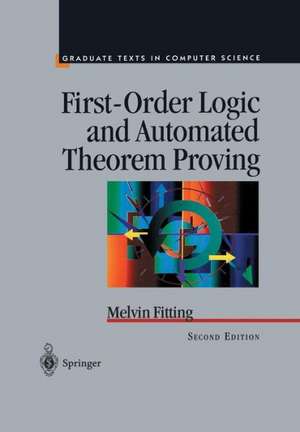
First-Order Logic and Automated Theorem Proving: Texts in Computer Science
Autor Melvin Fittingen Limba Engleză Paperback – 26 iun 2013
Din seria Texts in Computer Science
- 20%
 Preț: 507.43 lei
 - 17%
 Preț: 432.01 lei
 - 20%
 Preț: 398.91 lei
 - 20%
 Preț: 330.09 lei
 - 20%
 Preț: 501.79 lei
 - 20%
 Preț: 424.97 lei
 - 17%
 Preț: 396.70 lei
 - 15%
 Preț: 617.83 lei
 - 20%
 Preț: 469.65 lei
 - 20%
 Preț: 341.46 lei
 - 20%
 Preț: 382.84 lei
 - 20%
 Preț: 369.06 lei
 - 20%
 Preț: 365.42 lei
 - 20%
 Preț: 568.86 lei
 - 20%
 Preț: 400.45 lei
 - 23%
 Preț: 758.41 lei
 - 20%
 Preț: 325.29 lei
 - 24%
 Preț: 310.97 lei
 - 20%
 Preț: 570.30 lei
 - 20%
 Preț: 320.09 lei
 - 20%
 Preț: 636.67 lei
 - 20%
 Preț: 469.91 lei
 - 20%
 Preț: 344.57 lei
 - 20%
 Preț: 825.19 lei
 - 20%
 Preț: 335.11 lei
 - 20%
 Preț: 597.66 lei
 - 20%
 Preț: 335.61 lei
 - 20%
 Preț: 331.42 lei
 - 20%
 Preț: 665.88 lei
 -
 Preț: 491.23 lei
 - 20%
 Preț: 463.56 lei
 - 15%
 Preț: 727.69 lei
 -
 Preț: 401.78 lei
 - 20%
 Preț: 583.46 lei
 - 20%
 Preț: 645.78 lei
 - 20%
 Preț: 492.01 lei
 - 20%
 Preț: 333.38 lei
 - 20%
 Preț: 526.25 lei
Preț: 574.48 lei
Preț vechi: 718.10 lei
-20%
Puncte Express: 862
Carte tipărită la comandă
Livrare economică 09-23 iunie
Specificații
ISBN-13: 9781461275152
ISBN-10: 1461275156
Pagini: 348
Ilustrații: XVIII, 326 p.
Dimensiuni: 170 x 244 x 19 mm
Greutate: 0.6 kg
Ediția:Second Edition 1996
Editura: Springer
Colecția Texts in Computer Science
Seria Texts in Computer Science
Locul publicării:New York, NY, United States
ISBN-10: 1461275156
Pagini: 348
Ilustrații: XVIII, 326 p.
Dimensiuni: 170 x 244 x 19 mm
Greutate: 0.6 kg
Ediția:Second Edition 1996
Editura: Springer
Colecția Texts in Computer Science
Seria Texts in Computer Science
Locul publicării:New York, NY, United States
V-ar putea interesa
-
 Elements of Set TheoryHerbert B. Enderton-33%Preț: 358.00 lei532.16 lei
 -
 Conceptual Notation and Related ArticlesGottlob Frege-32%Preț: 766.03 lei1124.79 lei
 -
 -24%Preț: 361.70 lei474.98 lei
 -
 -34%Preț: 630.11 lei959.82 lei
 -
 Automorphisms of First-order StructuresRichard Kaye-33%Preț: 596.09 lei895.18 lei
 -
 -15%Preț: 570.70 lei671.41 lei
 -
 Godel's ProofErnest NagelPreț: 124.36 lei
 -
 TopoiRobert Goldblatt-25%Preț: 151.43 lei201.66 lei
 -
 Axiomatic Set TheoryPatrick SuppesPreț: 99.54 lei
 -
 First-Order LogicRaymond M. SmullyanPreț: 60.18 lei
 -
 Mathematical Logic for Computer ScienceMordechai Ben-Ari-20%Preț: 380.61 lei475.76 lei
 -
 The Joy of SetsKeith Devlin-15%Preț: 420.01 lei494.14 lei
 -
 Preț: 474.26 lei
 -
 Sets, Logic and CategoriesPeter J. CameronPreț: 272.04 lei
 -
 Incompleteness in the Land of SetsM. FittingPreț: 219.96 lei
 -
 Lattice Theory: Special Topics and ApplicationsGeorge Grätzer-15%Preț: 631.51 lei742.96 lei
 -
 -15%Preț: 689.64 lei811.34 lei
 -
 Theory of SetsN. BourbakiPreț: 476.32 lei
Public țintă
GraduateCuprins
1 Background.- 2 Propositional Logic.- 2.1 Introduction.- 2.2 Propositional Logic—Syntax.- 2.3 Propositional Logic—Semantics.- 2.4 Boolean Valuations.- 2.5 The Replacement Theorem.- 2.6 Uniform Notation.- 2.7 König’s Lemma.- 2.8 Normal Forms.- 2.9 Normal Form Implementations.- 3 Semantic Tableaux and Resolution.- 3.1 Propositional Semantic Tableaux.- 3.2 Propositional Tableaux Implementations.- 3.3 Propositional Resolution.- 3.4 Soundness.- 3.5 Hintikka’s Lemma.- 3.6 The Model Existence Theorem.- 3.7 Tableau and Resolution Completeness.- 3.8 Completeness With Restrictions.- 3.9 Propositional Consequence.- 4 Other Propositional Proof Procedures.- 4.1 Hilbert Systems.- 4.2 Natural Deduction.- 4.3 The Sequent Calculus.- 4.4 The Davis-Putnam Procedure.- 4.5 Computational Complexity.- 5 First-Order Logic.- 5.1 First-Order Logic—Syntax.- 5.2 Substitutions.- 5.3 First-Order Semantics.- 5.4 Herbrand Models.- 5.5 First-Order Uniform Notation.- 5.6 Hintikka’s Lemma.- 5.7 Parameters.- 5.8 The Model Existence Theorem.- 5.9 Applications.- 5.10 Logical Consequence.- 6 First-Order Proof Procedures.- 6.1 First-Order Semantic Tableaux.- 6.2 First-Order Resolution.- 6.3 Soundness.- 6.4 Completeness.- 6.5 Hilbert Systems.- 6.6 Natural Deduction and Gentzen Sequents.- 7 Implementing Tableaux and Resolution.- 7.1 What Next.- 7.2 Unification.- 7.3 Unification Implemented.- 7.4 Free-Variable Semantic Tableaux.- 7.5 A Tableau Implementation.- 7.6 Free-Variable Resolution.- 7.7 Soundness.- 7.8 Free-Variable Tableau Completeness.- 7.9 Free-Variable Resolution Completeness.- 8 Further First-Order Features.- 8.1 Introduction.- 8.2 The Replacement Theorem.- 8.3 Skolemization.- 8.4 Prenex Form.- 8.5 The AE-Calculus.- 8.6 Herbrand’s Theorem.- 8.7 Herbrand’s Theorem, Constructively.-8.8 Gentzen’s Theorem.- 8.9 Cut Elimination.- 8.10 Do Cuts Shorten Proofs?.- 8.11 Craig’s Interpolation Theorem.- 8.12 Craig’s Interpolation Theorem—Constructively.- 8.13 Beth’s Definability Theorem.- 8.14 Lyndon’s Homomorphism Theorem.- 9 Equality.- 9.1 Introduction.- 9.2 Syntax and Semantics.- 9.3 The Equality Axioms.- 9.4 Hintikka’s Lemma.- 9.5 The Model Existence Theorem.- 9.6 Consequences.- 9.7 Tableau and Resolution Systems.- 9.8 Alternate Tableau and Resolution Systems.- 9.9 A Free-Variable Tableau System With Equality.- 9.10 A Tableau Implementation With Equality.- 9.11 Paramodulation.- References.