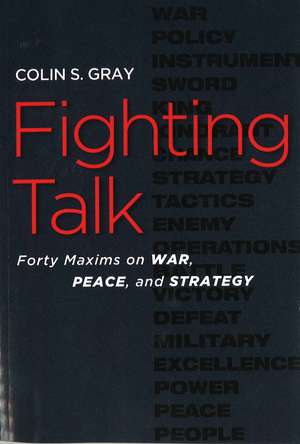
Fighting Talk: Forty Maxims on War, Peace, and Strategy
Autor Colin S. Grayen Limba Engleză Paperback – aug 2009
Colin Gray presents an inventive treatise on the nature of strategy, war, and peace, organized around forty maxims. This collection of mini essays will forearm politicians, soldiers, and the attentive general public against many—probably most— fallacies that abound in contemporary debates about war, peace, and security. While one can never guarantee strategic success, which depends on policy, military prowess, and the quality of the dialogue between the two, a strategic education led by the judgments in these maxims increases the chances that one’s errors will be small rather than catastrophic.
The maxims are grouped according to five clusters. “War and Peace” tackles the larger issues of strategic history that drive the demand for the services of strategic thought and practice. “Strategy” presses further, into the realm of strategic behavior, and serves as a bridge between the political focus of part one and the military concerns that follow. “Military Power and Warfare” turns to the pragmatic business of military performance: operations, tactics, and logistics. Part four, “Security and Insecurity,” examines why strategy is important, including a discussion of the nature, dynamic character, and functioning of world politics. Finally, “History and the Future” is meant to help strategists better understand the processes of historical change.
The maxims are grouped according to five clusters. “War and Peace” tackles the larger issues of strategic history that drive the demand for the services of strategic thought and practice. “Strategy” presses further, into the realm of strategic behavior, and serves as a bridge between the political focus of part one and the military concerns that follow. “Military Power and Warfare” turns to the pragmatic business of military performance: operations, tactics, and logistics. Part four, “Security and Insecurity,” examines why strategy is important, including a discussion of the nature, dynamic character, and functioning of world politics. Finally, “History and the Future” is meant to help strategists better understand the processes of historical change.
Preț: 113.48 lei
Puncte Express: 170
Carte disponibilă
Livrare economică 16-30 noiembrie
Livrare prin curier în România Termenul estimat este afișat lângă disponibilitate.
Transport gratuit de la 400.00 lei Plată online sau ramburs, în funcție de opțiunile comenzii.
Retur gratuit în 14 zile Comandă securizată și suport în română.
Specificații
ISBN-13: 9781597973076
ISBN-10: 1597973076
Pagini: 208
Ilustrații: notes, index
Dimensiuni: 152 x 229 x 15 mm
Greutate: 0.34 kg
Editura: Potomac Books Inc
Colecția Potomac Books
Locul publicării:United States
ISBN-10: 1597973076
Pagini: 208
Ilustrații: notes, index
Dimensiuni: 152 x 229 x 15 mm
Greutate: 0.34 kg
Editura: Potomac Books Inc
Colecția Potomac Books
Locul publicării:United States
V-ar putea interesa
-
 StalingradAntony BeevorPreț: 145.44 lei
 -
 The Practice of Strategy: From Alexander the Great to the PresentJohn Andreas Olsen-30%Preț: 768.84 lei1097.25 lei
 -
 Ardennes 1944Antony Beevor-17%Preț: 78.47 lei94.93 lei
 -
 The Future of StrategyColin S. GrayPreț: 484.39 lei
 -
 Strategic Studies and Public PolicyColin S. GrayPreț: 188.82 lei
 -
 Mein Kampf (german Language Edition)Adolf HitlerPreț: 220.55 lei
 -
 Hybrid WarfareWilliamson MurrayPreț: 264.59 lei
 -
 The Encyclopedia of Third Reich TablewareJames A. YannesPreț: 221.16 lei
 -
 The SAS 1983–2014Leigh Neville-27%Preț: 77.72 lei106.76 lei
 -
 Preț: 160.18 lei
 -
 Air Mobility: A Brief History of the American ExperienceRobert C. OwenPreț: 271.36 lei
 -
 Smart Power: Between Diplomacy and WarChristian WhitonPreț: 262.74 lei
 -
 The Civil War in the East: Struggle, Stalemate, and VictoryBrooks D. SimpsonPreț: 123.71 lei
 -
 Righting the Balance: How You Can Help Protect AmericaDaniel SerwerPreț: 150.94 lei
 -
 The Role and Limitations of Technology in U.S. Counterinsurgency WarfareRichard W. RubrightPreț: 297.15 lei
 -
 Clean Bombs and Dirty Wars: Air Power in Kosovo and LibyaRobert H. Gregory, Jr.Preț: 203.86 lei
 -
 Airpower for Strategic EffectColin S. GrayPreț: 188.74 lei
 -
 Defense Planning for National SecurityColin S. GrayPreț: 85.50 lei
 -
 Hitler, Mein Kampf: Eine kritische EditionInstitut f.Zeitgeschichte-11%Preț: 842.65 lei946.80 lei
Recenzii
"[Gray] has sustained and enhanced a reputation as the English-speaking world's leading strategic thinker. Gray's work has always eschewed abstraction for empiricism. His theoretical studies never fall prey to wishful thinking or mirror-imaging. His strategic analyses incorporate strong historical elements. Fighting Talk, though unpretentious in structure, represents the distillation of a career's worth of study and reflection in these contexts."—Journal of Military History
"Attributing his inspiration for this work to the seminal military thinker Carl von Clausewitz, Gray has come up with forty maxims of military strategy that he believes cover most of the intellectually essential elements for the education of a strategist and presents them accompanied by short explanatory essays. They are grouped into sections on war and peace, strategy, military power and warfare, security and insecurity, and history and the future."—Reference & Research Book News
Descriere
Descriere de la o altă ediție sau format:
Gray presents an inventive treatise on the nature of strategy, war, and peace, organized around forty maxims. This collection of mini-essays will forearm politicians, soldiers, and the attentive general public against many-probably most-fallacies that abound in contemporary debates about war, peace, and security. While one can never guarantee strategic success, which depends on policy, military prowess, and the quality of the dialogue between the two, a strategic education led by the judgments in these maxims increases the chances that one's errors will be small rather than catastrophic.
The maxims are grouped according to five clusters. War and Peace tackles the larger issues of strategic history that drive the demand for the services of strategic thought and practice. Strategy presses further, into the realm of strategic behavior, and serves as a bridge between the political focus of part one and the military concerns that follow. In Military Power and Warfare turns to the pragmatic business of military performance: operations, tactics, and logistics. Part four, Security and Insecurity examines why strategy is important, including a discussion of the nature, dynamic character, and functioning of world politics. Finally, History and the Future is meant to help strategists better understand the processes of historical change.
Gray presents an inventive treatise on the nature of strategy, war, and peace, organized around forty maxims. This collection of mini-essays will forearm politicians, soldiers, and the attentive general public against many-probably most-fallacies that abound in contemporary debates about war, peace, and security. While one can never guarantee strategic success, which depends on policy, military prowess, and the quality of the dialogue between the two, a strategic education led by the judgments in these maxims increases the chances that one's errors will be small rather than catastrophic.
The maxims are grouped according to five clusters. War and Peace tackles the larger issues of strategic history that drive the demand for the services of strategic thought and practice. Strategy presses further, into the realm of strategic behavior, and serves as a bridge between the political focus of part one and the military concerns that follow. In Military Power and Warfare turns to the pragmatic business of military performance: operations, tactics, and logistics. Part four, Security and Insecurity examines why strategy is important, including a discussion of the nature, dynamic character, and functioning of world politics. Finally, History and the Future is meant to help strategists better understand the processes of historical change.
Cuprins
Preface
Introduction: Getting the Big Things Right Enough
Part I: War and Peace
1 The Contexts of War Are All Important
2 War Is About Peace, and Peace Can Be About War
3 It Is More Difficult to Make Peace than It Is to Make War
4 War Works!-But Always Has Unintended and Unanticipated Consequences
5 Peace and Order Are Not Self-Enforcing, They Have to Be Organized and Kept by Somebody
6 Not Only Polities, but Societies and Their Cultures Make War and Peace
7 Reason Reigns Over War, but Passion and Chance Threaten to Rule
8 There Is More to War than Warfare
9 Policy Is King, but Often Is Ignorant of the Nature and Character of War
10 War Is Always a Gamble
Part II: Strategy
11 Knowledge of Strategy Is Vital: The Flame of Strategic Understanding Has to Be Kept Lit
12 Strategy Is More Difficult than Policy or Tactics
13 Bad Strategy Kills, but So Also Do Bad Policy and Tactics
14 If Thucydides, Sun-tzu, and Clausewitz Did Not Say It, It Probably Is Not Worth Saying
15 The Strategic "Concept du Jour" Will Be Tomorrow's Stale Left-Over, Until It Is Rediscovered, Recycled, and Revealed as a New Truth
16 The Enemy Too Has a Vote
17 Time Is the Least Forgiving Dimension of Strategy
18 Friction Is Unavoidable, but Need Not Be Fatal
19 All Strategy Is Geostrategy: Geography Is Fundamental
20 Strategy Is Not Wholly Military
21 The Impossible Is Impossible; It Is a Condition, Not a Problem for Which a Solution Has Yet to Be Found
Part III: Military Power and Warfare
22 People Matter Most
23 Military Power Is Trumps in Politics
24 Military Excellence Can Only Be Verified by Performance in War
25 Military Excellence Cannot Guarantee Strategic Success
26 Victory in Battle Does Not Ensure Strategic or Political Success, but Defeat All but Guarantees Failure
27 There Is More to War than Firepower: The Enemy Is Not Just a Target Set
28 Logistics Is the Arbiter of Strategic Opportunity
Part IV: Security and Insecurity
29 Bad Times Return
30 There Are Always Thugs, Villains, Rogues, and Fools Out There, as Well Some in Here, Who Mean Us Harm
31 Superthreats Do Appear
32 Prudence Is the Supreme Virtue in Statecraft and Strategy
33 Strategic History Punishes Good Intentions
34 Defense Costs Are Certain, but Security Benefits Are Uncertain and Arguable
35 Arms Can Be Controlled, but Not by Arms Control
Part V: History and the Future
36 Nothing of Real Importance Changes: Modern History Is Not Modern
37 History Can Be Misused to "Prove" Anything, but It Is All That We Have as a Guide to the Future
38 The Future Is Not Foreseeable: Nothing Dates So Rapidly as Today's Tomorrow
39 Surprise Is Unavoidable, but Its Effect Is Not
40 Tragedy Happens
Afterword: Cannon Lore
Notes
Bibliography
Index
Introduction: Getting the Big Things Right Enough
Part I: War and Peace
1 The Contexts of War Are All Important
2 War Is About Peace, and Peace Can Be About War
3 It Is More Difficult to Make Peace than It Is to Make War
4 War Works!-But Always Has Unintended and Unanticipated Consequences
5 Peace and Order Are Not Self-Enforcing, They Have to Be Organized and Kept by Somebody
6 Not Only Polities, but Societies and Their Cultures Make War and Peace
7 Reason Reigns Over War, but Passion and Chance Threaten to Rule
8 There Is More to War than Warfare
9 Policy Is King, but Often Is Ignorant of the Nature and Character of War
10 War Is Always a Gamble
Part II: Strategy
11 Knowledge of Strategy Is Vital: The Flame of Strategic Understanding Has to Be Kept Lit
12 Strategy Is More Difficult than Policy or Tactics
13 Bad Strategy Kills, but So Also Do Bad Policy and Tactics
14 If Thucydides, Sun-tzu, and Clausewitz Did Not Say It, It Probably Is Not Worth Saying
15 The Strategic "Concept du Jour" Will Be Tomorrow's Stale Left-Over, Until It Is Rediscovered, Recycled, and Revealed as a New Truth
16 The Enemy Too Has a Vote
17 Time Is the Least Forgiving Dimension of Strategy
18 Friction Is Unavoidable, but Need Not Be Fatal
19 All Strategy Is Geostrategy: Geography Is Fundamental
20 Strategy Is Not Wholly Military
21 The Impossible Is Impossible; It Is a Condition, Not a Problem for Which a Solution Has Yet to Be Found
Part III: Military Power and Warfare
22 People Matter Most
23 Military Power Is Trumps in Politics
24 Military Excellence Can Only Be Verified by Performance in War
25 Military Excellence Cannot Guarantee Strategic Success
26 Victory in Battle Does Not Ensure Strategic or Political Success, but Defeat All but Guarantees Failure
27 There Is More to War than Firepower: The Enemy Is Not Just a Target Set
28 Logistics Is the Arbiter of Strategic Opportunity
Part IV: Security and Insecurity
29 Bad Times Return
30 There Are Always Thugs, Villains, Rogues, and Fools Out There, as Well Some in Here, Who Mean Us Harm
31 Superthreats Do Appear
32 Prudence Is the Supreme Virtue in Statecraft and Strategy
33 Strategic History Punishes Good Intentions
34 Defense Costs Are Certain, but Security Benefits Are Uncertain and Arguable
35 Arms Can Be Controlled, but Not by Arms Control
Part V: History and the Future
36 Nothing of Real Importance Changes: Modern History Is Not Modern
37 History Can Be Misused to "Prove" Anything, but It Is All That We Have as a Guide to the Future
38 The Future Is Not Foreseeable: Nothing Dates So Rapidly as Today's Tomorrow
39 Surprise Is Unavoidable, but Its Effect Is Not
40 Tragedy Happens
Afterword: Cannon Lore
Notes
Bibliography
Index