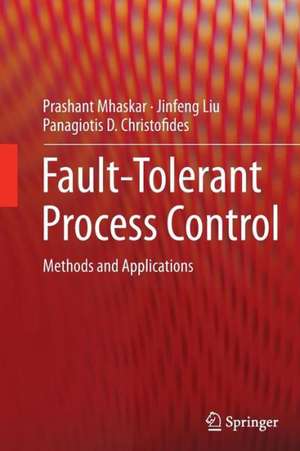
Fault-Tolerant Process Control
Autor Prashant Mhaskar, Jinfeng Liu, Panagiotis D. Christofidesen Limba Engleză Paperback – 14 dec 2014
· A framework for detection, isolation and diagnosis of actuator and sensor faults for nonlinear systems;
· Controller reconfiguration and safe-parking-based fault-handling methodologies;
· Integrated-data- and model-based fault-detection and isolation and fault-tolerant control methods;
· Methods for handling sensor faults and data losses; and
· Methods for monitoring the performance of low-level PID loops.
The methodologies proposed employ nonlinear systems analysis, Lyapunov techniques, optimization, statistical methods and hybrid systems theory and are predicated upon the idea of integrating fault-detection, local feedback control, and supervisory control. The applicability and performance of the methods are demonstrated through a number of chemical process examples. Fault-Tolerant Process Control is a valuable resource for academic researchers, industrial practitioners as well as graduate students pursuing research in this area.
Preț: 643.25 lei
Preț vechi: 756.75 lei
-15%
Puncte Express: 965
Carte tipărită la comandă
Livrare economică 07-21 decembrie
Livrare prin curier în România Termenul estimat este afișat lângă disponibilitate.
Transport gratuit pentru acest produs Plată online sau ramburs, în funcție de opțiunile comenzii.
Retur gratuit în 14 zile Comandă securizată și suport în română.
Specificații
ISBN-13: 9781447159636
ISBN-10: 1447159632
Pagini: 288
Ilustrații: XXIV, 264 p.
Dimensiuni: 155 x 235 x 16 mm
Greutate: 0.44 kg
Ediția:2013
Editura: Springer
Locul publicării:London, United Kingdom
ISBN-10: 1447159632
Pagini: 288
Ilustrații: XXIV, 264 p.
Dimensiuni: 155 x 235 x 16 mm
Greutate: 0.44 kg
Ediția:2013
Editura: Springer
Locul publicării:London, United Kingdom
V-ar putea interesa
-
 Optimal Control: An Introduction to the Theory with ApplicationsLeslie M. Hocking-37%Preț: 501.58 lei794.74 lei
 -
 Multivariable Feedback ControlSigurd SkogestadPreț: 477.89 lei
 -
 Stability and Control of Aircraft SystemsRoy Langton-23%Preț: 852.48 lei1107.11 lei
 -
 Nonlinear Dynamical Systems and ControlWassim M. Haddad-23%Preț: 1038.34 lei1348.49 lei
 -
 Control TheoryTorkel Glad-15%Preț: 642.10 lei755.41 lei
 -
 Fanuc CNC Custom MacrosPeter Smid-19%Preț: 515.32 lei636.20 lei
 -
 Beginning Arduino ProgrammingBrian EvansPreț: 367.84 lei
 -
 Geometric Methods and ApplicationsJean Gallier-15%Preț: 552.23 lei649.67 lei
 -
 Make: DronesDavid McgriffyPreț: 168.11 lei
 -
 -9%Preț: 1014.33 lei1114.65 lei
 -
 Model Predictive ControlEduardo F. Camacho-15%Preț: 521.46 lei613.47 lei
 -
 Mechatronic SystemsRolf Isermann-15%Preț: 605.64 lei712.51 lei
 -
 Logistik-Wörterbuch. Dictionary of LogisticsVanessa Scott-Sabic-18%Preț: 838.28 lei1022.30 lei
 -
 Automotive Mechatronics: Operational and Practical IssuesB. T. Fijalkowski-18%Preț: 1194.66 lei1456.91 lei
Public țintă
ResearchCuprins
Background on Nonlinear Systems and Control.- Integrated Fault-Detection and Fault-Tolerant Control.- Integrated Fault-Detection and Isolation and Fault-Tolerant Control.- Safe-Parking.- Fault Diagnosis and Robust Safe-Parking.- Utilizing FDI Insights in Controller Design and PID Monitoring.- Isolation and Handling of Sensor Faults.- Control and Fault-Handling Subject to Asynchronous Measurements.
Recenzii
From the reviews:
“The book is dedicated to the development of active Fault-Tolerant Control (FTC) methods for processes of the chemical industry. … The book will be useful and interesting both for academic researchers and for industrial practitioners working in the given area.” (Boris Ivanovich Konosevich, zbMATH, Vol. 1270, 2013)
“The book is dedicated to the development of active Fault-Tolerant Control (FTC) methods for processes of the chemical industry. … The book will be useful and interesting both for academic researchers and for industrial practitioners working in the given area.” (Boris Ivanovich Konosevich, zbMATH, Vol. 1270, 2013)
Textul de pe ultima copertă
Fault-Tolerant Process Control focuses on the development of general, yet practical, methods for the design of advanced fault-tolerant control systems; these ensure an efficient fault detection and a timely response to enhance fault recovery, prevent faults from propagating or developing into total failures, and reduce the risk of safety hazards. To this end, methods are presented for the design of advanced fault-tolerant control systems for chemical processes which explicitly deal with actuator/controller failures and sensor faults and data losses. Specifically, the book puts forward:
· a framework for detection, isolation and diagnosis of actuator and sensor faults for nonlinear systems;
· controller reconfiguration and safe-parking-based fault-handling methodologies;
· integrated-data- and model-based fault-detection and isolation and fault-tolerant control methods;
· methods for handling sensor faults and data losses; and
· methods for monitoring the performance of low-level PIDloops.
The methodologies proposed employ nonlinear systems analysis, Lyapunov techniques, optimization, statistical methods and hybrid systems theory and are predicated upon the idea of integrating fault-detection, local feedback control, and supervisory control. The applicability and performance of the methods are demonstrated through a number of chemical process examples.
Fault-Tolerant Process Control is a valuable resource for academic researchers, industrial practitioners as well as graduate students pursuing research in this area.
· a framework for detection, isolation and diagnosis of actuator and sensor faults for nonlinear systems;
· controller reconfiguration and safe-parking-based fault-handling methodologies;
· integrated-data- and model-based fault-detection and isolation and fault-tolerant control methods;
· methods for handling sensor faults and data losses; and
· methods for monitoring the performance of low-level PIDloops.
The methodologies proposed employ nonlinear systems analysis, Lyapunov techniques, optimization, statistical methods and hybrid systems theory and are predicated upon the idea of integrating fault-detection, local feedback control, and supervisory control. The applicability and performance of the methods are demonstrated through a number of chemical process examples.
Fault-Tolerant Process Control is a valuable resource for academic researchers, industrial practitioners as well as graduate students pursuing research in this area.
Caracteristici
Numerous comments and remarks provide fundamental understanding of fault detection and isolation and fault-tolerant control system design problems Many detailed examples of industrial relevance are easily tailored by practitioners to their specific applications Gives the reader a rich collection of state-of-the art, rigorous yet practical methods, new research topics, and references to significant recent work on the design of integrated fault detection and isolation and fault-tolerant control systems for chemical processes Includes supplementary material: sn.pub/extras
Notă biografică
Prashant Mhaskar received the B. Tech degree in Chemical Engineering from the Indian Institute of Technology, Bombay in May 1999, the MS degree in Chemical Engineering from Louisiana State University in May, 2001 and the Ph. D. degree in Chemical Engineering from the University of California, Los Angeles in 2005. He joined the Department of Chemical Engineering at McMaster University in 2005 as an Assistant Professor, where he is currently Professor. His research interests include nonlinear model predictive control and fault tolerant control, control of hybrid systems and batch process modeling and control. Research results from Dr. Mhaskar have resulted in over 73 refereed articles in leading scientific journals and a book on ``Fault-Tolerant Process Control: Methods and Applications,'' (Springer-Verlag, London, England, 2013.) Prashant Mhaskar is a recipient of the UCLA Dissertation Year Fellowship for the academic year 2004-2005, several Best Presentation in Session Awards at the American Control Conferences, Outstanding Ph.D. in Chemical Engineering Award, had two papers selected for the Computing and Systems Technology Division Plenary Session at the AIChE meetings in 2004 and 2012, and currently holds the Canada Research Chair in Nonlinear and Fault-Tolerant Control (2016-2021). He has organized several invited sessions at the American Control Conference, co-edited a special issue of Journal of Process Control on Energy Efficient Buildings and a special issue of Computers and Chemical Engineering on Control of Complex and Networked process systems, and is currently an Associate Editor for IEEE Transactions on Control Systems Technology and Automatica.
Abhinav Garg received the B. Tech degree in Electronics and Instrumentation Engineering from Uttar Pradesh Technical University in June 2011, the Masters of Science by Research degree in Chemical Engineering from Indian Institute of Technology Madras in December, 2013 and Ph.D in Chemical Engineering from McMaster University in August 2018. His research interests include system identification, time-frequency analysis, causality analysis and process monitoring, control and optimization. His research has resulted in several peer-reviewed journal and conference articles.
Brandon Corbett received the B. Eng degree in Chemical Engineering from McMaster University in June 2011 and the Ph.D. degree in Chemical Engineering from McMaster University in September 2016. In 2017, he completed an industrial postdoctoral fellowship with Professor John F. MacGregor. Dr. Corbett's research interests focus on data-driven modeling. He has publications in data-driven dynamic modeling, particularly for batch processes, and data-driven modeling of product development data.