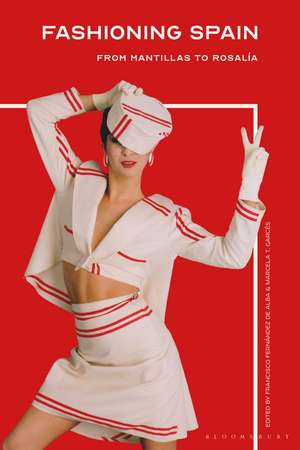
Fashioning Spain: From Mantillas to Rosalía
Editat de Francisco Fernández de Alba, Marcela T. Garcésen Limba Engleză Paperback – 29 dec 2022
Considerăm Fashioning Spain o resursă academică esențială pentru studenții și cercetătorii din domeniul studiilor culturale, istoriei artei și designului vestimentar, fiind concepută special pentru nivelul de educație terțiară. Această lucrare nu este doar o cronică a stilului, ci o analiză profundă a modului în care vestimentația a servit drept catalizator pentru identitate într-o Spanie aflată în tranziție de la dictatură la democrație. Subliniem rigoarea metodologică prin care editorii Francisco Fernández de Alba și Marcela T. Garcés integrează perspective diverse, de la politizarea mantilei până la estetica avangardistă a artistei Rosalía.
Structura volumului este organizată tematic, debutând cu relația dintre modă și politică, continuând cu reprezentarea feminității în film și fotografie, și culminând cu influența muzicii și a mediului digital. Remarcăm continuitatea tematică față de lucrările anterioare ale lui Francisco Fernández de Alba, precum Toward a Cultural Archive of la Movida, unde explorarea efervescenței artistice din anii '70-'80 primește aici o dimensiune vestimentară specifică prin analiza benzilor desenate și a corpurilor viitorului.
În contextul bibliografiei de specialitate, Fashioning Spain completează excelent titluri precum Women's Narrative and Film in 20th Century Spain de Kathleen Glenn. În timp ce lucrarea lui Glenn se concentrează pe tradiția culturală feminină în literatură și cinema, volumul de față adaugă dimensiunea materială a modei ca instrument de emancipare și rezistență. De asemenea, se raportează la Refiguring Spain de Marsha Kinder, extinzând discuția despre identitatea națională post-Franco dinspre media generalistă către cultura vizuală a obiectului vestimentar, demonstrând că moda este un depozit dens de semnificații istorice.
Preț: 206.77 lei
Preț vechi: 288.03 lei
-28%
Carte tipărită la comandă
Livrare economică 02-16 decembrie
Specificații
ISBN-10: 1350244589
Pagini: 240
Ilustrații: 33 bw illus
Dimensiuni: 232 x 154 x 14 mm
Greutate: 0.34 kg
Editura: Bloomsbury Publishing
Colecția Bloomsbury Visual Arts
Locul publicării:London, United Kingdom
V-ar putea interesa
-
 The Mode in Furs: A Historical Survey with 680 IllustrationsR. Turner WilcoxPreț: 93.10 lei
 -
 ShoesRaissa BretañaPreț: 76.68 lei
 -
 Out of the BoxElizabeth SemmelhackPreț: 326.61 lei
 -
 HatsProfessor Clair Hughes-41%Preț: 145.20 lei244.11 lei
 -
 Hair: An Illustrated HistorySusan J. Vincent-37%Preț: 152.65 lei240.79 lei
 -
 Fashioning the Victorians: A Critical SourcebookProfessor Rebecca Mitchell-23%Preț: 208.70 lei272.56 lei
 -
 A Cultural History of Dress and Fashion in the Modern AgeProfessor Alexandra Palmer-24%Preț: 204.53 lei270.02 lei
 -
 A Cultural History of Dress and Fashion in the RenaissanceElizabeth Currie-24%Preț: 204.31 lei269.75 lei
 -
 A Cultural History of Dress and Fashion in the Medieval AgeProfessor Sarah-Grace Heller-18%Preț: 211.70 lei257.41 lei
 -
 The Hidden History of the Smock FrockAlison Toplis-18%Preț: 194.02 lei238.03 lei
 -
 Understanding Fashion Scandals: Social Media, Identity, and GlobalizationProfessor Annamari Vänskä-31%Preț: 508.35 lei738.71 lei
 -
 -35%Preț: 571.06 lei882.85 lei
 -
 Fashion and Motherhood: Image, Material, IdentityLaura Snelgrove-37%Preț: 547.29 lei867.21 lei
 -
 Behind the SeamsSusan Hiner-21%Preț: 516.18 lei654.33 lei
 -
 Dress and Identity in America: The Baby Boom Years 1946-1964Daniel Delis Hill-36%Preț: 567.72 lei880.83 lei
 -
 The Way We WoreDaphne Selfe-24%Preț: 87.40 lei114.64 lei
 -
 Fashion and Masculinity in Renaissance FlorenceElizabeth Currie-33%Preț: 835.12 lei1242.40 lei
 -
 Fabric of Vision: Dress and Drapery in PaintingAnne Hollander-34%Preț: 183.12 lei278.04 lei
 -
 The Sports Shoe: A History from Field to FashionThomas Turner-51%Preț: 188.67 lei382.75 lei
 -
 -33%Preț: 784.44 lei1166.22 lei
 -
 -25%Preț: 173.78 lei230.89 lei
 -
 Slowness in FashionSolen Kipoz PhDPreț: 192.34 lei
De ce să citești această carte
Recomandăm această carte celor interesați de intersecția dintre estetică și sociopolitică. Cititorul va obține o înțelegere nuanțată a modului în care Spania și-a renegociat identitatea prin imagine, de la rigoarea epocii Franco la libertatea digitală contemporană. Este o lectură fundamentală pentru a decoda simbolismul ascuns în spatele unor elemente iconice ale culturii spaniole, oferind o perspectivă academică proaspătă asupra modului în care hainele „vorbesc” despre putere și gen.
Descriere
Using a range of case studies and approaches, this collection explores fashion in films, comics from la Movida, Rosalía's music videos, and both brick-and-mortar and virtual museums. It demonstrates that fashion is ripe with historical meaning, and offers unique insights into the many facets of Spanish cultural life.
Cuprins
Foreword
Acknowledgements
Note on Translations
Introduction
"Fashion in Spain: Catalyst for Affect and Identity."
Francisco Fernández de Alba (Wheaton College, MA) and Marcela T. Garcés (Siena College)
Part I: Identity: Politics and Futures
Chapter 1: "Accessorizing the Nation: Mantillas, Cultural Identity, and Modern Spain." Inés Corujo-Martín (Bryn Mawr College)
Chapter 2: "Bodies of the Future: Comics, Fashion, and 1980s Movida." Alberto Villamandos (University of Missouri, Kansas City)
Part II: Picturing Femininity: Film and Photography
Chapter 3: "Women, Fashion, and the Spanish Civil War: From the Fashion Parade to the Victory Parade." Kathleen Vernon (SUNY, Stony Brook)
Chapter 4: "From Market to Feminism: Fashion Photography during the Franco Dictatorship." Olga Sendra Ferrer (Wesleyan University)
Part III: Designing Fashion Stars: Film and Music
Chapter 5: "Fashioning Spanish Film Stars: Balenciaga and Conchita Montenegro." Jorge Pérez (University of Texas, Austin)
Chapter 6: "Rosalía, Fashion, and the Rise of Poligonera Chic." Mary Kate Donovan (Skidmore College)
Part IV: Museums: From Closets to the Cloud
Chapter 7: "The Museo del Traje's research on Spanish Prêt-à-Porter." Juan Gutiérrez (Curator, Museo del Traje, CEPI)
Chapter 8: "Curating Catalan Cultural Identity through Dress in the Virtual Fashion Museum of Catalonia." Nicholas Wolters (Wake Forest University)
Index
Recenzii
Fashioning Spain makes us aware not just of the many things that fashion can tell us about cultural values, from the eighteenth century to the present, but also of the major contribution that Spain has made to fashion design and entrepreneurship. The illustrations tell a story of their own."
An indispensable collection for Spanish cultural studies. Demonstrating that fashion analysis serves to illuminate intersecting political, economic and social processes, the contributors position twentieth-century fashion as a crucial interface for studies of modern Spanish memory, nation, affect and materiality.
The volume offers fascinating insights into the relationship of fashion and cultural identity in modern Spain, exploring the intersections of gender, sexuality, class and nationalism. It constitutes a solid critical contribution to an important, but relatively neglected area of Spanish cultural studies, which will be a fundamental reference for any future studies in this field.