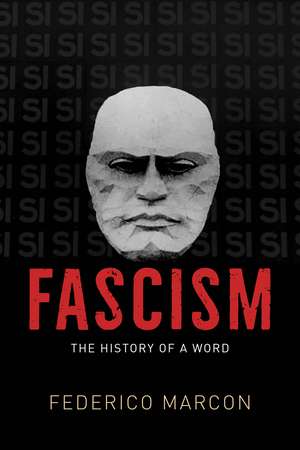
Fascism: The History of a Word: The Life of Ideas
Autor Federico Marconen Limba Engleză Paperback – 6 iun 2025
The rise and popular support for authoritarianism around the world and within traditional democracies have spurred debates over the meaning of the term “fascist” and when and whether it is appropriate to use it. The landmark study Fascism: The History of a Word takes this debate further by tackling its most fundamental questions: How did the terms “fascism” and “fascist” come to be in the first place? How and in what circumstances have they been used? How can they be understood today? And what are the advantages (or disadvantages) of using “fascism” to make sense of interwar authoritarianism as well as contemporary politics?
Exploring the writings and deeds of political leaders, activists, artists, authors, and philosophers, Federico Marcon traces the history of the term’s use (and usefulness) in relation to Mussolini’s political regime, antifascist resistance, and the quest of postwar historians to develop a definition of a “fascist minimum.” This investigation of the semiotics of “fascism” also aims to inquire about people’s voluntary renunciation of the modern emancipatory ideals of freedom, equality, and solidarity.
Din seria The Life of Ideas
-
 Preț: 217.28 lei
 -
 Preț: 231.98 lei
 -
 Preț: 167.34 lei
 -
 Preț: 293.00 lei
 -
 Preț: 175.18 lei
 -
 Preț: 315.76 lei
 -
 Preț: 233.79 lei
 -
 Preț: 198.88 lei
 -
 Preț: 216.28 lei
 -
 Preț: 289.61 lei
 -
 Preț: 232.60 lei
 -
 Preț: 379.31 lei
 -
 Preț: 200.71 lei
 -
 Preț: 200.33 lei
 -
 Preț: 329.06 lei
 - nou
 Preț: 292.64 lei
Preț: 235.24 lei
Nou
Puncte Express: 353
Preț estimativ în valută:
41.63€ • 48.81$ • 36.56£
41.63€ • 48.81$ • 36.56£
Carte disponibilă
Livrare economică 20 ianuarie-03 februarie 26
Livrare express 06-10 ianuarie 26 pentru 34.91 lei
Preluare comenzi: 021 569.72.76
Specificații
ISBN-13: 9780226841328
ISBN-10: 0226841324
Pagini: 448
Dimensiuni: 152 x 229 x 25 mm
Greutate: 0.6 kg
Ediția:First Edition
Editura: University of Chicago Press
Colecția University of Chicago Press
Seria The Life of Ideas
ISBN-10: 0226841324
Pagini: 448
Dimensiuni: 152 x 229 x 25 mm
Greutate: 0.6 kg
Ediția:First Edition
Editura: University of Chicago Press
Colecția University of Chicago Press
Seria The Life of Ideas
Notă biografică
Federico Marcon is professor of East Asian studies and history at Princeton University. He is the author of The Knowledge of Nature and the Nature of Knowledge in Early Modern Japan, also published by the University of Chicago Press.
Cuprins
Preface
Introduction: The Advantages and Disadvantages of “Fascism” for History (and for Life)
Part I: The Invention of “Fascism”
1. “Fascism” before Fascism
2. The Advent of “Fascism”
3. The Semantic Consolidation of “Fascism,” 1922–1945
4. The Language of Fascism
Part II: Antifascists’ “Fascism”
5. Contexts: The Global Reception of Fascism and the Invention of “Antifascism”
6. Liberals’ “Fascism”
7. Marxists’ “Fascism”
8. The Liberals’ Genericizations of “Fascism”
9. The Marxists’ Genericizations of “Fascism”
Part III: “Fascism” since 1945
10. Contexts: “Fascism” between the Postwar Era and the Cold War
11. The Search for a “Fascist Minimum”
12. Historical Knowledge and the Unbearable Fuzziness of “Fascism”
Conclusions: On the Advantages and Disadvantages of “Fascism,” Again
Acknowledgments
Notes
Index
Introduction: The Advantages and Disadvantages of “Fascism” for History (and for Life)
Part I: The Invention of “Fascism”
1. “Fascism” before Fascism
2. The Advent of “Fascism”
3. The Semantic Consolidation of “Fascism,” 1922–1945
4. The Language of Fascism
Part II: Antifascists’ “Fascism”
5. Contexts: The Global Reception of Fascism and the Invention of “Antifascism”
6. Liberals’ “Fascism”
7. Marxists’ “Fascism”
8. The Liberals’ Genericizations of “Fascism”
9. The Marxists’ Genericizations of “Fascism”
Part III: “Fascism” since 1945
10. Contexts: “Fascism” between the Postwar Era and the Cold War
11. The Search for a “Fascist Minimum”
12. Historical Knowledge and the Unbearable Fuzziness of “Fascism”
Conclusions: On the Advantages and Disadvantages of “Fascism,” Again
Acknowledgments
Notes
Index
Recenzii
"Marcon has created a rich semantic history of a ubiquitous but elusive word of enormous consequence . . . Highly recommended. Advanced undergraduates through faculty; professionals."
“Marcon’s semiotic history offers a necessary corrective and long-overdue complement to a century’s worth of efforts to contour fascism as a generic category. Thorough and incisive, it will prove an indispensable companion for scholars of twentieth-century political discourse and critical reading for anyone invested in the fate of liberal democracy today.”
“Timely and comprehensive, this book’s detailed analysis is unprecedented and promises to provide the scholarly community with valuable insights. Marcon offers a compelling new perspective through which both the interpretation and the definition of fascism can be considered.”