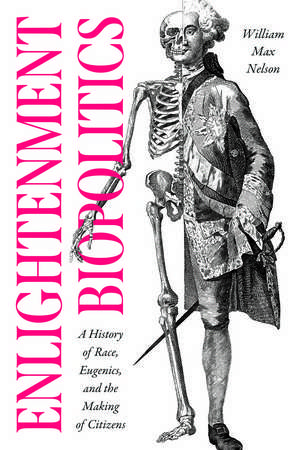
Enlightenment Biopolitics: A History of Race, Eugenics, and the Making of Citizens: The Life of Ideas
Autor William Max Nelsonen Limba Engleză Paperback – 6 mai 2024
In Enlightenment Biopolitics, historian William Max Nelson pursues the ambitious task of tracing the context in which biopolitical thought emerged and circulated. He locates that context in the Enlightenment when emancipatory ideals sat alongside the horrors of colonialism, slavery, and race-based discrimination. In fact, these did not just coexist, Nelson argues; they were actually mutually constitutive of Enlightenment ideals.
In this book, Nelson focuses on Enlightenment-era visions of eugenics (including proposals to establish programs of selective breeding), forms of penal slavery, and spurious biological arguments about the supposed inferiority of particular groups. The Enlightenment, he shows, was rife with efforts to shape, harness, and “organize” the minds and especially the bodies of subjects and citizens. In his reading of the birth of biopolitics and its transformations, Nelson examines the shocking conceptual and practical connections between inclusion and exclusion, equality and inequality, rights and race, and the supposed “improvement of the human species” and practices of dehumanization.
| Toate formatele și edițiile | Preț | Express |
|---|---|---|
| Paperback (1) | 233.62 lei 3-5 săpt. | +19.62 lei 6-12 zile |
| University of Chicago Press – 6 mai 2024 | 233.62 lei 3-5 săpt. | +19.62 lei 6-12 zile |
| Hardback (1) | 669.98 lei 6-8 săpt. | |
| University of Chicago Press – 6 mai 2024 | 669.98 lei 6-8 săpt. |











Preț: 233.62 lei
Puncte Express: 350
Preț estimativ în valută:
41.33€ • 48.45$ • 35.95£
41.33€ • 48.45$ • 35.95£
Carte disponibilă
Livrare economică 12-26 februarie
Livrare express 28 ianuarie-03 februarie pentru 29.61 lei
Preluare comenzi: 021 569.72.76
Specificații
ISBN-13: 9780226825588
ISBN-10: 0226825582
Pagini: 336
Ilustrații: 10 halftones
Dimensiuni: 152 x 229 x 23 mm
Greutate: 0.47 kg
Ediția:First Edition
Editura: University of Chicago Press
Colecția University of Chicago Press
Seria The Life of Ideas
ISBN-10: 0226825582
Pagini: 336
Ilustrații: 10 halftones
Dimensiuni: 152 x 229 x 23 mm
Greutate: 0.47 kg
Ediția:First Edition
Editura: University of Chicago Press
Colecția University of Chicago Press
Seria The Life of Ideas
Notă biografică
William Max Nelson is associate professor of history at the University of Toronto. He is the author of The Time of Enlightenment: Constructing the Future in France, 1750 to Year One and a coeditor of The French Revolution in Global Perspective.
Cuprins
List of Illustrations
Introduction: Becoming Biopolitics
Chapter One: Organizing the Swarm of Being
Chapter Two: Enlightenment Eugenics
Chapter Three: Making Men in the Colonies
Chapter Four: In Society, but Not of It
Chapter Five: New Citizens, New Slaves
Chapter Six: Making the New Man
Chapter Seven: An Evolving Constellation
Conclusion
Acknowledgments
List of Abbreviations
Notes
Index
Introduction: Becoming Biopolitics
Chapter One: Organizing the Swarm of Being
Chapter Two: Enlightenment Eugenics
Chapter Three: Making Men in the Colonies
Chapter Four: In Society, but Not of It
Chapter Five: New Citizens, New Slaves
Chapter Six: Making the New Man
Chapter Seven: An Evolving Constellation
Conclusion
Acknowledgments
List of Abbreviations
Notes
Index
Recenzii
"Impressive. Nelson links the Enlightenment to modern racism, but in a sophisticated manner that involves more than simply stringing together quotations. . . . Cohesive and concise."
“How can we account for France’s historical wavering on race, between an extraordinary openness to assimilation and outbursts of unashamed racism? Nelson’s Enlightenment Biopolitics offers an elegant solution to the puzzle.”
"Incorporating archives into his rich textual/contextual analysis, Nelson examines the Enlightenment's biopolitical foundations, eugenic ideas and experiments, colonial racial engineering proposals, biopolitical exclusion, biopolitics during the
Revolution, and biopolitical influence extending to the present. Nelson presents Enlightenment biopolitics as historically revolutionary and consequential. He acknowledges its worthy educational aims, its plans to create an engaged citizenry, and its improvement of individual and corporate living. Yet, he underscores paradoxical strains of preconceived/privileged standards, hubris, misuses of malleable equality, and rights violations that fostered racism, sexism, and exclusion. . . . An outstanding study on human complexity. . . . Essential."
Revolution, and biopolitical influence extending to the present. Nelson presents Enlightenment biopolitics as historically revolutionary and consequential. He acknowledges its worthy educational aims, its plans to create an engaged citizenry, and its improvement of individual and corporate living. Yet, he underscores paradoxical strains of preconceived/privileged standards, hubris, misuses of malleable equality, and rights violations that fostered racism, sexism, and exclusion. . . . An outstanding study on human complexity. . . . Essential."
“This is a highly original study that breaks new ground and discusses fundamental issues in Enlightenment history, political theory, and biopolitics. With flawless scholarship and an extraordinary mastery of the many relevant controversies and debates of the time, Nelson fills a major gap in our knowledge of the Enlightenment. This book makes important contributions to Enlightenment scholarship and will compel us to rethink the balance between equality and inequality, as well as between inclusion and exclusion, in Enlightenment social and political thought.”
“Enlightenment Biopolitics is a well-crafted book that intervenes in an important period using little-known documents. In this innovative work, Nelson offers a creative riposte to the canonical debate about social contract theory in the French eighteenth century and its echoes in modern discourse. Striking an impressive balance between shocking materials on human breeding and highly contextual readings of their implications, this book is a subtle and elegant contribution to the history of the French Enlightenment and French Revolution.”
“Enlightenment Biopolitics is already an impressive and insightful contribution to the literature. That it is also provocative and stimulating reflects its scholarly importance. Nelson’s monograph is a major achievement that breaks new ground in the historiography of the European Enlightenment.”
“Nelson reveals that long before the eugenics movements of the modern age, French naturalists and philosophes saw transforming biological humanity as the key to solving sociopolitical and economic problems in France and its colonies.”
“Enlightenment Biopolitics is a very interesting and lively book that will appeal to many readers whether or not they have any interest in or even knowledge of Michel Foucault’s work.”
“Enlightenment Biopolitics is a crucial contribution to conversations in French Studies at a time when the field is witnessing an efflorescence of work on race and whiteness. Ultimately, the book will be of interest to any scholar working on bodily difference, modernity, or European intellectual history.”
"An intriguing and sophisticated examination of eighteenth-century science. . . . it is scrupulous in its attention to detail, careful in its claims, and nuanced in its analytical contributions. . . . Enlightenment Biopolitics will undoubtedly be a valuable resource for historians of science, intellectual historians, and interdisciplinary scholars of the Francophone Enlightenment."
"Enlightenment Biopolitics is an essential work that will be read with great interest by political and intellectual historians. Nelson’s study offers a critical reassessment of Foucault’s biopolitics by tracing its roots to 18th-century practices of racial, social, and reproductive control. By illuminating the paradoxes within Enlightenment ideals—where aspirations for human betterment were often predicated on systems of exclusion—Nelson challenges us to reconsider both the legacy and the limits of the Enlightenment’s contributions to modern statecraft. In our own troubled age, Enlightenment Biopolitics serves as a cautionary reminder of the complex origins of our biopolitical landscape."