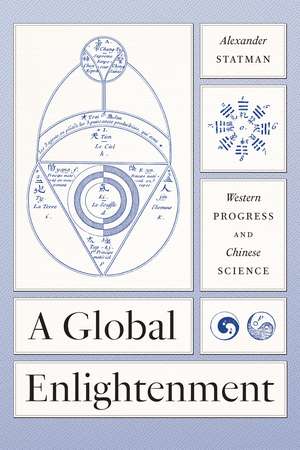
A Global Enlightenment: Western Progress and Chinese Science: The Life of Ideas
Autor Alexander Statmanen Limba Engleză Hardback – 26 apr 2023
The Enlightenment gave rise not only to new ideas of progress but consequential debates about them. Did distant times and places have anything to teach the here and now? Voltaire could believe that they did; Hegel was convinced that they did not. Early philosophes praised Chinese philosophy as an enduring model of reason. Later philosophes rejected it as stuck in the past. Seeking to vindicate ancient knowledge, a group of French statesmen and savants began a conversation with the last great scholar of the Jesuit mission to China. Together, they drew from Chinese learning to challenge the emerging concept of Western advancement.
A Global Enlightenment traces this overlooked exchange between China and the West to make compelling claims about the history of progress, notions of European exceptionalism, and European engagement with Chinese science. To tell this story, Alexander Statman focuses on a group of thinkers he terms “orphans of the Enlightenment,” intellectuals who embraced many of their contemporaries’ ideals but valued ancient wisdom. They studied astronomical records, gas balloons, electrical machines, yin-yang cosmology, animal magnetism, and Daoist medicine. And their inquiries helped establish a new approach to the global history of science.
Rich with new archival research and fascinating anecdotes, A Global Enlightenment deconstructs two common assumptions about the early to late modern period. Though historians have held that the idea of a mysterious and inscrutable East was inherent in Enlightenment progress theory, Statman argues that it was the orphans of the Enlightenment who put it there: by identifying China as a source of ancient wisdom, they turned it into a foil for scientific development. But while historical consensus supposes that non-Western ideas were banished from European thought over the course of the Enlightenment, Statman finds that Europeans became more interested in Chinese science—as a precursor, then as an antithesis, and finally as an alternative to modernity.
Din seria The Life of Ideas
-
 Preț: 253.36 lei
 -
 Preț: 173.26 lei
 -
 Preț: 293.08 lei
 -
 Preț: 184.66 lei
 -
 Preț: 340.47 lei
 -
 Preț: 214.72 lei
 -
 Preț: 223.18 lei
 -
 Preț: 306.40 lei
 -
 Preț: 247.06 lei
 -
 Preț: 306.63 lei
 -
 Preț: 409.04 lei
 -
 Preț: 210.80 lei
 -
 Preț: 243.65 lei
 -
 Preț: 245.54 lei
 -
 Preț: 242.00 lei
 -
 Preț: 206.42 lei
 - nou
 Preț: 211.07 lei
Preț: 390.38 lei
Puncte Express: 586
Carte disponibilă
Livrare economică 10-24 noiembrie
Livrare express 24-30 octombrie pentru 46.35 lei
Livrare prin curier în România Termenul estimat este afișat lângă disponibilitate.
Transport gratuit de la 400.00 lei Plată online sau ramburs, în funcție de opțiunile comenzii.
Retur gratuit în 14 zile Comandă securizată și suport în română.
Specificații
ISBN-13: 9780226825762
ISBN-10: 0226825760
Pagini: 320
Ilustrații: 27 halftones
Dimensiuni: 152 x 229 x 30 mm
Greutate: 0.62 kg
Ediția:First Edition
Editura: University of Chicago Press
Colecția University of Chicago Press
Seria The Life of Ideas
ISBN-10: 0226825760
Pagini: 320
Ilustrații: 27 halftones
Dimensiuni: 152 x 229 x 30 mm
Greutate: 0.62 kg
Ediția:First Edition
Editura: University of Chicago Press
Colecția University of Chicago Press
Seria The Life of Ideas
V-ar putea interesa
-
 1434Gavin MenziesPreț: 126.98 lei
 -
 The Light of AsiaChristopher HardingPreț: 108.16 lei
 -
 The End of EnlightenmentRichard WhatmorePreț: 114.56 lei
 -
 The Enlightenment: A Very Short IntroductionJohn Robertson-20%Preț: 57.15 lei71.12 lei
 -
 -17%Preț: 36.50 lei43.96 lei
 -
 Thoughts From the Ice-Drinker's StudioLiang Qichao-20%Preț: 74.31 lei92.67 lei
 -
 -23%Preț: 1532.06 lei1989.69 lei
 -
 CandideVoltairePreț: 32.48 lei
 -
 Chinese Asianism, 1894-1945Craig A. SmithPreț: 389.99 lei
 -
 A Source Book in Chinese PhilosophyWing-Tsit ChanPreț: 362.51 lei
 -
 Unfabling the East – The Enlightenment`s Encounter with AsiaJürgen OsterhammelPreț: 299.89 lei
 -
 Unfabling the EastJürgen OsterhammelPreț: 246.73 lei
 -
 The Pattern of ChangeRobert V MoodyPreț: 329.25 lei
 -
 Esotericism in East Asia: Cultural Interpretation and PoliticsChienhui Chuang-32%Preț: 553.97 lei818.75 lei
 -
 RumorsMladen DolarPreț: 87.97 lei
 -
 China ImaginedGregory Lee-16%Preț: 138.71 lei165.65 lei
 -
 The Unrealizable: Towards a Politics of OntologyGiorgio AgambenPreț: 159.80 lei
 -
 The Best of All Possible WorldsMichael KempePreț: 93.61 lei
 -
 New Radical EnlightenmentMarina GarcesPreț: 130.44 lei
 -
 Preț: 112.39 lei
Notă biografică
Alexander Statman is a Distinguished Scholar and JD candidate at the UCLA School of Law and a former A.W. Mellon Postdoctoral Fellow at the University of Wisconsin-Madison.
Cuprins
Introduction
One. The Death of Voltaire’s Confucius
Two. The Ex-Jesuit Mission in China
Three. The Origins of Esotericism
Four. The Yin-Yang Theory of Animal Magnetism
Five. The Invention of Eastern Wisdom
Conclusion
Acknowledgments
Notes
Bibliography
Index
One. The Death of Voltaire’s Confucius
Two. The Ex-Jesuit Mission in China
Three. The Origins of Esotericism
Four. The Yin-Yang Theory of Animal Magnetism
Five. The Invention of Eastern Wisdom
Conclusion
Acknowledgments
Notes
Bibliography
Index
Recenzii
“A magnificent intellectual history of the late Enlightenment’s interest in Chinese knowledge traditions, revealing their central role in European debates over the meaning and value of ‘progress.’”
"This erudite and engaging study with its extensive use of archival sources, many of which are studied for the first time, is a welcome addition to the literature on the history of science, the Enlightenment, and Jesuit missionaries in China."
“The orphans of the Enlightenment and their fascination for Confucian texts, esoteric knowledge, and yin-yang theories also played key roles in this process. As Statman shows, it was both Chinese science itself and the orphans’ changing engagement with Chinese science that shaped the idea of progress that Enlightenment thinkers and their inheritors were (and are) so keen to claim as their own.”
“An excellent and well-researched exercise in global history.”
"This book exemplifies the global turn currently underway in the history of science by uncovering the impact of Chinese science on the European Enlightenment, especially on the emerging Enlightenment conception of progress."
“Statman has written a marvelous, engaging, and brilliant book. He is uniquely poised to demonstrate the genuine exchanges between Chinese and Western scholars during this period. His in-depth familiarity with the network of former Jesuit missionaries proves invaluable as he traces with extreme precision intellectual connections between Paris and Beijing. Truly a paradigm-shifting book.”
“This is a wonderful book about wonder—about the Europeans who mediated Chinese thought, history, and technology for their compatriots, and the categories they constructed to house the translated facts and concepts.”