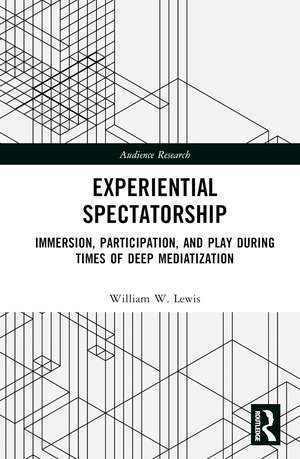
Experiential Spectatorship: Immersion, Participation, and Play During Times of Deep Mediatization: Audience Research
Autor William W. Lewisen Limba Engleză Hardback – 7 noi 2024
This book prepares the reader to think in a digital manner so they can best recognize how performance and spectatorship in the twenty-first century are evolving to meet the needs of future waves of spectators brought up in a postdigital world.


Preț: 1025.30 lei
Preț vechi: 1250.36 lei
-18%
Puncte Express: 1538
Carte tipărită la comandă
Livrare economică 04-18 iulie
Specificații
ISBN-13: 9781032502892
ISBN-10: 1032502894
Pagini: 280
Ilustrații: 48
Dimensiuni: 156 x 234 mm
Greutate: 0.68 kg
Ediția:1
Editura: Taylor & Francis
Colecția Routledge
Seria Audience Research
Locul publicării:Oxford, United Kingdom
ISBN-10: 1032502894
Pagini: 280
Ilustrații: 48
Dimensiuni: 156 x 234 mm
Greutate: 0.68 kg
Ediția:1
Editura: Taylor & Francis
Colecția Routledge
Seria Audience Research
Locul publicării:Oxford, United Kingdom
V-ar putea interesa
-
 Understanding MediaJames CurranPreț: 78.60 lei
 -
 Digital PerformanceSteve DixonPreț: 430.28 lei
 -
 Preț: 117.94 lei
 -
 Preț: 323.51 lei
 -
 Preț: 340.76 lei
 -
 The Theatre Experience: 2025 Release ISEAlvin Goldfarb-4%Preț: 354.17 lei368.92 lei
 -
 -22%Preț: 137.83 lei175.75 lei
 -
 Theatre and TourismMargaret Werry-20%Preț: 68.05 lei85.44 lei
 -
 Site-Reliant Immersive Experiences: Sensing Affective Spaces in Art and ArchitectureDr Liana Psarologaki-34%Preț: 542.67 lei816.94 lei
 -
 -14%Preț: 543.56 lei632.05 lei
 -
 Media Industries in the Digital AgeAmanda D LotzPreț: 139.06 lei
 -
 Interactive Cinema: The Ambiguous Ethics of Media ParticipationMarina HassapopoulouPreț: 203.59 lei
 -
 -23%Preț: 178.75 lei231.11 lei
 -
 Theatre FandomFrancesca Coppa-8%Preț: 524.55 lei570.16 lei
 -
 The Culture Box: Museums as MediaHarley Parker-12%Preț: 170.86 lei194.43 lei
 -
 -23%Preț: 705.58 lei916.34 lei
 -
 Preț: 283.28 lei
 -
 -15%Preț: 671.32 lei789.79 lei
 -
 Theorising and Designing Immersive EnvironmentsÁgnes-Karolina Bakk-18%Preț: 695.39 lei848.04 lei
 -
 States of Immersion Across Media: Bodies, Techniques, PracticesPhilippe Bédard-9%Preț: 934.09 lei1026.47 lei
Public țintă
AcademicCuprins
Introduction
1. Mediatization, Perception, and Experience
1.0 Foundations of the Mediatized Spectator
2. The Architecture of Immersion
2.0 Virtuality, Simulation, and Technologies of Immersion
2.1 The Feeling Spectator and the Affect Economy of Immersion
3. The Architecture of Participation
3.0 The Promise of Web 2.0: Participation, Convergence, and Collaborative Technologies
3.1 The Democratic Spectator: Choice Making and Political Exchange in Participatory Performance
4. The Architecture of Game Play
4.0 Pervasive Connections: Smart Devices, Locative Media, and the Gamification of Reality
4.1 The Playing Spectator: iPerformance and Ludic Criticality
5. The Architecture of Role Play
5.0 Algorithms, Avatars, and Affective Computing: Datafication and Social Feedback Loops
5.1 The Spectator as Flexible Character: (Co)Authoring Identity Through Role Play and Data Interactions
Afterword: Technics and Evolving Paradigms
1. Mediatization, Perception, and Experience
1.0 Foundations of the Mediatized Spectator
2. The Architecture of Immersion
2.0 Virtuality, Simulation, and Technologies of Immersion
2.1 The Feeling Spectator and the Affect Economy of Immersion
3. The Architecture of Participation
3.0 The Promise of Web 2.0: Participation, Convergence, and Collaborative Technologies
3.1 The Democratic Spectator: Choice Making and Political Exchange in Participatory Performance
4. The Architecture of Game Play
4.0 Pervasive Connections: Smart Devices, Locative Media, and the Gamification of Reality
4.1 The Playing Spectator: iPerformance and Ludic Criticality
5. The Architecture of Role Play
5.0 Algorithms, Avatars, and Affective Computing: Datafication and Social Feedback Loops
5.1 The Spectator as Flexible Character: (Co)Authoring Identity Through Role Play and Data Interactions
Afterword: Technics and Evolving Paradigms
Notă biografică
William W. Lewis is Assistant Professor of Theatre History, Literature, and Criticism at Purdue University. He is an interdisciplinary scholar/artist whose work focuses on the fields of intermedial, postdramatic, and devised performance. His research explores the role of mediatization on contemporary audiences and the implications of constant connection to media on how we teach theatre-making.
Recenzii
'Experiential Spectatorship is a rich and timely contribution to performance studies, media theory, and digital culture. Lewis offers in-depth case studies that set the grounds for future research and reflection on the influences of mediatized culture on notions of spectatorship. Topics covered in this volume align with the pedagogical needs of many university courses that teach multimedia and new technology-laden contemporary performance practice. This makes the book an essential resource for scholars, students, and theatre practitioners interested in thinking about contemporary performance in a digital manner and the future of spectatorship in a postdigital world.'
Piotr Woycicki, Aberystwyth University, UK for Theatre Topics by Johns Hopkins University Press
'Experiential Spectatorship is most cogent when summarizing the milestones in scholarship and tech infrastructure that relate to each architecture of exchange. All chapters begin with an extensive review of several major theoretical perspectives
that have considered each technology vis-à-vis spectatorship as well as a historiography of the technology’s development.'
E.B Hunter, Theatre Survey, Volume 67, Number 1, January 2026 by Johns Hopkins University Press
'In connecting the theatrical experience to a highly influential mediatized world, Experiential Spectatorship crafts a persuasive snapshot of contemporary audience expectations, ulti-mately forecasting an ambiguous future as we look to the waves fast approaching our shore. Indeed, as Lewis gestures toward in his conclusion, the technics associated with generative AI remain somewhat mysterious as the technology finds unsteady purchase in the cultural milieu. How will its wave of mediatization shape our perception of reality and our expectations of media? How will theatre and performance respond? Although these pressing questions elude a definitive answer, this text provides theatre scholars interested in mediatization, participation, agency, and audience experience with trail markers and actionable strategies for navigating an ever-shifting intersection of technology and performance.'
Derek Manderson, Theatre, Dance and Performance Studies, York University, Toronto, Ontario, Canada
'In Experiential Spectatorship Lewis reminds us that it is important to first understand ‘the relationship between people and technologies before the act of spectating’ (54). We are then positioned to make sense of how the mediatised spectator ‘emerges’ from the techno-logical, before we can make sense of their experience. The monograph provides clear examples of the usefulness of each architecture as a framework for analysing spectators’ digital and mediatised experiences. While Lewis does not have the scope to broadly apply the model beyond his experience as a spectator, the theoretically robust framework will be useful to audience scholars. Moreover, the detailed theorisation of media philosophy and history will be useful for media and theatre scholars interested in spectators.'
Abbie Victoria Trott, University of Queensland, Brisbane, Australia for International Journal of Performance Arts and Digital Media
Piotr Woycicki, Aberystwyth University, UK for Theatre Topics by Johns Hopkins University Press
'Experiential Spectatorship is most cogent when summarizing the milestones in scholarship and tech infrastructure that relate to each architecture of exchange. All chapters begin with an extensive review of several major theoretical perspectives
that have considered each technology vis-à-vis spectatorship as well as a historiography of the technology’s development.'
E.B Hunter, Theatre Survey, Volume 67, Number 1, January 2026 by Johns Hopkins University Press
'In connecting the theatrical experience to a highly influential mediatized world, Experiential Spectatorship crafts a persuasive snapshot of contemporary audience expectations, ulti-mately forecasting an ambiguous future as we look to the waves fast approaching our shore. Indeed, as Lewis gestures toward in his conclusion, the technics associated with generative AI remain somewhat mysterious as the technology finds unsteady purchase in the cultural milieu. How will its wave of mediatization shape our perception of reality and our expectations of media? How will theatre and performance respond? Although these pressing questions elude a definitive answer, this text provides theatre scholars interested in mediatization, participation, agency, and audience experience with trail markers and actionable strategies for navigating an ever-shifting intersection of technology and performance.'
Derek Manderson, Theatre, Dance and Performance Studies, York University, Toronto, Ontario, Canada
'In Experiential Spectatorship Lewis reminds us that it is important to first understand ‘the relationship between people and technologies before the act of spectating’ (54). We are then positioned to make sense of how the mediatised spectator ‘emerges’ from the techno-logical, before we can make sense of their experience. The monograph provides clear examples of the usefulness of each architecture as a framework for analysing spectators’ digital and mediatised experiences. While Lewis does not have the scope to broadly apply the model beyond his experience as a spectator, the theoretically robust framework will be useful to audience scholars. Moreover, the detailed theorisation of media philosophy and history will be useful for media and theatre scholars interested in spectators.'
Abbie Victoria Trott, University of Queensland, Brisbane, Australia for International Journal of Performance Arts and Digital Media
Descriere
Experiential Spectatorship offers a lens for analyzing audience experience with(in) a variety of contemporary media.