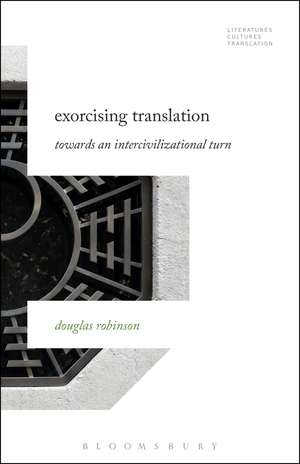
Exorcising Translation: Towards an Intercivilizational Turn: Literatures, Cultures, Translation
Autor Professor Douglas Robinsonen Limba Engleză Paperback – 15 dec 2016
The hot-button issue of Eurocentrism in translation studies has roiled the discipline in the past few years, with critiques followed by defenses and defenses followed by enhanced critiques. Douglas Robinson identifies Eurocentrism in translation studies as what Sakai Naoki calls a "civilizational spell." Exorcising Translation tracks two translation histories. In the first, moving from Friedrich Nietzsche to Harold Bloom, we find ourselves caught, trapped, cursed, haunted by the spell. In the second, focused on English translations and translators of Chinese literature, Robinson explores accusations against American translators not only for their inadequate (or even totally absent) knowledge of Chinese and Daoism, but for their Americanness, their trappedness in individualistic and secular Western thought. A closer look at that history shows that Western thought and Chinese thought are mutually shaped in fascinating ways. Exorcising Translation presents a major re-envisioning of translation studies, and indeed the literary relationship between East and West, by a pioneering scholar in the field.
Din seria Literatures, Cultures, Translation
- 20%
 Preț: 173.94 lei
 - 25%
 Preț: 210.94 lei
 - 16%
 Preț: 162.97 lei
 - 23%
 Preț: 261.74 lei
 - 25%
 Preț: 210.11 lei
 - 17%
 Preț: 205.33 lei
 -
 Preț: 296.18 lei
 - 25%
 Preț: 241.91 lei
 - 27%
 Preț: 178.39 lei
 -
 Preț: 220.43 lei
 - 12%
 Preț: 162.91 lei
 - 26%
 Preț: 206.96 lei
 - 28%
 Preț: 209.73 lei
 - 30%
 Preț: 536.59 lei
 - 30%
 Preț: 536.95 lei
 - 26%
 Preț: 206.39 lei
 - 26%
 Preț: 210.86 lei
 - 30%
 Preț: 549.61 lei
Preț: 210.11 lei
Preț vechi: 278.88 lei
-25%
Puncte Express: 315
Carte tipărită la comandă
Livrare economică 30 noiembrie-14 decembrie
Livrare prin curier în România Termenul estimat este afișat lângă disponibilitate.
Transport gratuit de la 400.00 lei Plată online sau ramburs, în funcție de opțiunile comenzii.
Retur gratuit în 14 zile Comandă securizată și suport în română.
Specificații
ISBN-13: 9781501326042
ISBN-10: 150132604X
Pagini: 208
Dimensiuni: 134 x 214 x 14 mm
Greutate: 0.26 kg
Editura: Bloomsbury Publishing
Colecția Bloomsbury Academic
Seria Literatures, Cultures, Translation
Locul publicării:New York, United States
ISBN-10: 150132604X
Pagini: 208
Dimensiuni: 134 x 214 x 14 mm
Greutate: 0.26 kg
Editura: Bloomsbury Publishing
Colecția Bloomsbury Academic
Seria Literatures, Cultures, Translation
Locul publicării:New York, United States
V-ar putea interesa
-
 -21%Preț: 174.41 lei219.76 lei
 -
 -20%Preț: 164.78 lei206.35 lei
 -
 Inside TradingMalcolm Bradbury-17%Preț: 85.08 lei102.36 lei
 -
 -15%Preț: 176.20 lei208.11 lei
 -
 MigrationsSheila PackaPreț: 85.20 lei
 -
 North CountryTajinder Singh Hayer-24%Preț: 85.18 lei112.40 lei
 -
 Wild HoneyMichael Frayn-22%Preț: 108.32 lei139.47 lei
 -
 ChildMimi KhalvatiPreț: 92.94 lei
 -
 Spectacle & PigstyKiwao NomuraPreț: 87.43 lei
 -
 Preț: 103.74 lei
 -
 MountainsDonna LathamPreț: 36.46 lei
Cuprins
Preface
0.1 Panicked Eurocentrism
0.2 The Structure of the Book
0.3 Acknowledgments
Chapter 1: Sakai Naoki on Translation
1.1 Sakai's Model
1.2 Implications for Civilizational Spells
Chapter 2: The Casting of Civilizational Spells: Nietzsche as Precursor, Bloom as Ephebe
2.1 Nietzsche 1: Slave Morality as a Civilizational Spell
2.2 Nietzsche 2: The Mnemotechnics of Pain
2.3 Bloom 1: The Western Canon as a Tug-of-War Between Civilizational Spells
2.4 Bloom 2: The Canon as Memory as Pain
2.5 Nietzsche 3: Guilt and Debt
2.6 Nietzsche 4: The Desomatization of Somatic Codes
2.7 Bloom 3: The Western Canon, Universalized
2.8 Cofiguration?
Chapter 3: East and West: Towards an Intercivilizational Turn
3.1 An East-to-West Countertradition as a Cofigurative Regime of Translation
3.2 The Occidentalist Attack on "Immature, Self-Centered Western Minds"
3.2.1 Kirkland on Distortions of Daoism
3.2.2 Problems in Kirkland's Attack
3.3 Three Historical Stages of Laozi Translation
3.3.1 Christianity
3.3.2 Esotericism
3.3.3 Romanticism
3.4 First Conclusion: Civilizational Spells, Again
3.5 Second Conclusion: Eurocentrism, Decentered
3.6 Third Conclusion: An Intercivilizational Turn?
References
Endnotes
Index
0.1 Panicked Eurocentrism
0.2 The Structure of the Book
0.3 Acknowledgments
Chapter 1: Sakai Naoki on Translation
1.1 Sakai's Model
1.2 Implications for Civilizational Spells
Chapter 2: The Casting of Civilizational Spells: Nietzsche as Precursor, Bloom as Ephebe
2.1 Nietzsche 1: Slave Morality as a Civilizational Spell
2.2 Nietzsche 2: The Mnemotechnics of Pain
2.3 Bloom 1: The Western Canon as a Tug-of-War Between Civilizational Spells
2.4 Bloom 2: The Canon as Memory as Pain
2.5 Nietzsche 3: Guilt and Debt
2.6 Nietzsche 4: The Desomatization of Somatic Codes
2.7 Bloom 3: The Western Canon, Universalized
2.8 Cofiguration?
Chapter 3: East and West: Towards an Intercivilizational Turn
3.1 An East-to-West Countertradition as a Cofigurative Regime of Translation
3.2 The Occidentalist Attack on "Immature, Self-Centered Western Minds"
3.2.1 Kirkland on Distortions of Daoism
3.2.2 Problems in Kirkland's Attack
3.3 Three Historical Stages of Laozi Translation
3.3.1 Christianity
3.3.2 Esotericism
3.3.3 Romanticism
3.4 First Conclusion: Civilizational Spells, Again
3.5 Second Conclusion: Eurocentrism, Decentered
3.6 Third Conclusion: An Intercivilizational Turn?
References
Endnotes
Index
Recenzii
While the introduction and legitimation of CTS (Critical Translation Studies) to plain old TS (Translation Studies) frames Exorcising Translation, its significance for readers outside of Translation Studies is considerably deeper. In short, out of Sakai's notion of the "civilizational spell," Robinson builds a critical apparatus that can explain Orientalism and its less discursively-defined other Occidentalism, critiquing renowned scholars and philosophers for being spellbound to "ethnocentric misunderstandings of other cultures and other civilizations". . [Robinson] builds a framework for a more ambitious Translation Studies.
Exorcising Translation is a cogent and innovative problematisation of the unnecessarily inevitable and highly influential dichotomy that confronts universalist and relativist ideologies in translation studies, in theory and in comparative cultural studies. Doug Robinson's work exemplifies maturing trends in postcolonial and postmodernist studies.
In his very compelling Exorcising Translation, Douglas Robinson draws heavily from the work of Sakai Naoki, a plethora of figures in translation studies, and several intriguing case studies from Chinese writing, to create a kind of dialogue between "East" and "West." He explores some of the conundrums that have arisen within translation studies and the impasse between the deconstruction of the many cliché oppositions still taken for granted and the labels of "ethnocentrism" and "appropriation" when theorists attempt to cross these oppositions. With the kind of creativity and novelty usually exhibited in Robinson's work, he provides a new kind of vocabulary to examine the borders between binary oppositions from the point of view of the "leakage" across them that, while not eliminating difference, at least help us "demystify" it.
This book presents a very thought-provoking critical exposition of the nature of translation by driving it into its crucial foundations in philosophies in East and West. From this powerful Exorcising, translation emerges beyond temporal and spatial boundaries not just as a bridge between cultures or ideologies but, most fundamentally, between human minds over the troubled water of (mis)understanding under the spell of civilizational biases - an insight meaningful for anyone interested in translation and cultural studies.
Exorcising Translation is a cogent and innovative problematisation of the unnecessarily inevitable and highly influential dichotomy that confronts universalist and relativist ideologies in translation studies, in theory and in comparative cultural studies. Doug Robinson's work exemplifies maturing trends in postcolonial and postmodernist studies.
In his very compelling Exorcising Translation, Douglas Robinson draws heavily from the work of Sakai Naoki, a plethora of figures in translation studies, and several intriguing case studies from Chinese writing, to create a kind of dialogue between "East" and "West." He explores some of the conundrums that have arisen within translation studies and the impasse between the deconstruction of the many cliché oppositions still taken for granted and the labels of "ethnocentrism" and "appropriation" when theorists attempt to cross these oppositions. With the kind of creativity and novelty usually exhibited in Robinson's work, he provides a new kind of vocabulary to examine the borders between binary oppositions from the point of view of the "leakage" across them that, while not eliminating difference, at least help us "demystify" it.
This book presents a very thought-provoking critical exposition of the nature of translation by driving it into its crucial foundations in philosophies in East and West. From this powerful Exorcising, translation emerges beyond temporal and spatial boundaries not just as a bridge between cultures or ideologies but, most fundamentally, between human minds over the troubled water of (mis)understanding under the spell of civilizational biases - an insight meaningful for anyone interested in translation and cultural studies.