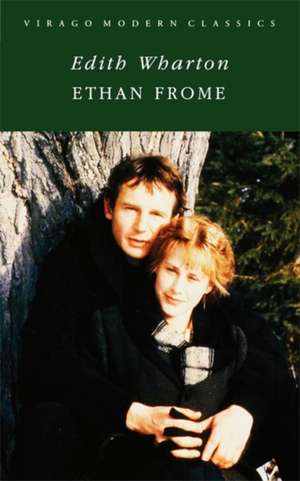
Ethan Frome: Virago Modern Classics
Autor Edith Whartonen Limba Engleză Paperback – 26 apr 2007
Din seria Virago Modern Classics
- 28%
 Preț: 56.44 lei
 - 26%
 Preț: 58.06 lei
 - 27%
 Preț: 57.23 lei
 - 27%
 Preț: 56.09 lei
 - 28%
 Preț: 65.48 lei
 - 28%
 Preț: 64.95 lei
 - 27%
 Preț: 51.24 lei
 - 25%
 Preț: 60.27 lei
 - 28%
 Preț: 56.23 lei
 - 26%
 Preț: 58.16 lei
 - 27%
 Preț: 57.51 lei
 - 28%
 Preț: 66.39 lei
 - 27%
 Preț: 57.30 lei
 - 28%
 Preț: 56.48 lei
 - 24%
 Preț: 95.87 lei
 - 27%
 Preț: 57.24 lei
 - 27%
 Preț: 57.44 lei
 - 27%
 Preț: 57.10 lei
 - 26%
 Preț: 68.91 lei
 - 26%
 Preț: 59.06 lei
 - 26%
 Preț: 91.72 lei
 - 24%
 Preț: 61.27 lei
 - 25%
 Preț: 60.03 lei
 - 27%
 Preț: 57.49 lei
 -
 Preț: 63.26 lei
 - 28%
 Preț: 56.19 lei
 - 28%
 Preț: 55.67 lei
 - 28%
 Preț: 56.58 lei
 - 26%
 Preț: 59.06 lei
 - 25%
 Preț: 92.67 lei
 -
 Preț: 79.15 lei
 - 22%
 Preț: 100.04 lei
 - 27%
 Preț: 56.40 lei
 - 27%
 Preț: 57.08 lei
 - 28%
 Preț: 54.79 lei
 - 26%
 Preț: 89.78 lei
 - 26%
 Preț: 52.45 lei
 - 25%
 Preț: 59.72 lei
 - 26%
 Preț: 59.09 lei
 - 27%
 Preț: 57.22 lei
 - 28%
 Preț: 55.77 lei
 - 27%
 Preț: 66.43 lei
 - 25%
 Preț: 91.99 lei
 - 28%
 Preț: 55.23 lei
 - 26%
 Preț: 58.22 lei
 - 27%
 Preț: 56.88 lei
 - 25%
 Preț: 59.57 lei
 - 23%
 Preț: 63.73 lei
Preț: 72.27 lei
Puncte Express: 108
Carte indisponibilă temporar
Livrare prin curier în România Termenul estimat este afișat lângă disponibilitate.
Transport gratuit de la 400.00 lei Plată online sau ramburs, în funcție de opțiunile comenzii.
Retur gratuit în 14 zile Comandă securizată și suport în română.
Specificații
ISBN-13: 9781844083527
ISBN-10: 1844083527
Pagini: 108
Ilustrații: black & white illustrations
Dimensiuni: 129 x 198 x 7 mm
Greutate: 0.09 kg
Ediția:Revised edition
Editura: Little Brown
Colecția Virago
Seria Virago Modern Classics
Locul publicării:London, United Kingdom
ISBN-10: 1844083527
Pagini: 108
Ilustrații: black & white illustrations
Dimensiuni: 129 x 198 x 7 mm
Greutate: 0.09 kg
Ediția:Revised edition
Editura: Little Brown
Colecția Virago
Seria Virago Modern Classics
Locul publicării:London, United Kingdom
V-ar putea interesa
-
 Carve the MarkVeronica RothPreț: 142.81 lei
 -
 -16%Preț: 106.30 lei126.96 lei
 -
 Vanity FairWilliam Makepeace Thackeray-20%Preț: 68.02 lei84.52 lei
 -
 A Room with a ViewE. M. Forster-27%Preț: 47.22 lei64.74 lei
 -
 Sons and LoversD. H. Lawrence-27%Preț: 62.80 lei85.54 lei
 -
 The Winter of Our DiscontentJohn SteinbeckPreț: 99.88 lei
 -
 The Curious Case of Benjamin ButtonF. Scott FitzgeraldPreț: 104.60 lei
 -
 Preț: 58.99 lei
 -
 Elizabeth and her German GardenElizabeth von Arnim-29%Preț: 45.32 lei63.60 lei
 -
 Home of the BraveKatherine ApplegatePreț: 59.52 lei
 -
 Moby DickHerman MelvillePreț: 43.37 lei
 -
 The English Teacher's Survival GuideMary Lou BrandvikPreț: 181.45 lei
 -
 Preț: 38.44 lei
 -
 EndangeredEliot SchreferPreț: 72.90 lei
 -
 Pie (Scholastic Gold)Sarah WeeksPreț: 50.45 lei
 -
 ThreatenedEliot SchreferPreț: 73.64 lei
 -
 ESL BeginnerBoguchwal SherryPreț: 136.29 lei
 -
 Three Books of Occult PhilosophyHenry C Agrippa-16%Preț: 452.62 lei540.78 lei
 -
 Preț: 255.44 lei
 -
 Oedipus RexSophoclesPreț: 52.99 lei
 -
 AntigoneSophoclesPreț: 49.18 lei
 -
 The Complete Plays of Jean RacineJean RacinePreț: 207.64 lei
 -
 The Man in the MoonWilliam JoycePreț: 127.06 lei
 -
 LilithGeorge MacdonaldPreț: 96.23 lei
Recenzii
Edith Wharton is unique in the intimacy and sureness, not to mention the virile and satiric tone, with which she investigates this narrow and declining society
Wharton's prose, with its menacing images of death and darkness, is superb. First published in 1911, it remains a hauntingly stark masterpiece
Wharton's prose, with its menacing images of death and darkness, is superb. First published in 1911, it remains a hauntingly stark masterpiece
Notă biografică
America's most famous woman of letters, and the first woman to win the Pulitzer Prize, Edith Wharton was born into one of the last "leisured class" families in New York City, as she put it, in 1862. Educated privately, she was married to Edward Wharton in 1885, and for the next few years, they spent their time in the high society of Newport (Rhode Island), then Lenox (Massachusetts) and Europe. It was in Europe that Wharton first met Henry James, who was to have a profound and lasting influence on her life and work. Wharton's first published book was a work of nonfiction, in collaboration with Ogden Codman, The Decoration of Houses (1897), but from early on, her marriage had been a source of distress, and she was advised by her doctor to write fiction to relieve her nervous tension. Wharton's first short stories appeared in Scribner's Magazine, and though she published several volumes of fiction around the turn of the century, including The Greater Inclination (1899), The Touchstone (1900), Crucial Instances (1901), The Valley of Decision (1902), Sanctuary (1903), and The Descent of Man and Other Stories (1904), it wasn't until 1905, with the publication of the bestselling The House of Mirth, that she was recognized as one of the most important novelists of her time for her keen social insight and subtle sense of satire. In 1906, Wharton visited Paris, which inspired Madame de Treymes (1907), and made her home there in 1907, finally divorcing her husband in 1912. The years before the outbreak of World War I represent the core of her artistic achievement, when Ethan Frome (1911), The Reef (1912), and The Custom of the Country (1913) were published. During the war, she remained in France organizing relief for Belgian refugees, for which she was later awarded the Legion of Honor. She also wrote two novels about the war, The Marne (1918) and A Son at the Front (1923), and continued, in France, to write about New England and the Newport society she had known so well in Summer (1917), the companion to Ethan Frome, and The Age of Innocence (1920), for which she won the Pulitzer Prize. Wharton died in France in 1937. Her other works include Old New York (1924), The Mother's Recompense (1925), The Writing of Fiction (1925), The Children (1928), Hudson River Bracketed (1929), and her autobiography, A Backward Glance (1934).
Cuprins
Acknowledgements
Introduction
Edith Wharton: A Brief Chronology
A Note on the Text
Ethan Frome
Appendix A: Writings by Edith Wharton
Introduction
Edith Wharton: A Brief Chronology
A Note on the Text
Ethan Frome
Appendix A: Writings by Edith Wharton
- Introduction to Ethan Frome (1922)
- From The Writing of Fiction (1925)
- From A Backward Glance (1934)
- “Mrs. Manstey’s View” (10 July 1891)
- Edith Wharton to Elizabeth Frelinghuysen Davis Lodge (20 June [1910])
- Edith Wharton to Bernard Berenson (4 January [1911])
- Edith Wharton to W. Morton Fullerton (16 October [1911])
- Henry James to Edith Wharton (25 October 1911)
- Edith Wharton to Charles Scribner (27 November [1911])
- From The New York Times (8 October 1911)
- From Outlook (21 October 1911)
- From The Nation (26 October 1911)
- From The Saturday Review (18 November 1911)
- From John Curtis Underwood, “Culture and Edith Wharton” (1914)
- From William Lyon Phelps, “The Advance of the English Novel,” The Bookman (July 1916)
- From Katharine Fullerton Gerould, Edith Wharton: A Critical Study (1922)
- From Alfred Kazin, “The Lady and the Tiger,” Virginia Quarterly Review (Winter 1941)
- From Percy Lubbock, Portrait of Edith Wharton (1947)
- From Aristotle, Poetics (335 BCE)
- From Arthur Miller, “Tragedy and the Common Man” (1949)
- From Richard Sewall, The Vision of Tragedy (1980)
- From Theodore Roosevelt, “The Strenuous Life” (1902)
- From Samuel McComb, “The Power of Suggestion in Nervous Troubles” (May 1908)
- From Sigmund Freud, Three Essays on Sexuality (1905) and “The Economic Problem of Masochism” (1924)
- From George Kennan, “The Problems of Suicide” (June 1908)
- Junius Browne, “Romantic Marriages” (January 1895)
- From Mrs. P.T. Barnum, “Moths of Modern Marriage” (March 1891)
- From Byron Hall, “A Lesson Conjugal” (1 September 1903)
- From William Lee Howard, Facts for the Married (1912)
- “Separation the Cure for Matrimonial Woe” (16 January 1905)
- From “Felix Adler on Divorce” (26 January 1905)
- “Lenox High School Girl Dashed to her Death,” The Berkshire Evening Eagle (12 March 1904)
- “A Sleeping Giant,” The Youth’s Companion (18 November 1909)
- From Rollin Lynde Hartt, “The Regeneration of Rural New England,” Outlook (3 March 1900)
- From “The Value of Natural Scenery,” Outlook (26 September 1908)
- The Mount, Lenox, Massachusetts (1906)
- The Mount, Lenox, Massachusetts (1906)
- Edith Wharton (1910)
- Wharton’s Library, The Mount (undated)
- Sledding in Lenox, Massachusetts (1890s)
- Cover of Ethan Frome, the Play (1936)
Textul de pe ultima copertă
Set against the bleak winter landscape of New England, Ethan Frome tells the story of a poor farmer, lonely and downtrodden, his wife Zeena, and her cousin, the enchanting Mattie Silver. In the playing out of this short novel's powerful and engrossing drama, Edith Wharton constructed her least characteristic and most celebrated book. In its unyielding and shocking pessimism, its bleak demonstration of tragic waste, it is a masterpiece of psychological and emotional realism. In her introduction the distinguished critic Elaine Showalter discusses the background to the novel's composition and the reasons for its enduring success.
Extras
I.
The village lay under two feet of snow, with drifts at thewindy corners. In a sky of iron the points of the Dipper hung like icicles and Orion flashed his cold fires. The moon had set, but the night was sotransparent that the white house-fronts between the elms looked grey against the snow, clumps of bushes made black stains on it, and the basement windows ofthe church sent shafts of yellow light far across the endless undulations.
Young Ethan Frome walked at a quick pace along the desertedstreet, past the bank and Michael Eady’s new brick store and Lawyer Varnum’shouse with the two black Norway spruces at the gate. Opposite the Varnum gate,where the road fell away toward the Corbury valley, the church reared its slimwhite steeple and narrow peristyle. As the young man walked toward it the upperwindows drew a black arcade along the side wall of the building, but from thelower openings, on the side where the ground sloped steeply down to the Corburyroad, the light shot its long bars, illuminating many fresh furrows in thetrack leading to the basement door, and showing, under an adjoining shed, aline of sleighs with heavily blanketed horses.
The night was perfectly still, and the air so dry and purethat it gave little sensation of cold. The effect produced on Frome was ratherof a complete absence of atmosphere, as though nothing less tenuous than etherintervened between the white earth under his feet and the metallic domeoverhead. ‘It’s like being in an exhausted receiver,’ he thought. Four or five years earlier he had taken a year’s course at a technological college at Worcester, and dabbled in the laboratory with a friendly professor of physics; and the images supplied by that experience still cropped up, at unexpectedmoments, through the totally different associations of thought in which he hadsince been living. His father’s death, and the misfortunes following it, had put a premature end to Ethan’s studies; but though they had not gone far enoughto be of much practical use they had fed his fancy and made him aware of hugecloudy meanings behind the daily face of things.
As he strode along through the snow the sense of such meanings glowed in his brain and mingled with the bodily flush produced by his sharptramp. At the end of the village he paused before the darkened front of the church. He stood there a moment, breathing quickly, and looking up and down the street, in which not another figure moved. The pitch of the Corbury road, below lawyer Varnum’s spruces, was the favourite coasting-ground of Stark field, andon clear evenings the church corner rang till late with the shouts of the coasters; but to-night not a sled darkened the whiteness of the long declivity. The hush of midnight lay on the village, and all its wakening life was gatheredbehind the church windows, from which strains of dance-music flowed with thebroad bands of yellow light.
The young man, skirting the side of the building, went down the slope toward the basement door. To keep out of range of the revealing raysfrom within he made a circuit through the untrodden snow and gradually approached the farther angle of the basement wall. Thence, still hugging theshadow, he edged his way cautiously forward to the nearest window, holding back his straight spare body and craning his neck till he got a glimpse of the room.
Seen thus, from the pure and frosty darkness in which hestood, it seemed to be seething in a mist of heat. The metal reflectors of the gas-jets sent crude waves of light against the whitewashed walls, and the iron flanksof the stove at the end of the hall looked as though they were heaving with volcanic fires. The floor was thronged with girls and young men. Down the sidewall facing the window stood a row of kitchen chairs from which the older womenhad just risen. By this time the music had stopped, and the musicians — a fiddler, and the young lady who played the harmonium on Sundays — were hastily refreshing themselves at one corner of the supper-table which aligned its devastated pie-dishes and ice-cream saucers on the platform at the end of the hall. The guests were preparing to leave, and the tide had already set toward the passage where coats and wraps were hung, when a young man with a sprightly foot and a shock of black hair shot into the middle of the floor and clapped his hands. The signal took instant effect. The musicians hurried to their instruments, the dancers — some already half-muffled for departure — fell into line down each side of the room, the older spectators slipped back to their chairs, and the lively young man, after diving about here and there in thethrong, drew forth a girl who had already wound a cherry-coloured ‘fascinator’ about her head, and, leading her up to the end of the floor, whirled her down its length to the bounding tune of a Virginia reel.
Frome’s heart was beating fast. He had been straining for aglimpse of the dark head under the cherry-coloured scar fand it vexed him that another eye should have been quicker than his. The leader of the reel, who looked as if he had Irish blood in his veins, danced well, and his partner caught his fire. As she passed down the line, her light figure swinging from hand to hand in circles of increasing swiftness, the scarf flew off her head and stood out behind her shoulders, and Frome, at each turn, caught sight of her laughing panting lips, the cloud of dark hair about her forehead, and the dark eyes which seemed the only fixed points in a maze off lying lines.
The dancers were going faster and faster, and the musicians,to keep up with them, belaboured their instruments like jockeys lashing their mounts on the home-stretch; yet it seemed to the young man at the window that the reel would never end. Now and then he turned his eyes from the girl’s faceto that of her partner, which, in the exhilaration of the dance, had taken on alook of almost impudent ownership. Denis Eady was the son of Michael Eady, the ambitious Irish grocer, whose suppleness and effrontery had given Starkfield its first notion of ‘smart’ business methods, and whose new brick store testified to the success of the attempt. His son seemed likely to follow in his steps, and was meanwhile applying the same arts to the conquest of the Starkfield maidenhood. Hitherto Ethan Frome had been content to think him a mean fellow; but now he positively invited a horse-whipping. It was strange that the girl did not seem aware of it: that she could lift her rapt face to her dancer’s, and drop her hands into his, without appearing to feel the offence of his look and touch.
Frome was in the habit of walking into Starkfield to fetchhome his wife’s cousin, Mattie Silver, on the rare evenings when some chance of amusement drew her to the village. It was his wife who had suggested, when the girl came to live with them, that such opportunities should be put in her way. Mattie Silver came from Stamford, and when she entered the Frames’ household toact as her cousin Zeena’s aid it was thought best, as she came without pay, not to let her feel too sharp a contrast between the life she had left and the isolation of a Starkfield farm. But for this — as Frome sardonically reflected —it would hardly have occurred to Zeena to take any thought for the girl’s amusement.
When his wife first proposed that they should give Mattie an occasional evening out he had inwardly demurred at having to do the extra two miles to the village and back after his hard day on the farm; but not long afterward he had reached the point of wishing that Starkfield might give all its nights to revelry.
Mattie Silver had lived under his roof for a year, and from early morning till they met at supper he had frequent chances of seeing her; but no moments in her company were comparable to those when, her arm in his, and her light step flying to keep time with his long stride, they walked back through the night to the farm. He had taken to the girl from the first day, when he had driven over to the Flats to meet her, and she had smiled and waved to him from the train, crying out ‘You must be Ethan!’ as she jumped down withher bundles, while he reflected, looking over her slight person: ‘She don’t look much on house-work, but she ain’t a fretter, anyhow.’ But it was not only that the coming to his house of a bit of hopeful young life was like the lighting of a fire on a cold hearth. The girl was more than the bright serviceable creature he had thought her. She had an eye to see and an ear to hear: he could show her things and tell her things, and taste the bliss of feeling that all he imparted left long reverberations and echoes he could wake at will.
It was during their night walks back to the farm that he felt most intensely the sweetness of this communion. He had always been more sensitive than the people about him to the appeal of natural beauty. His unfinished studies had given form to this sensibility and even in his unhappiest moments field and sky spoke to him with a deep and powerful persuasion. But hitherto the emotion had remained in him as a silent ache, veiling with sadness the beauty that evoked it. He did not even know whether anyone else in the world felt as he did, or whether he was the sole victim of this mournful privilege. Then he learned that one other spirit had trembled with the same touch of wonder: that at his side, living under his roof andeating his bread, was a creature to whom he could say: ‘That’s Orion downyonder; the big fellow to the right is Aldebaran, and the bunch of little ones —like bees swarming — they’re the Pleiades...’ or whom he could hold entranced before a ledge of granite thrusting up through the fern while he unrolled the huge panorama of the ice age, and the long dim stretches of succeeding time.The fact that admiration for his learning mingled with Mattie’s wonder at wha the taught was not the least part of his pleasure. And there were other sensations, less definable but more exquisite, which drew them together with ashock of silent joy: the cold red of sunset behind winter hills, the flight of cloud-flocks over slopes of golden stubble, or the intensely blue shadows of hemlocks on sunlit snow. When she said to him once: ‘It looks just as if it waspainted!’ it seemed to Ethan that the art of definition could go no farther, and that words had at last been found to utter his secret soul....
As he stood in the darkness outside the church the sememories came back with the poignancy of vanished things. Watching Mattie whirl down the floor from hand to hand, he wondered how he could ever have thought that his dull talk interested her. To him, who was never gay but in her presence, her gaiety seemed plain proof of indifference. The face she lifted to her dancers was the same which, when she saw him, always looked like a window that has caught the sunset. He even noticed two or three gestures which, in his fatuity, he had thought she kept for him: a way of throwing her head back when she was amused, as if to taste her laugh before she let it out, and a trick of sinking her lids slowly when anything charmed or moved her.
The sight made him unhappy, and his unhappiness roused his latent fears. His wife had never shown any jealousy of Mattie, but of late she had grumbled increasingly over the house-work and found oblique ways of attracting attention to the girl’s inefficiency. Zeena had always been what Starkfield called ‘sickly’, and Frome had to admit that, if she were as ailing as she believed, she needed the help of a stronger arm than the one which lay solightly in his during the night walks to the farm. Mattie had no natural turn for house-keeping, and her training had done nothing to remedy the defect. She was quick to learn, but forgetful and dreamy, and not disposed to take the matter seriously. Ethan had an idea that if she were to marry a man she was fond of the dormant instinct would wake, and her pies and biscuits become the pride of the county; but domesticity in the abstract did not interest her. At first she was so awkward that he could not help laughing at her; but she laughed with him and that made them better friends. He did his best to supplement her unskilled efforts, getting up earlier than usual to light the kitchen fire, carrying in the wood overnight, and neglecting the mill for the farm that he might help her about the house during the day. He even crept down on Saturday nights to scrub the kitchen floor after the women had gone to bed; and Zeena, one day, had surprised him at the churn and had turned away silently, with one of her queer looks.
Of late there had been other signs of his wife’s disfavour, as intangible but more disquieting. One cold winter morning, as he dressed in the dark, his candle flickering in the draught of the ill-fitting window, he had heard her speak from the bed behind him.
‘The doctor don’t want I should be left without anybody to do for me,’ she said in her flat whine.
He had supposed her to be asleep, and the sound of her voice had startled him, though she was given to abrupt explosions of speech afterlong intervals of secretive silence.
He turned and looked at her where she lay indistinctly outlined under the dark calico quilt, her high-boned face taking a greyish tinge from the whiteness of the pillow.
‘Nobody to do for you?’ he repeated.
‘If you say you can’t afford a hired girl when Mattie goes.’
Frome turned away again, and taking up his razor stooped to catch the reflection of his stretched cheek in the blotched looking-glass above the wash-stand.
‘Why on earth should Mattie go?’
‘Well, when she gets married, I mean,’ his wife’s drawl came from behind him.
‘Oh, she’d never leave us as long as you needed her,’ he returned, scraping hard at his chin.
‘I wouldn’t ever have it said that I stood in the way of a poor girl like Mattie marrying a smart fellow like Denis Eady,’ Zeena answered in a tone of plaintive self-effacement.
Ethan, glaring at his face in the glass, threw his head back to draw the razor from ear to chin. His hand was steady, but the attitude was an excuse for not making an immediate reply.
The village lay under two feet of snow, with drifts at thewindy corners. In a sky of iron the points of the Dipper hung like icicles and Orion flashed his cold fires. The moon had set, but the night was sotransparent that the white house-fronts between the elms looked grey against the snow, clumps of bushes made black stains on it, and the basement windows ofthe church sent shafts of yellow light far across the endless undulations.
Young Ethan Frome walked at a quick pace along the desertedstreet, past the bank and Michael Eady’s new brick store and Lawyer Varnum’shouse with the two black Norway spruces at the gate. Opposite the Varnum gate,where the road fell away toward the Corbury valley, the church reared its slimwhite steeple and narrow peristyle. As the young man walked toward it the upperwindows drew a black arcade along the side wall of the building, but from thelower openings, on the side where the ground sloped steeply down to the Corburyroad, the light shot its long bars, illuminating many fresh furrows in thetrack leading to the basement door, and showing, under an adjoining shed, aline of sleighs with heavily blanketed horses.
The night was perfectly still, and the air so dry and purethat it gave little sensation of cold. The effect produced on Frome was ratherof a complete absence of atmosphere, as though nothing less tenuous than etherintervened between the white earth under his feet and the metallic domeoverhead. ‘It’s like being in an exhausted receiver,’ he thought. Four or five years earlier he had taken a year’s course at a technological college at Worcester, and dabbled in the laboratory with a friendly professor of physics; and the images supplied by that experience still cropped up, at unexpectedmoments, through the totally different associations of thought in which he hadsince been living. His father’s death, and the misfortunes following it, had put a premature end to Ethan’s studies; but though they had not gone far enoughto be of much practical use they had fed his fancy and made him aware of hugecloudy meanings behind the daily face of things.
As he strode along through the snow the sense of such meanings glowed in his brain and mingled with the bodily flush produced by his sharptramp. At the end of the village he paused before the darkened front of the church. He stood there a moment, breathing quickly, and looking up and down the street, in which not another figure moved. The pitch of the Corbury road, below lawyer Varnum’s spruces, was the favourite coasting-ground of Stark field, andon clear evenings the church corner rang till late with the shouts of the coasters; but to-night not a sled darkened the whiteness of the long declivity. The hush of midnight lay on the village, and all its wakening life was gatheredbehind the church windows, from which strains of dance-music flowed with thebroad bands of yellow light.
The young man, skirting the side of the building, went down the slope toward the basement door. To keep out of range of the revealing raysfrom within he made a circuit through the untrodden snow and gradually approached the farther angle of the basement wall. Thence, still hugging theshadow, he edged his way cautiously forward to the nearest window, holding back his straight spare body and craning his neck till he got a glimpse of the room.
Seen thus, from the pure and frosty darkness in which hestood, it seemed to be seething in a mist of heat. The metal reflectors of the gas-jets sent crude waves of light against the whitewashed walls, and the iron flanksof the stove at the end of the hall looked as though they were heaving with volcanic fires. The floor was thronged with girls and young men. Down the sidewall facing the window stood a row of kitchen chairs from which the older womenhad just risen. By this time the music had stopped, and the musicians — a fiddler, and the young lady who played the harmonium on Sundays — were hastily refreshing themselves at one corner of the supper-table which aligned its devastated pie-dishes and ice-cream saucers on the platform at the end of the hall. The guests were preparing to leave, and the tide had already set toward the passage where coats and wraps were hung, when a young man with a sprightly foot and a shock of black hair shot into the middle of the floor and clapped his hands. The signal took instant effect. The musicians hurried to their instruments, the dancers — some already half-muffled for departure — fell into line down each side of the room, the older spectators slipped back to their chairs, and the lively young man, after diving about here and there in thethrong, drew forth a girl who had already wound a cherry-coloured ‘fascinator’ about her head, and, leading her up to the end of the floor, whirled her down its length to the bounding tune of a Virginia reel.
Frome’s heart was beating fast. He had been straining for aglimpse of the dark head under the cherry-coloured scar fand it vexed him that another eye should have been quicker than his. The leader of the reel, who looked as if he had Irish blood in his veins, danced well, and his partner caught his fire. As she passed down the line, her light figure swinging from hand to hand in circles of increasing swiftness, the scarf flew off her head and stood out behind her shoulders, and Frome, at each turn, caught sight of her laughing panting lips, the cloud of dark hair about her forehead, and the dark eyes which seemed the only fixed points in a maze off lying lines.
The dancers were going faster and faster, and the musicians,to keep up with them, belaboured their instruments like jockeys lashing their mounts on the home-stretch; yet it seemed to the young man at the window that the reel would never end. Now and then he turned his eyes from the girl’s faceto that of her partner, which, in the exhilaration of the dance, had taken on alook of almost impudent ownership. Denis Eady was the son of Michael Eady, the ambitious Irish grocer, whose suppleness and effrontery had given Starkfield its first notion of ‘smart’ business methods, and whose new brick store testified to the success of the attempt. His son seemed likely to follow in his steps, and was meanwhile applying the same arts to the conquest of the Starkfield maidenhood. Hitherto Ethan Frome had been content to think him a mean fellow; but now he positively invited a horse-whipping. It was strange that the girl did not seem aware of it: that she could lift her rapt face to her dancer’s, and drop her hands into his, without appearing to feel the offence of his look and touch.
Frome was in the habit of walking into Starkfield to fetchhome his wife’s cousin, Mattie Silver, on the rare evenings when some chance of amusement drew her to the village. It was his wife who had suggested, when the girl came to live with them, that such opportunities should be put in her way. Mattie Silver came from Stamford, and when she entered the Frames’ household toact as her cousin Zeena’s aid it was thought best, as she came without pay, not to let her feel too sharp a contrast between the life she had left and the isolation of a Starkfield farm. But for this — as Frome sardonically reflected —it would hardly have occurred to Zeena to take any thought for the girl’s amusement.
When his wife first proposed that they should give Mattie an occasional evening out he had inwardly demurred at having to do the extra two miles to the village and back after his hard day on the farm; but not long afterward he had reached the point of wishing that Starkfield might give all its nights to revelry.
Mattie Silver had lived under his roof for a year, and from early morning till they met at supper he had frequent chances of seeing her; but no moments in her company were comparable to those when, her arm in his, and her light step flying to keep time with his long stride, they walked back through the night to the farm. He had taken to the girl from the first day, when he had driven over to the Flats to meet her, and she had smiled and waved to him from the train, crying out ‘You must be Ethan!’ as she jumped down withher bundles, while he reflected, looking over her slight person: ‘She don’t look much on house-work, but she ain’t a fretter, anyhow.’ But it was not only that the coming to his house of a bit of hopeful young life was like the lighting of a fire on a cold hearth. The girl was more than the bright serviceable creature he had thought her. She had an eye to see and an ear to hear: he could show her things and tell her things, and taste the bliss of feeling that all he imparted left long reverberations and echoes he could wake at will.
It was during their night walks back to the farm that he felt most intensely the sweetness of this communion. He had always been more sensitive than the people about him to the appeal of natural beauty. His unfinished studies had given form to this sensibility and even in his unhappiest moments field and sky spoke to him with a deep and powerful persuasion. But hitherto the emotion had remained in him as a silent ache, veiling with sadness the beauty that evoked it. He did not even know whether anyone else in the world felt as he did, or whether he was the sole victim of this mournful privilege. Then he learned that one other spirit had trembled with the same touch of wonder: that at his side, living under his roof andeating his bread, was a creature to whom he could say: ‘That’s Orion downyonder; the big fellow to the right is Aldebaran, and the bunch of little ones —like bees swarming — they’re the Pleiades...’ or whom he could hold entranced before a ledge of granite thrusting up through the fern while he unrolled the huge panorama of the ice age, and the long dim stretches of succeeding time.The fact that admiration for his learning mingled with Mattie’s wonder at wha the taught was not the least part of his pleasure. And there were other sensations, less definable but more exquisite, which drew them together with ashock of silent joy: the cold red of sunset behind winter hills, the flight of cloud-flocks over slopes of golden stubble, or the intensely blue shadows of hemlocks on sunlit snow. When she said to him once: ‘It looks just as if it waspainted!’ it seemed to Ethan that the art of definition could go no farther, and that words had at last been found to utter his secret soul....
As he stood in the darkness outside the church the sememories came back with the poignancy of vanished things. Watching Mattie whirl down the floor from hand to hand, he wondered how he could ever have thought that his dull talk interested her. To him, who was never gay but in her presence, her gaiety seemed plain proof of indifference. The face she lifted to her dancers was the same which, when she saw him, always looked like a window that has caught the sunset. He even noticed two or three gestures which, in his fatuity, he had thought she kept for him: a way of throwing her head back when she was amused, as if to taste her laugh before she let it out, and a trick of sinking her lids slowly when anything charmed or moved her.
The sight made him unhappy, and his unhappiness roused his latent fears. His wife had never shown any jealousy of Mattie, but of late she had grumbled increasingly over the house-work and found oblique ways of attracting attention to the girl’s inefficiency. Zeena had always been what Starkfield called ‘sickly’, and Frome had to admit that, if she were as ailing as she believed, she needed the help of a stronger arm than the one which lay solightly in his during the night walks to the farm. Mattie had no natural turn for house-keeping, and her training had done nothing to remedy the defect. She was quick to learn, but forgetful and dreamy, and not disposed to take the matter seriously. Ethan had an idea that if she were to marry a man she was fond of the dormant instinct would wake, and her pies and biscuits become the pride of the county; but domesticity in the abstract did not interest her. At first she was so awkward that he could not help laughing at her; but she laughed with him and that made them better friends. He did his best to supplement her unskilled efforts, getting up earlier than usual to light the kitchen fire, carrying in the wood overnight, and neglecting the mill for the farm that he might help her about the house during the day. He even crept down on Saturday nights to scrub the kitchen floor after the women had gone to bed; and Zeena, one day, had surprised him at the churn and had turned away silently, with one of her queer looks.
Of late there had been other signs of his wife’s disfavour, as intangible but more disquieting. One cold winter morning, as he dressed in the dark, his candle flickering in the draught of the ill-fitting window, he had heard her speak from the bed behind him.
‘The doctor don’t want I should be left without anybody to do for me,’ she said in her flat whine.
He had supposed her to be asleep, and the sound of her voice had startled him, though she was given to abrupt explosions of speech afterlong intervals of secretive silence.
He turned and looked at her where she lay indistinctly outlined under the dark calico quilt, her high-boned face taking a greyish tinge from the whiteness of the pillow.
‘Nobody to do for you?’ he repeated.
‘If you say you can’t afford a hired girl when Mattie goes.’
Frome turned away again, and taking up his razor stooped to catch the reflection of his stretched cheek in the blotched looking-glass above the wash-stand.
‘Why on earth should Mattie go?’
‘Well, when she gets married, I mean,’ his wife’s drawl came from behind him.
‘Oh, she’d never leave us as long as you needed her,’ he returned, scraping hard at his chin.
‘I wouldn’t ever have it said that I stood in the way of a poor girl like Mattie marrying a smart fellow like Denis Eady,’ Zeena answered in a tone of plaintive self-effacement.
Ethan, glaring at his face in the glass, threw his head back to draw the razor from ear to chin. His hand was steady, but the attitude was an excuse for not making an immediate reply.