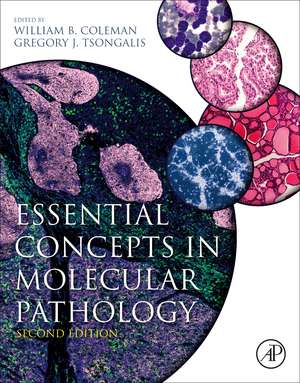
Essential Concepts in Molecular Pathology
Editat de William B. Coleman, Gregory J. Tsongalisen Limba Engleză Paperback – 25 noi 2019
Sub coordonarea editorilor William B. Coleman și Gregory J. Tsongalis, personalități marcante în cercetarea biomedicală, Essential Concepts in Molecular Pathology se impune ca o resursă academică riguroasă, menită să pună în dialog patologia tradițională cu descoperirile geneticii moderne. Putem afirma că lucrarea nu este doar o simplă sinteză, ci o recalibrare a materialului vast din ediția mamă, Molecular Pathology, fiind adaptată special pentru studenții la medicină și rezidenții care au nevoie de o bază conceptuală solidă fără a parcurge un tratat enciclopedic. Cartea extinde cadrul propus de Principles of Molecular Pathology cu date noi despre genomul și epigenomul uman, oferind o perspectivă de biologie integrativă a sistemelor.
Notăm cu interes modul în care autorii poziționează această lucrare în raport cu proiectele lor anterioare, precum The Molecular Basis of Human Cancer sau Molecular Diagnostics. Dacă acelea se concentrau pe nișe specifice (oncologie sau tehnici de laborator), volumul de față servește drept punte de legătură, explicând cum mecanismele moleculare dictează manifestările clinice vizibile în histopatologie. Structura este bicefală: prima parte analizează procesele fundamentale precum inflamația și neoplazia, în timp ce a doua parte plonjează în arhitectura moleculară a transcriptomului și a variațiilor genetice.
Experiența de parcurgere este facilitată de o organizare extrem de logică, unde fiecare capitol se încheie cu puncte de sumar ce fixează conceptele-cheie. Stilul este unul tehnic, precis, eliminând redundanțele pentru a lăsa loc explicațiilor despre medicina personalizată și diagnosticarea moleculară. Față de Pathology: A Modern Case Study, care mizează pe studii de caz, acest manual preferă o abordare sistematică a principiilor, fiind ideal pentru curriculumul universitar care vizează înțelegerea cauzalității bolilor la nivel celular.
Preț: 540.59 lei
Preț vechi: 779.51 lei
-31%
Carte tipărită la comandă
Livrare economică 23 noiembrie-07 decembrie
Specificații
ISBN-10: 0128132574
Pagini: 634
Dimensiuni: 216 x 276 x 34 mm
Ediția:2
Editura: ELSEVIER SCIENCE
V-ar putea interesa
-
 Nucleic Acids, Part DNathan P. Kaplan-27%Preț: 744.94 lei1020.47 lei
 -
 Plasma Lipoproteins, Part C: QuantitationJohn N. Abelson-27%Preț: 741.89 lei1016.28 lei
 -
 Gene Expression Systems: Using Nature for the Art of ExpressionJoseph M. Fernandez-23%Preț: 479.20 lei622.33 lei
 -
 -8%Preț: 435.41 lei473.27 lei
 -
 -5%Preț: 569.40 lei599.37 lei
 -
 Diagnostic Molecular Pathology: A Guide to Applied Molecular TestingWilliam B. Coleman-25%Preț: 769.97 lei1021.98 lei
 -
 Molecular Pathology: The Molecular Basis of Human DiseaseWilliam B. Coleman-29%Preț: 782.76 lei1102.44 lei
 -
 -28%Preț: 736.35 lei1016.96 lei
 -
 Cell SignallingJohn T. Hancock-20%Preț: 424.25 lei529.81 lei
 -
 -27%Preț: 1197.52 lei1640.45 lei
 -
 Aaron Klug - A Long Way from DurbanKenneth C. HolmesPreț: 366.76 lei
 -
 Rye: Genetics, Breeding, and CultivationRolf H. J. Schlegel-15%Preț: 615.01 lei723.53 lei
 -
 Aquaculture Microbiology and Biotechnology, Volume TwoDidier Montet-15%Preț: 659.01 lei775.30 lei
 -
 -23%Preț: 732.44 lei951.23 lei
 -
 Advances in Lipobiology, Volume 1R.W. Gross-23%Preț: 734.88 lei954.39 lei
 -
 Molecular DiagnosticsWilliam B. Coleman-5%Preț: 1692.88 lei1781.98 lei
 -
 G-Quadruplex Structures, Formation & Role in BiologyHannah Santos-27%Preț: 1274.96 lei1736.85 lei
 -
 A Practical Guide to Using Glycomics DatabasesKiyoko F. Aoki-Kinoshita-24%Preț: 914.03 lei1202.67 lei
 -
 BASE EXCISION REPAIR PATHWAY, THEIii David M Wilson-18%Preț: 1694.28 lei2066.20 lei
Public țintă
Biomedical graduate students, allied health students, medical students studying pathology, human disease, and the translational aspects of basic science; residents and postdoctoral fellows in pathology, laboratory medicine, and internal medicine; practicing basic scientists and physician scientists.De ce să citești această carte
Recomandăm această carte studenților și rezidenților care doresc să înțeleagă biologia din spatele fiziopatologiei. Este un text esențializat care face legătura între patologia clasică și medicina de precizie. Cititorul câștigă o înțelegere clară a modului în care genomica și epigenomica transformă diagnosticul modern, beneficiind de un format structurat pentru învățare rapidă și eficientă, fără a sacrifica rigoarea științifică a editurii ELSEVIER SCIENCE.
Descriere scurtă
By bridging molecular concepts of pathogenesis to the clinical expression of disease in cell, tissue and organ, this fully updated, introductory reference provides the background necessary for an understanding of today’s advances in pathology and medicine.
- Explains the practice of "molecular medicine" and the translational aspects of molecular pathology, including molecular diagnostics, molecular assessment and personalized medicine
- Orients non-pathologists on what pathologists look for and how they interpret their observational findings based on histopathology
- Provides the reader with what is missing from most targeted introductions to pathology—the cell biology behind pathophysiology
Cuprins
1. Molecular Mechanisms of Cell Death
2. Acute and Chronic Inflammation
3. Infection and Host Response
4. Neoplasia
PART II Concepts in Molecular Biology and Genetics
5. Basic Concepts in Human Molecular Genetics
6. The Human Genome: Implications for the Understanding of Human Disease
7. The Human Transcriptome: Implications for the Understanding of Human Disease
8. The Human Epigenome: Implications for the Understanding of Human Disease
9. Clinical Proteomics and Molecular Pathology
10. Integrative Systems Biology: Implications for the Understanding of Human Disease
11. Pathology: The Clinical Description of Human Disease
12. Molecular Pathogenesis: The Biological Basis of Human Disease and Implications for Improved Treatment of Human Disease
13. Integration of Molecular and Cellular Pathogenesis
PART IV Molecular Pathology of Human Disease
14. Molecular Basis of Cardiovascular Disease
15. Molecular Basis of Hemostatic and Thrombotic Diseases
16. Molecular Basis of Lymphoid and Myeloid Diseases
17. Molecular Basis of Diseases of Immunity
18. Molecular Basis of Pulmonary Disease
19. Molecular Basis of Diseases of the Gastrointestinal Tract
20. Molecular Basis of Liver Disease
21. Molecular Basis of Diseases of the Exocrine Pancreas
22. Molecular Basis of Diseases of the Endocrine System
23. Molecular Basis of Gynecologic Diseases
24. Molecular Pathogenesis of Kidney Diseases
25. Molecular Pathogenesis of Prostate Cancer: Somatic, Epigenetic, and Genetic Alterations
26. Molecular Biology of Breast Cancer
27. Molecular Basis of Skin Disease
28. Molecular Pathology: Neuropathology
PART V Practice of Molecular Medicine
29. Molecular Diagnosis of Human Disease
30. Molecular Assessment of Human Disease in the Clinical Laboratory
31. Pharmacogenomics and Personalized Medicine in the Treatment of Human Disease
Recenzii
Praise for the first edition:
"The book is compact, easy to follow, filled with useful tables and figures and deserves reading by students and professionals interested in the molecular basis of disease." --Howard Reisner PhD, Professor of Pathology and Laboratory Medicine, University of North Carolina at Chapel Hill, North Carolina, USA
"Finally, a book that captures the real world environment of molecular diagnosis and pathology…is available in Essential Concepts in Molecular Pathology! --Rodney E. Rohde, MS, SV, SM, MP (ASCP), Associate Professor, Texas State University-San Marcos, Clinical Laboratory Science, San Marcos, TX, USA