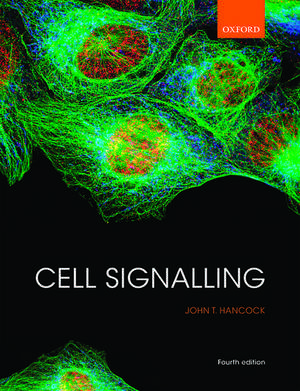
Cell Signalling
Autor John T. Hancocken Limba Engleză Paperback – 15 dec 2016
Preț: 424.25 lei
Preț vechi: 529.81 lei
-20%
Puncte Express: 636
Carte disponibilă
Livrare economică 06-17 noiembrie
Livrare express 24-30 octombrie pentru 112.68 lei
Livrare prin curier în România Termenul estimat este afișat lângă disponibilitate.
Transport gratuit pentru acest produs Plată online sau ramburs, în funcție de opțiunile comenzii.
Retur gratuit în 14 zile Comandă securizată și suport în română.
Specificații
ISBN-13: 9780199658480
ISBN-10: 019965848X
Pagini: 456
Ilustrații: Over 120 colour illustrations
Dimensiuni: 191 x 246 x 18 mm
Greutate: 0.86 kg
Ediția:4 Revised edition
Editura: OUP OXFORD
Colecția OUP Oxford
Locul publicării:Oxford, United Kingdom
ISBN-10: 019965848X
Pagini: 456
Ilustrații: Over 120 colour illustrations
Dimensiuni: 191 x 246 x 18 mm
Greutate: 0.86 kg
Ediția:4 Revised edition
Editura: OUP OXFORD
Colecția OUP Oxford
Locul publicării:Oxford, United Kingdom
V-ar putea interesa
-
 Evolution: From Molecules to EcosystemsAndres Moya-33%Preț: 525.12 lei783.54 lei
 -
 Molecular Machines in BiologyJoachim Frank-14%Preț: 746.82 lei868.40 lei
 -
 Fluorescent Analogs of Biomolecular Building BlocksMarcus Wilhelmsson-9%Preț: 1103.81 lei1212.97 lei
 -
 The Manga Guide to Molecular BiologyMasaharu Takemura-18%Preț: 129.35 lei158.62 lei
 -
 EDEXCEL Biology 1 A-Level 1/AS Student WorkbookTracey GreenwoodPreț: 152.37 lei
Recenzii
A good overview of the key underlying concepts and principles, allowing students to gain a solid grounding in the subject. I like the Case Study sections which link to research findings; these provide relevant context and help students to understand the key message in complex scientific articles.
It is really the best specialist text for undergraduates on this topic I have seen.
Review from previous edition: John Hancock's Cell Signalling is a straightforward introduction to a rapidly expanding field of biology. Its unintimidating writing style, simple and uncluttered figures, and competitive price make it a wonderful introductory text for undergraduates.
Review from previous edition: Complexity and specificity are the hallmarks of cell signalling, yet Hancock in this third edition has gone a long way to simplify these complicated processes. His signalling examples are clever and well-conceived, his writing descriptive and his passion for his subject infectious ... this is marvellous value for money and is a worthy companion to an undergraduate/postgraduate reference library.
It is really the best specialist text for undergraduates on this topic I have seen.
Review from previous edition: John Hancock's Cell Signalling is a straightforward introduction to a rapidly expanding field of biology. Its unintimidating writing style, simple and uncluttered figures, and competitive price make it a wonderful introductory text for undergraduates.
Review from previous edition: Complexity and specificity are the hallmarks of cell signalling, yet Hancock in this third edition has gone a long way to simplify these complicated processes. His signalling examples are clever and well-conceived, his writing descriptive and his passion for his subject infectious ... this is marvellous value for money and is a worthy companion to an undergraduate/postgraduate reference library.
Notă biografică
John Hancock is Professor of Cell Signalling at the University of the West of England. He has had a long standing interest in cell signalling and redox biology, and tries to bring these together as much as possible in his research. In addition to Cell Signalling he has published several reviews on nitric oxide and reactive oxygen species, and most recently on hydrogen sulfide.