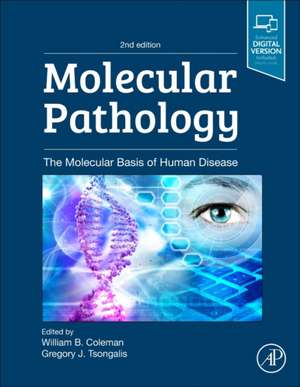
Molecular Pathology: The Molecular Basis of Human Disease
Editat de William B. Coleman, Gregory J. Tsongalisen Limba Engleză Hardback – 20 dec 2017
Acest manual de referință, Molecular Pathology, aflat la a doua ediție, reprezintă o resursă fundamentală pentru înțelegerea mecanismelor moleculare care stau la baza bolilor umane. Apreciem modul în care editorii William B. Coleman și Gregory J. Tsongalis au structurat cele peste 800 de pagini pentru a face tranziția de la patologia tradițională către medicina moleculară modernă. Ediția actuală integrează progresele tehnologice din ultimii șapte ani, oferind o perspectivă asupra biologiei sistemelor integrative, esențială în contextul actual al cercetării biomedicale.
Descoperim aici o organizare riguroasă, care debutează cu principiile fundamentale ale patogenezei și mecanismele morții celulare, continuând cu analiza detaliată a genomului, transcriptomului și epigenomului uman. Un element distinctiv este capitolul despre bioinformatică, care servește drept punte de legătură pentru integrarea datelor complexe în practica clinică. Considerăm că această lucrare completează perspectiva oferită de Essential Concepts in Molecular Pathology, de același autor, adăugând profunzime teoretică și detalii tehnice extinse pe care varianta condensată le omite în favoarea accesibilității.
În contextul operei lui William B. Coleman, acest volum acționează ca pilon central, oferind baza teoretică pentru lucrări mai aplicate precum Molecular Diagnostics. Dacă Principles of Molecular Pathology de Anthony Killeen se concentrează pe o introducere concisă și stil de scriere fluid, manualul de față explorează exhaustiv corelația dintre evoluția bolii și mecanismele sale moleculare, fiind ideal pentru curriculumul universitar avansat și pentru cercetătorii care au nevoie de o resursă de referință cuprinzătoare.
Preț: 782.76 lei
Preț vechi: 1102.44 lei
-29%
Carte tipărită la comandă
Livrare economică 26 noiembrie-10 decembrie
Specificații
ISBN-10: 0128027614
Pagini: 802
Dimensiuni: 216 x 276 x 43 mm
Greutate: 2.43 kg
Ediția:2
Editura: ELSEVIER SCIENCE
V-ar putea interesa
-
 Essential Concepts in Molecular PathologyWilliam B. Coleman-25%Preț: 363.82 lei484.93 lei
 -
 -5%Preț: 296.63 lei312.23 lei
 -
 Electrocardiography of Laboratory AnimalsJeffrey W. Richig-28%Preț: 908.93 lei1259.61 lei
 -
 Diagnostic Molecular Pathology: A Guide to Applied Molecular TestingWilliam B. Coleman-24%Preț: 788.80 lei1040.05 lei
 -
 Endocrine Biomarkers: Clinicians and Clinical Chemists in PartnershipHossein Sadrzadeh-21%Preț: 551.08 lei697.52 lei
 -
 -31%Preț: 245.02 lei356.87 lei
 -
 The Common Marmoset in Captivity and Biomedical ResearchRobert P. Marini-28%Preț: 1227.05 lei1697.22 lei
 -
 Pharmacology Flash CardsGeorge M. Brenner-5%Preț: 264.93 lei278.88 lei
 -
 Advances in Molecular Pathology, 2019Gregory J Tsongalis-5%Preț: 1312.40 lei1381.47 lei
 -
 -19%Preț: 530.28 lei654.67 lei
 -
 -25%Preț: 476.15 lei636.78 lei
 -
 Applying Pharmacogenomics in TherapeuticsXiaodong Feng-18%Preț: 1416.75 lei1727.75 lei
 -
 HematologyS. Z. a. Zaidi-5%Preț: 248.88 lei261.98 lei
 -
 Molecular DiagnosticsWilliam B. Coleman-5%Preț: 1692.88 lei1781.98 lei
 -
 Diagnostic EnzymologySteven Kazmierczak-5%Preț: 491.73 lei517.62 lei
 -
 -5%Preț: 902.26 lei949.75 lei
 -
 ROS and Antioxidant Systems in ApoptosisChristian Oberdanner-5%Preț: 355.78 lei374.50 lei
 -
 -5%Preț: 410.78 lei432.40 lei
De ce să citești această carte
Recomandăm acest manual studenților la medicină și rezidenților care doresc să depășească nivelul introductiv al patologiei clasice. Cititorul câștigă o înțelegere profundă a medicinei translaționale, învățând cum genetica și biologia moleculară dictează diagnosticul și tratamentul modern. Este o investiție esențială pentru cei care vizează o carieră în cercetarea biomedicală sau patologia clinică de înaltă performanță.
Descriere scurtă
The Second Edition of Molecular Pathology has been thoroughly updated to reflect seven years of exponential changes in the fields of genetics, molecular, and cell biology which molecular pathology translates in the practice of molecular medicine. The textbook is intended to serve as a multi-use textbook that would be appropriate as a classroom teaching tool for biomedical graduate students, medical students, allied health students, and others (such as advanced undergraduates). Further, this textbook will be valuable for pathology residents and other postdoctoral fellows that desire to advance their understanding of molecular mechanisms of disease beyond what they learned in medical/graduate school. In addition, this textbook is useful as a reference book for practicing basic scientists and physician scientists that perform disease-related basic science and translational research, who require a ready information resource on the molecular basis of various human diseases and disease states.
- Explores the principles and practice of molecular pathology: molecular pathogenesis, molecular mechanisms of disease, and how the molecular pathogenesis of disease parallels the evolution of the disease
- Explains the practice of “molecular medicine and the translational aspects of molecular pathology
- Teaches from the perspective of “integrative systems biology
- Enhanced digital version included with purchase
Cuprins
2. Acute and Chronic Inflammation Induces Disease Pathogenesis
3. Infection and Host Response
4. Neoplasia
5. Basic Concepts in Human Molecular Genetics
6. The Human Genome: Implications for the Understanding of Human Disease
7. The Human Transcriptome: Implications for the Understanding of Human Disease
8. The Human Epigenome: Implications for the Understanding of Human Disease
9. Clinical Proteomics and Molecular Pathology
10. Integrative Systems Biology: Implications for the Understanding of Human Disease
11. Pathology: The Clinical Description of Human Disease
12. Understanding Molecular Pathogenesis: Implications for Improved Treatment of Human Disease
13. Integration of Molecular and Cellular Pathogenesis: A Bioinformatics Approach
14. Molecular Basis of Cardiovascular Disease
15. Molecular Basis of Hemostatic and Thrombotic Diseases
16. Molecular Basis of Lymphoid and Myeloid Diseases
17. Molecular Basis of Diseases of Immunity
18. Molecular Basis of Pulmonary Disease
19. Molecular Basis of Diseases of the Gastrointestinal Tract
20. Molecular basis of Liver Disease
21. Molecular basis of diseases of the exocrine pancreas
22. Molecular Basis of Diseases of the Endocrine System
23. Molecular Basis of Gynecologic Diseases
24. Molecular Basis of Kidney Disease
25. Molecular Pathogenesis of Prostate Cancer
26. Molecular Biology of Breast Cancer
27. Molecular Basis of Skin Disease
28. Molecular Basis of Bone diseases
29. Molecular Basis of Diseases of the Nervous System
30. Molecular Diagnosis of Human Disease
31. Molecular Assessment of Human Disease in the Clinical Laboratory
32. Pharmacogenomics and Personalzed Medicine in the Treatment of Human Disease