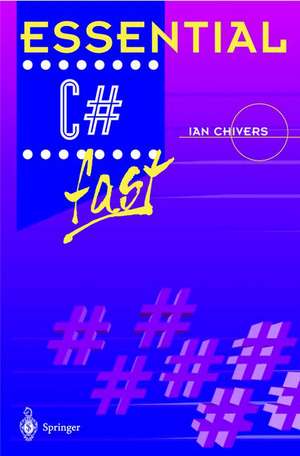
Essential C# fast: Essential Series
Autor Ian Chiversen Limba Engleză Paperback – 25 apr 2003
Din seria Essential Series
-
 Preț: 41.99 lei
 - 20%
 Preț: 320.59 lei
 - 20%
 Preț: 323.89 lei
 - 20%
 Preț: 318.89 lei
 - 20%
 Preț: 318.80 lei
 - 20%
 Preț: 296.61 lei
 - 20%
 Preț: 331.63 lei
 - 20%
 Preț: 319.96 lei
 - 20%
 Preț: 261.58 lei
 - 20%
 Preț: 332.91 lei
 - 20%
 Preț: 191.49 lei
 - 20%
 Preț: 318.73 lei
 - 20%
 Preț: 292.72 lei
 - 20%
 Preț: 616.72 lei
 - 20%
 Preț: 314.67 lei
 - 20%
 Preț: 317.08 lei
 - 20%
 Preț: 320.76 lei
 - 20%
 Preț: 237.92 lei
 - 20%
 Preț: 321.66 lei
 - 20%
 Preț: 614.03 lei
 - 20%
 Preț: 317.60 lei
 - 20%
 Preț: 324.41 lei
 - 20%
 Preț: 643.63 lei
 - 20%
 Preț: 318.00 lei
 - 20%
 Preț: 316.86 lei
 - 20%
 Preț: 319.36 lei
 - 20%
 Preț: 616.88 lei
Preț: 307.54 lei
Preț vechi: 384.42 lei
-20%
Puncte Express: 461
Carte tipărită la comandă
Livrare economică 05-19 decembrie
Livrare prin curier în România Termenul estimat este afișat lângă disponibilitate.
Transport gratuit de la 400.00 lei Plată online sau ramburs, în funcție de opțiunile comenzii.
Retur gratuit în 14 zile Comandă securizată și suport în română.
Specificații
ISBN-13: 9781852335625
ISBN-10: 1852335629
Pagini: 320
Ilustrații: XIII, 303 p.
Dimensiuni: 155 x 235 x 18 mm
Greutate: 0.49 kg
Ediția:Softcover reprint of the original 1st ed. 2003
Editura: Springer
Colecția Essential Series
Seria Essential Series
Locul publicării:London, United Kingdom
ISBN-10: 1852335629
Pagini: 320
Ilustrații: XIII, 303 p.
Dimensiuni: 155 x 235 x 18 mm
Greutate: 0.49 kg
Ediția:Softcover reprint of the original 1st ed. 2003
Editura: Springer
Colecția Essential Series
Seria Essential Series
Locul publicării:London, United Kingdom
V-ar putea interesa
-
 The C++ Programming LanguageBjarne Stroustrup-20%Preț: 507.21 lei634.02 lei
 -
 Python Programming for BiologyTim J. Stevens-20%Preț: 460.01 lei575.01 lei
 -
 Beginning Programming with C++ For DummiesStephen R. Davis-20%Preț: 173.62 lei217.02 lei
 -
 Pro ASP.NET Web API SecurityBadrinarayanan Lakshmiraghavan-20%Preț: 525.86 lei657.33 lei
 -
 -20%Preț: 230.97 lei288.71 lei
 -
 -20%Preț: 156.43 lei195.54 lei
 -
 Functional Programming in ScalaRunar Bjarnason-20%Preț: 340.60 lei425.75 lei
 -
 Python Programming for BeginnersJoseph Joyner-20%Preț: 53.61 lei67.02 lei
 -
 Murachs C# 2012Joel Murach-28%Preț: 359.74 lei496.79 lei
 -
 Practical Aspects of Declarative LanguagesPascal Van Hentenryck-20%Preț: 332.26 lei415.32 lei
 -
 OpenMPSimon Hoffmann-20%Preț: 177.74 lei222.18 lei
 -
 -20%Preț: 329.60 lei412.00 lei
 -
 -20%Preț: 319.42 lei399.28 lei
 -
 -20%Preț: 320.24 lei400.30 lei
 -
 Programming Languages and SystemsHongseok Yang-20%Preț: 327.27 lei409.09 lei
 -
 -20%Preț: 321.17 lei401.46 lei
 -
 -20%Preț: 317.85 lei397.31 lei
Public țintă
Professional/practitionerCuprins
1. Overview.- 1.1 Assumptions.- 1.2 What Is Covered.- 1.3 System Requirements.- 1.4 C# History.- 1.5 Languages and Standards.- 1.6 Algorithms and Libraries.- 1.7 News Groups.- 1.8 Bibliography.- 2. Language Concepts.- 2.1 Programming Language Developments.- 2.2 C# Concepts and Terminology.- 2.3 Bibliography.- 3. An Introduction to Programming in C#.- 3.1 Introduction.- 3.2 Hello World Using the Console.- 3.3 Hello World Using Developer Studio.- 3.4 Console Application.- 3.5 SimpleText I/O.- 3.6 Simple Numeric I/O.- 3.7 On-Line Documentation.- 3.8 Key Concepts of C#.- 3.9 Summary.- 4. Arithmetic and Expressions.- 4.1 Introduction.- 4.2 Integral Types.- 4.3 Floating Point Types.- 4.4 The Decimal Type.- 4.5 Math Members.- 4.6 Operators.- 4.7 Simple and Aliased Types.- 4.8 Integer Arithmetic.- 4.9 Floating Point Arithmetic.- 4.10 Formatting Numbers.- 4.11 Escape Sequences.- 4.12 Literals.- 4.13 Arithmetic in Other languages.- 4.14 Summary.- 4.15 Bibliography.- 4.16 Problems.- 5. Some More on Data Types.- 5.1 Booleans.- 5.2 Characters and Strings.- 5.3 Value and Reference Types.- 5.4 Enum Types.- 5.5 Other Types.- 5.6 C# Keywords.- 5.7 Comments.- 5.8 Summary.- 5.9 Problem.- 6. Strings.- 6.1 Basic String Manipulation.- 6.2 Concatenating and Splitting Strings.- 6.3 Using the Length Property and IndexOf Method.- 6.4 String Constructors, Fields, Methods, Operators and Properties.- 6.5 Problems.- 7. Arrays.- 7.1 Introduction.- 7.2 One-dimensional Arrays.- 7.3 Array Initialization.- 7.4 Simple Two-dimensional Arrays.- 7.5 Arrays of Arrays.- 7.6 Ragged Arrays.- 7.7 List of Array Members.- 7.8 Summary.- 7.9 Problems.- 8. Control Structures.- 8.1 Statement End Points and Reachability.- 8.2 Types of Statements.- 8.3 Selection Statements.- 8.4 Iteration Statements.- 8.5 Jump Statements.- 8.6 Exception Handling Using Try, Catch Throw.- 8.7 Summary.- 8.8 Bibliography.- 8.9 Problems.- 9. Input and Output.- 9.1 Introduction.- 9.2 Using the Console Class.- 9.3 Using the StreamReader Class.- 9.4 Specifying the File Location.- 9.5 Reading from Standard Input.- 9.6 Reading from the Command Line.- 9.7 Using StreamReader and StreamWriter with Hard-coded File Names.- 9.8 Reading a File from a Web Server.- 9.9 Reading Tabular Data from a Text File.- 9.10 The System.Console Class.- 9.11 The StreamReader Class.- 9.12 The System.IO.File Class.- 9.13 Problems.- 10. Exceptions.- 10.1 Introduction.- 10.2 The Exception Hierarchy.- 10.3 Integer Arithmetic Exceptions.- 10.4 Floating Point Exceptions.- 10.5 Summary.- 11. Threads.- 11.1 Introduction.- 11.2 Basic Thread Syntax.- 11.3 Using the Sleep Method.- 11.4 Threads and Static Variables.- 11.5 Threads with Start, Suspend and Resume.- 11.6 Thread Priority.- 11.7 Thread States.- 11.8 Microsoft Examples.- 11.9 Bibliography.- 11.10 Problems.- 12. Structs.- 12.1 Introduction.- 12.2 Basic Syntax.- 12.3 Simple Example.- 13. Classes.- 13.1 Basic Class Syntax.- 13.2 Examples.- 13.3 Passing Parameters.- 13.4 Instance and Static Members.- 13.5 Additional Syntax.- 13.6 Bibliography.- 14. The System. Collections Namespace.- 14.1 Introduction.- 14.2 Using the Hashtable Class.- 14.3 Using the SortedList Class.- 14.4 A Spelling Checker.- 14.5 Summary.- 14.6 Bibliography.- 15. Operator Overloading.- 15.1 Complex Numbers.- 15.2 Complex Arithmetic in Other Languages.- 15.3 Complex Numbers Using the Float Data Type.- 15.4 Complex Numbers Using the Double Data Type.- 15.5 Complex Arithmetic Using Implicit Type Conversions.- 15.6 Complex Arithmetic Using Explicit Type Conversions.- 15.7 Arrays of Complex Numbers.- 15.8 Summary.- 16. An Introduction to Windows Programming.- 16.1 Introduction.- 16.2 The .Net IDE.- 16.3 Buttons and Event Handling Using a MessageBox Control.- 16.4 Using a TextBox to Accept User Input.- 16.5 Using a RichTextBox to Display Program Output.- 16.6 Using a PictureBox to Display an Image.- 16.7 Selecting a File with the OpenFileDialog Control.- 16.8 Text and Graphics Using GDI+.- 16.9 Converting a Console to a Windows Application.- 16.10 Bibliography.- 17. Additional Language Features.- 17.1 Events and Event Handling.- 17.2 Interfaces.- 17.3 Attributes.- 17.4 Delegates.- 17.5 Windows-based Programming.- 17.6 Namespaces.- 17.7 Assemblies and Versioning.- 17.8 Bibliography.- 18. Where Next?.- 18.1 Online Documentation.- 18.2 Examples.- 18.3 Tutorials.- 18.4 Wizards.- 18.5 Web Sources.- 18.6 Books.- 18.7 Microsoft.- 18.8 Source Code.- 18.9 Coda.- Appendix A.- Default Coordinate System Example in C++.
Caracteristici
A quick, practical introduction to the C# programming language Includes lots of clear simple examples, highlighting the core features of the language This is a new language, and there are not many introductory books on the full release version of C# yet - which came out early in 2002 Includes supplementary material: sn.pub/extras