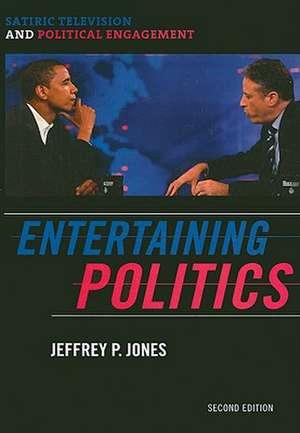
Entertaining Politics: Satiric Television and Political Engagement
Autor Jeffrey P. Jonesen Limba Engleză Paperback – 16 dec 2009
Descoperim în Entertaining Politics o analiză surprinzătoare a modului în care satira televizată a încetat să fie doar un divertisment marginal pentru a deveni o sursă vitală de critică politică și economică. Într-o epocă marcată de 'truthiness' și știri false, Jeffrey P. Jones ne propune o radiografie a maturizării acestui gen, demonstrând cum emisiuni iconice precum The Daily Show sau The Colbert Report au preluat rolul de mediatori ai vieții politice. Cartea amintește de Satire TV – Politics and Comedy in the Post–Network Era de Jonathan Gray prin interesul pentru transformarea comediei într-o resursă de informare, dar se distinge prin accentul pus pe impactul psihologic și civic asupra audienței, demontând mitul tinerilor spectatori „cinici”.
Suntem de părere că această a doua ediție, considerabil extinsă, oferă o perspectivă academică riguroasă asupra tranziției de la jurnalismul tradițional la formele hibride de 'infotainment'. Autorul, cunoscut și pentru lucrări precum The Essential HBO Reader, își folosește expertiza în comunicare pentru a contextualiza satira în cadrul mai larg al campaniilor electorale și al culturii media contemporane. Structura volumului este una progresivă: pornește de la redefinirea angajamentului civic pe micul ecran, analizează transformarea talk-show-ului politic și culminează cu un studiu detaliat asupra parodiei de tip 'punditry'. Este un demers care nu doar descrie un fenomen, ci îl legitimează ca pe un pilon al democrației moderne, unde umorul devine un instrument de cercetare a adevărului.
Preț: 333.17 lei
Preț vechi: 409.41 lei
-19%
Carte tipărită la comandă
Livrare economică 28 noiembrie-12 decembrie
Specificații
ISBN-10: 0742565289
Pagini: 311
Dimensiuni: 148 x 228 x 22 mm
Greutate: 0.53 kg
Ediția:2nd ed.
Editura: Bloomsbury Publishing
Colecția Rowman & Littlefield
Locul publicării:New York, United States
V-ar putea interesa
-
 Preț: 151.42 lei
 -
 -19%Preț: 358.11 lei439.66 lei
 -
 Intercultural PragmaticsIstvan Kecskes-31%Preț: 741.55 lei1080.82 lei
 -
 Humanity's LawRuti Teitel-20%Preț: 304.40 lei381.47 lei
 -
 The Practice of Public DiplomacyW. RughPreț: 391.23 lei
 -
 Freedom's BattleGary J. BassPreț: 153.36 lei
 -
 Advocacy and Social Work PracticeTom Wilks-21%Preț: 200.22 lei252.11 lei
 -
 Branding Cities: Cosmopolitanism, Parochialism, and Social ChangeStephanie Hemelryk DonaldPreț: 477.89 lei
 -
 Citizens, Politics and Social CommunicationR. Robert HuckfeldtPreț: 304.24 lei
 -
 The Nature and Origins of Mass OpinionJohn R. ZallerPreț: 267.49 lei
 -
 -37%Preț: 250.76 lei398.75 lei
 -
 The Ethics of Armed Humanitarian InterventionDon E. ScheidPreț: 221.43 lei
 -
 International Law and International RelationsDavid ArmstrongPreț: 380.80 lei
 -
 International Public Relations and Public DiplomacyGuy J. GolanPreț: 415.54 lei
 -
 Managing the Public's Trust in Non-profit OrganizationsChristopher D.B. BurtPreț: 361.78 lei
De ce să citești această carte
Recomandăm această carte studenților la jurnalism, științe politice sau sociologie, dar și spectatorilor care doresc să înțeleagă mecanismele din spatele emisiunilor de tip 'fake news'. Cititorul va câștiga o perspectivă nuanțată asupra modului în care satira poate stimula implicarea civică în loc să o descurajeze, oferind argumente solide împotriva prejudecăților legate de consumul de divertisment politic.
Despre autor
Jeffrey P. Jones este profesor asociat de comunicare la Old Dominion University și un cercetător respectat în domeniul intersecției dintre politică și cultura populară. Expertiza sa acoperă o gamă largă de subiecte, de la dinamica campaniilor prezidențiale americane, explorată în The 2012 Presidential Campaign, până la evoluția televiziunii prin cablu, analizată în The Essential HBO Reader. Prin munca sa, Jones investighează modul în care formele media emergente modelează opinia publică și comportamentul cetățenesc, fiind o voce autorizată în studiul televiziunii americane contemporane.
Descriere
Cuprins
Chapter 2 The Changing Face of Politics on Television
Chapter 3 Rethinking Television's Relationship to Civic Engagement
Part 4 Part II: Entertaining Political Talk
Chapter 5 From Insiders to Outsiders: The Transformation of Political Talk on Television
Chapter 6 New Political Television: Questioning News Media's Regime of Truth
Chapter 7 The Competing Senses of Political Insiders and Outsiders
Chapter 8 Changing the Conversation: The Daily Show's Interviews and Interrogations
Part 9 Part III: Faking it (For Real) in News and Talk
Chapter 10 Muckraking Through Fake Newsmagazines: Michael Moore's Satire TV
Chapter 11 Fake News vs. Real News: The Case of The Daily Show and CNN
Chapter 12 Faux Real and Faux Play: The Parody of Punditry in The Colbert Report
Part 13 Part IV: Audiences / Fans / Citizens
Chapter 14 Viewer Engagement Beyond Information Acquisition: Celebrity, Talk, and Play
Chapter 15 The Expanding and Contested Boundaries of New Political Television
Chapter 16 Appendix: Methodology for Audience Research
Recenzii
Media practitioners and critics, along with a small but growing number of scholars, have increasingly noted the role of entertainment programming in public discourse about politics. Most observers lament this apparent trend, doing so with little attempt to place it in the context of democratic theory or practice. Entertaining Politics helps fill this void and in the process provides a nuanced, provocative-and at times optimistic-view of the changing face of television and politics.
These are more than interesting times-they are entertaining ones. And the risk of that is a trivialization of politics, a loss of seriousness, and a spread of ignorance. But does that mean we should simply deride popular culture and the media, or rather that we must address them all the more urgently? Jeff Jones has the answers to these questions, and he acts as a perfect guide along a path to our enlightenment.
Entertaining Politics shows us why we must take satiric television seriously. Jeff Jones' cases and insights help us consider and question the political landscape in important ways. The first edition has been warmly received in my undergraduate survey courses and graduate research seminars; this engaging and detailed second edition will be equally attractive to a wide range of audiences attempting to make sense of the changing face of politics on television.
The book is annotated and could serve as supplementary reading for courses in US electoral politics, communications and politics, and mass media.... Recommended.
Praise for the First Edition:
This is a fresh and stimulating contribution to the study of media and politics. Jeffrey Jones underscores in a compelling way the complexity behind such traditional polarities as 'information' and 'entertainment,' and sheds new light on key concepts such as 'engagement.' Looking at contemporary humorous political talk shows on television, Jones highlights with insight and clarity the inexorable links between politics and popular culture. His book marks a major step forward in our understanding of civic culture and its relationship to the ubiquitous media milieu. Demonstrating analytic depth and yet written in an accessible manner, this book will become an important bridge between political communication and cultural studies.
It is a second edition, but such is the significance of this work that for anyone interested in the intersections of politics and popular culture -- even those who have read the original -- this book is an absolute must-read.