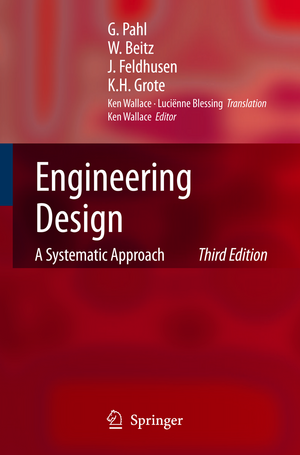
Engineering Design
Autor Gerhard Pahl, W. Beitz, Jörg Feldhusen, Karl-Heinrich Groteen Limba Engleză Hardback – 12 dec 2006
Lucrarea Engineering Design se adresează specialiștilor și studenților la nivel de masterat sau doctorat, presupunând o bază solidă de cunoștințe tehnice și o înțelegere prealabilă a principiilor fundamentale de inginerie. Descoperim aici un tratat de referință care transformă procesul de creație tehnică dintr-o activitate intuitivă într-o metodologie riguroasă și planificată. Reținem că această a treia ediție în limba engleză, tradusă sub egida unor instituții prestigioase precum University of Cambridge, integrează perspective moderne asupra mecatronicii și adaptronicii, reflectând evoluția sistemelor tehnice complexe. Structura volumului este una progresivă și logică, oglindind etapele reale ale dezvoltării unui produs. Putem afirma că parcurgerea cuprinsului — de la clarificarea sarcinii de proiectare și designul conceptual până la regulile de „embodiment design” — oferă o hartă completă pentru managementul proiectelor de inginerie. Față de lucrarea anterioară a autorilor, Konstruieren mit 3D-CAD-Systemen, care se concentra pe modelarea tridimensională, prezentul volum extinde orizontul către planificarea strategică, comportamentul echipelor și estimarea costurilor. Cititorul care a aplicat ideile din Introduction to Design Engineering de W. Ernst Eder va găsi aici o aprofundare a modelelor abstracte prin metode de lucru concrete și studii de caz actualizate. În timp ce Engineering Design Methods de Nigel Cross oferă o privire de ansamblu excelentă asupra strategiilor de proiectare, Gerhard Pahl și colaboratorii săi propun un nivel de detaliu tehnic superior, axat pe reguli de proiectare pentru minimizarea uzurii și sustenabilitate prin reciclare. Tonul este unul practic, axat pe eficiență, oferind instrumente de evaluare a soluțiilor care elimină ambiguitatea din procesul de dezvoltare.
Preț: 631.37 lei
Preț vechi: 742.79 lei
-15%
Carte tipărită la comandă
Livrare economică 04-18 decembrie
Specificații
ISBN-10: 1846283183
Pagini: 617
Ilustrații: XXI, 617 p.
Dimensiuni: 161 x 244 x 40 mm
Greutate: 1.07 kg
Ediția:3rd edition
Editura: SPRINGER LONDON
Locul publicării:London, United Kingdom
V-ar putea interesa
-
 -39%Preț: 483.04 lei798.37 lei
 -
 -31%Preț: 526.00 lei759.22 lei
 -
 Computational Intelligence in Design and ManufacturingAndrew Kusiak-14%Preț: 931.37 lei1082.98 lei
 -
 Notes on the Synthesis of FormChristopher AlexanderPreț: 235.55 lei
 -
 Design-Tech: Building Science for ArchitectsJason Alread-8%Preț: 496.29 lei539.45 leiRecomandat
 -
 Product Design for StudentsPeter BarkerPreț: 317.98 lei
 -
 Sustainable Design from Vision to ActionJeremy FaludiPreț: 393.26 lei
 -
 Preț: 231.49 lei
 -
 -19%Preț: 526.02 lei649.41 lei
 -
 Product Development and Management Body of KnowledgeAllan AndersonPreț: 403.49 lei
 -
 -23%Preț: 813.65 lei1056.69 lei
 -
 ISE Product Design and DevelopmentKarl Ulrich-37%Preț: 365.29 lei577.37 lei
 -
 Managing Engineering DesignCrispin Hales-15%Preț: 618.05 lei727.12 lei
 -
 -30%Preț: 234.31 lei335.86 lei
 -
 -19%Preț: 282.20 lei348.18 lei
 -
 Design Engineering JourneyRamana M. PidapartiPreț: 436.57 lei
 -
 Circular Economy in Engineering Design and ProductionSamira KeivanpourPreț: 311.36 lei
 -
 Delft Design Guide (revised edition): Perspectives - Models - Approaches - MethodsAnnemiek van Boeijen-19%Preț: 209.61 lei260.28 lei
 -
 Design. Think. Make. Break. Repeat.: Revised editionMartin Tomitsch-20%Preț: 183.96 lei230.75 lei
Public țintă
GraduateDe ce să citești această carte
Recomandăm această carte inginerilor care doresc să implementeze un flux de lucru sistematic în dezvoltarea de produse. Veți câștiga o metodologie recunoscută internațional pentru gestionarea complexității tehnice, de la faza de concept până la optimizarea costurilor și a calității. Este o resursă esențială pentru trecerea de la designul academic la practica industrială avansată, oferind soluții concrete pentru integrarea mecatronicii în proiectele curente.
Despre autor
Gerhard Pahl a fost un pionier al metodologiei de proiectare, contribuind fundamental la standardele germane de inginerie (VDI). Alături de W. Beitz, a transformat modul în care este predat și practicat designul tehnic la nivel global. Experiența sa academică și industrială este completată în această ediție de expertiza profesorilor Jörg Feldhusen și Karl-Heinrich Grote. Coordonarea traducerii de către Ken Wallace și Luciënne Blessing asigură adaptarea perfectă a terminologiei riguroase germane pentru mediul de inginerie anglo-saxon și internațional.
Cuprins
Recenzii
Warren Seering, Weber-Shaughness Professor of Mechanical Engineering, Massachusetts Institute of Technology
On the second edition of this title:
"With a renewed interest in the critical role product design plays in maintaining economic competitiveness, American designers would be well advised to become thoroughly acquainted with this wealth of information."
American Scientist
Notă biografică
Dr.Ing. Joerg Feldhusen graduated from the Technical University of Berlin in 1989. Between 1989 and 1994 he was the department head of Electronic Design at AEG Westinghouse Transportation Systems, Berlin. He then went on to become head of design and development of the Duewag railway vehicle manufacturing company, Duesseldorf, followed by technical manager of Siemens Light Rail, Düsseldorf and Erlangen. In 1999 he was made professor forEngineering Design and in 2000 director of the Institute for General Mechanical Engineering Design Technology of the Technical College of Rhineland-Westphalia in Aachen.
Dr.Ing. Karl Grote graduated from DO Berlin in 1984 and then studied for his Postdoc in the USA. In 1990 he became professor at the California State University, Long Beach, USA, before moving to the OvG Univ. Magdeburg in 1995. From October 2002 to September 2004 he was a visiting professor at the Engineering Design Research Laboratory of Professor Erik Antonsson, CalTech, Pasadena, USA.
Textul de pe ultima copertă
Engineering Design (3rd edition) describes a systematic approach to engineering design. The authors argue that such an approach, applied flexibly and adapted to a particular task, is essential for successful product development. The design process is first broken down into phases and then into distinct steps, each with its own working methods. The third edition of this internationally-recognised text is enhanced with new perspectives and the latest thinking. These include extended treatment of product planning; new sections on organisation structures, simultaneous engineering, leadership and team behaviour; and updated chapters on quality methods and estimating costs. New examples have been added and existing ones extended, with additions on design to minimise wear, design for recycling, mechanical connections, mechatronics, and adaptronics.
Engineering Design (3rd edition) is translated and edited from the sixth German edition by Ken Wallace, Professor of Engineering Design at the University of Cambridge, and Luciënne Blessing, Professor of Engineering Design and Methodology at the Technical University of Berlin.
Topics covered include:
- fundamentals;
- product planning and product development;
- task clarification and conceptual design;
- embodiment design rules, principles and guidelines;
- mechanical connections, mechatronics and adaptronics;
- size ranges and modular products;
- quality methods; and
- cost estimation methods.
Engineering Design is widely acknowledged to be the most complete available treatise on systematic design methods. In it, each step of the engineering design process and associated best practices are documented. The book has particularly strong sections on design from the functional perspective and on the phase of the process between conceptual and detail design in which most key design decisions are made. The 3rd edition includes new material on project planning and scheduling. Anyone committed to understanding the design process should be familiar with the contents of this book.
Warren Seering, Weber-Shaughness Professor of Mechanical Engineering, Massachusetts Institute of Technology