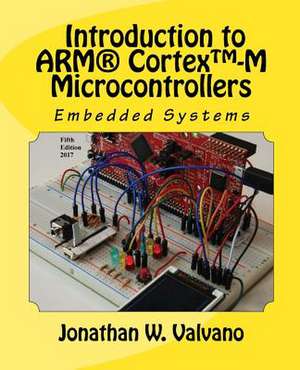
Embedded Systems
Autor Jonathan W. Valvanoen Limba Engleză Paperback
Actualizarea adusă de această ediție reflectă tranziția necesară în educația inginerească de la microcontrolerele simple pe 8 biți către arhitecturile complexe Arm(r) Cortex-M, capabile să gestioneze miliarde de calcule pe secundă. Observăm că Jonathan W. Valvano nu se limitează la o simplă prezentare a fișelor tehnice, ci construiește un cadru aplicativ riguros pentru interfațarea sistemelor încorporate. Ne-a atras atenția structura didactică ce pune accent pe laboratoare practice și puncte de control cu răspunsuri incluse, facilitând o învățare activă.
Textul explorează în detaliu metodologia de design, de la sincronizarea hardware/software la procesarea semnalelor digitale și comunicarea wireless. Într-o eră în care complexitatea software-ului crește exponențial, volumul pune un accent deosebit pe verificarea sistemului și pe toleranța la erori, aspecte esențiale în aplicațiile industriale moderne. Apreciem integrarea unor concepte avansate precum filtrele analogice și digitale, controlul motoarelor și proiectarea pentru IoT, oferind o viziune de ansamblu asupra ecosistemului Embedded Systems.
Complementar lucrării Fast and Effective Embedded Systems Design de Tim Wilmshurst, care utilizează ecosistemul mbed pentru prototipare rapidă, volumul de față oferă o bază teoretică și practică mult mai profundă asupra arhitecturii specifice MSP432 și a mecanismelor interne de interfațare. În timp ce Embedded Systems with ARM Cortex-M Microcontrollers in Assembly Language and C de Yifeng Zhu se concentrează masiv pe instrucțiunile de asamblare și reprezentarea datelor, Jonathan W. Valvano extinde perspectiva către integrarea la nivel de sistem și performanța în timp real, pregătind terenul pentru cel de-al treilea volum dedicat sistemelor de operare.
Preț: 242.26 lei
Preț vechi: 302.82 lei
-20%
Carte disponibilă
Livrare economică 05-19 noiembrie
Specificații
ISBN-10: 1477508996
Pagini: 508
Dimensiuni: 201 x 239 x 30 mm
Greutate: 0.91 kg
Ediția:2
Editura: CreateSpace Independent Publishing Platform
V-ar putea interesa
-
 -41%Preț: 457.81 lei769.47 lei
 -
 Embedded Systems: ARM Programming and OptimizationJason D. Bakos-34%Preț: 412.11 lei624.90 lei
 -
 -20%Preț: 279.02 lei348.77 lei
 -
 Principles of Computer HardwareAlan Clements-29%Preț: 602.71 lei846.14 lei
 -
 ARM System-on-Chip ArchitectureSteve Furber-23%Preț: 591.53 lei768.22 lei
 -
 -40%Preț: 458.81 lei768.90 lei
 -
 -31%Preț: 441.34 lei639.30 lei
 -
 Modern Assembly Language Programming with the ARM ProcessorLarry D Pyeatt-31%Preț: 462.90 lei675.11 lei
 -
 Computer Architecture: A Quantitative ApproachJohn L. Hennessy-39%Preț: 534.37 lei882.55 lei
 -
 Embedded System Design: Methodologies and IssuesLawrence J. Henschen-40%Preț: 431.09 lei719.49 lei
 -
 Software Engineering Essentials, Volume IRichard Hall Thayer-20%Preț: 287.02 lei358.79 lei
 -
 Software Engineering Essentials, Volume IIRichard Hall Thayer-20%Preț: 286.67 lei358.33 lei
 -
 Software Engineering Essentials, Volume IIIRichard Hall Thayer-20%Preț: 226.11 lei282.63 lei
 -
 -8%Preț: 451.09 lei490.32 lei
 -
 Operating Systems: Internals and Design Principles, Global EditionWilliam Stallings-20%Preț: 703.73 lei879.66 lei
 -
 Making Embedded SystemsElecia White-38%Preț: 200.48 lei324.68 lei
 -
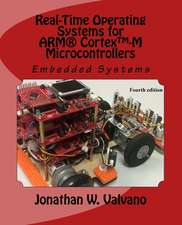 Embedded SystemsJonathan ValvanoPreț: 293.05 lei
 -
 Introduction to Computer Organization: ARM EditionRobert G. Plantz-35%Preț: 303.72 lei468.10 lei
 -
 The Art of ARM Assembly Volume 1Randall Hyde-35%Preț: 433.39 lei665.56 lei
 -
 Embedded Systems Design using the MSP430FR2355 LaunchPad(TM)Brock J. Lameres-20%Preț: 375.56 lei469.44 lei
De ce să citești această carte
Recomandăm acest volum studenților la inginerie electrică și profesioniștilor care doresc să stăpânească arhitectura ARM Cortex-M. Cititorul câștigă competențe concrete în proiectarea interfețelor, procesarea semnalelor și dezvoltarea de soluții IoT. Este o resursă tehnică solidă pentru oricine dorește să treacă de la proiecte hobby la sisteme încorporate profesionale, robuste și verificate riguros.