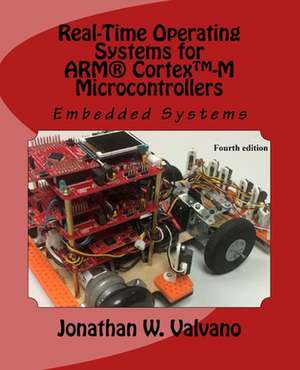
Embedded Systems
Autor Jonathan Valvanoen Limba Engleză Paperback
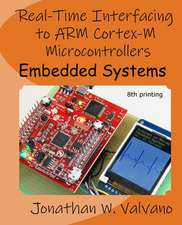
Prin parcurgerea acestui volum, cititorul va dobândi capacitatea de a proiecta și implementa propriul sistem de operare în timp real (RTOS) pe platforme ARM Cortex-M, trecând dincolo de simpla utilizare a unor soluții software preexistente. Remarcăm o structură riguros tehnică, unde accentul cade pe înțelegerea blocurilor fundamentale ce alcătuiesc dispozitive complexe precum sistemele de frânare ABS, controlerele de motor sau echipamentele medicale. Subliniem faptul că Embedded Systems de Jonathan Valvano nu este o simplă recapitulare a fișelor tehnice, ci un ghid metodologic care utilizează exemple de design concrete pentru a ilustra sincronizarea hardware/software și procesarea semnalelor în timp real.
Observăm că abordarea diferă de Embedded System Design with ARM Cortex-M Microcontrollers de Cem Ünsalan prin faptul că este mai puțin abstractă și mult mai aplicabilă la nivel de nucleu de sistem de operare; în timp ce Cem Ünsalan explorează RTOS prin prisma FreeRTOS, Jonathan Valvano ghidează cititorul în scrierea codului sursă pentru gestionarea thread-urilor și a resurselor. De asemenea, spre deosebire de Fast and Effective Embedded Systems Design de Tim Wilmshurst, care se bazează pe ecosistemul mbed, acest manual oferă un control mult mai granular asupra arhitecturii hardware LM3S și TM4C. Experiența de învățare este susținută de laboratoare practice și proiecte Keil uVision, transformând teoria filtrelor digitale și a controlului motoarelor în implementări funcționale, esențiale pentru aplicații moderne de robotică și IoT.
Preț: 293.05 lei
Carte tipărită la comandă
Livrare economică 27 noiembrie-11 decembrie
Specificații
ISBN-10: 1466468866
Pagini: 486
Dimensiuni: 191 x 231 x 28 mm
Greutate: 0.82 kg
Ediția:2
Editura: CreateSpace Independent Publishing Platform
V-ar putea interesa
-
 -41%Preț: 457.81 lei769.47 lei
 -
 Embedded Systems: ARM Programming and OptimizationJason D. Bakos-34%Preț: 412.11 lei624.90 lei
 -
 -20%Preț: 279.02 lei348.77 lei
 -
 ARM System-on-Chip ArchitectureSteve Furber-23%Preț: 591.53 lei768.22 lei
 -
 -40%Preț: 458.81 lei768.90 lei
 -
 -31%Preț: 441.34 lei639.30 lei
 -
 Modern Assembly Language Programming with the ARM ProcessorLarry D Pyeatt-31%Preț: 463.18 lei675.11 lei
 -
 Computer Architecture: A Quantitative ApproachJohn L. Hennessy-39%Preț: 534.37 lei882.55 lei
 -
 Embedded System Design: Methodologies and IssuesLawrence J. Henschen-40%Preț: 431.09 lei719.49 lei
 -
 Software Engineering Essentials, Volume IRichard Hall Thayer-20%Preț: 287.02 lei358.79 lei
 -
 Software Engineering Essentials, Volume IIRichard Hall Thayer-20%Preț: 286.67 lei358.33 lei
 -
 Software Engineering Essentials, Volume IIIRichard Hall Thayer-20%Preț: 226.11 lei282.63 lei
 -
 Operating Systems: Internals and Design Principles, Global EditionWilliam Stallings-20%Preț: 703.73 lei879.66 lei
 -
 Making Embedded SystemsElecia White-38%Preț: 200.48 lei324.68 lei
 -
 Embedded SystemsJonathan W. Valvano-20%Preț: 248.55 lei310.69 lei
 -
 Embedded SystemsJonathan W. Valvano-20%Preț: 242.26 lei302.82 lei
 -
 Modern C, Third EditionJens Gustedt-20%Preț: 350.34 lei437.92 lei
 -
 Introduction to Computer Organization: ARM EditionRobert G. Plantz-35%Preț: 303.72 lei468.10 lei
 -
 The Art of ARM Assembly Volume 1Randall Hyde-35%Preț: 433.39 lei665.56 lei
 -
 -36%Preț: 295.65 lei462.12 lei
 -
 Concise Guide to the Internet of ThingsMichael Mccarthy-20%Preț: 421.74 lei527.18 lei
De ce să citești această carte
Recomandăm această carte inginerilor și studenților care doresc să stăpânească arhitectura ARM la un nivel profund. Cititorul câștigă abilitatea critică de a dezvolta un RTOS de la zero, înțelegând exact cum sunt gestionate întreruperile și resursele hardware. Este un instrument esențial pentru cei care lucrează la sisteme critice unde performanța și predictibilitatea în timp real sunt obligatorii, oferind o bază solidă pentru proiecte complexe de robotică.