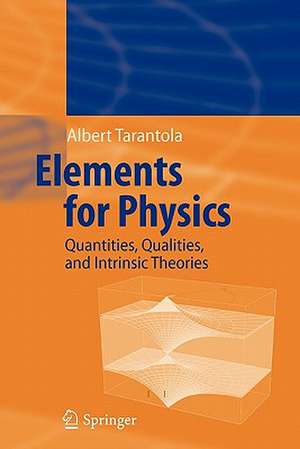
Elements for Physics
Autor Albert Tarantolaen Limba Engleză Paperback – 12 feb 2010
Preț: 375.34 lei
Puncte Express: 563
Carte tipărită la comandă
Livrare economică 24 noiembrie-08 decembrie
Livrare prin curier în România Termenul estimat este afișat lângă disponibilitate.
Transport gratuit de la 400.00 lei Plată online sau ramburs, în funcție de opțiunile comenzii.
Retur gratuit în 14 zile Comandă securizată și suport în română.
Specificații
ISBN-13: 9783642064524
ISBN-10: 3642064523
Pagini: 280
Ilustrații: XIV, 266 p. 44 illus., 10 illus. in color.
Dimensiuni: 155 x 235 x 16 mm
Greutate: 0.43 kg
Ediția:Softcover reprint of hardcover 1st edition 2006
Editura: Springer
Locul publicării:Berlin, Heidelberg, Germany
ISBN-10: 3642064523
Pagini: 280
Ilustrații: XIV, 266 p. 44 illus., 10 illus. in color.
Dimensiuni: 155 x 235 x 16 mm
Greutate: 0.43 kg
Ediția:Softcover reprint of hardcover 1st edition 2006
Editura: Springer
Locul publicării:Berlin, Heidelberg, Germany
V-ar putea interesa
-
 -20%Preț: 394.89 lei496.49 lei
 -
 Sociophysics: An IntroductionParongama Sen-24%Preț: 665.30 lei876.47 lei
 -
 Mathematics for PhysicistsBrian R. MartinPreț: 443.98 lei
 -
 Principia: The Authoritative TranslationIsaac NewtonPreț: 146.15 lei
 -
 Quantum GravityCarlo Rovelli-11%Preț: 689.32 lei774.51 lei
 -
 Groups, Representations and PhysicsH.F Jones-15%Preț: 632.97 lei744.67 lei
 -
 Geometry, Topology and PhysicsMikio Nakahara-18%Preț: 728.00 lei887.81 lei
 -
 Lectures on Quantum MechanicsSteven WeinbergPreț: 470.84 lei
 -
 A Student's Guide to Dimensional AnalysisDon S. LemonsPreț: 218.88 lei
 -
 Introduction to Mathematica® for PhysicistsAndrey GrozinPreț: 473.71 lei
 -
 Mathematical PhysicsSadri Hassani-17%Preț: 569.82 lei686.52 lei
 -
 Towards the Mathematics of Quantum Field TheoryFrédéric Paugam-18%Preț: 1165.29 lei1421.09 lei
 -
 Mathematical Tools for Physicists 2eM. Grinfeld-9%Preț: 1104.47 lei1213.71 lei
 -
 -33%Preț: 567.40 lei848.57 lei
 -
 A First Course in Mathematical PhysicsCT WhelanPreț: 342.58 lei
 -
 -15%Preț: 436.46 lei513.49 lei
Public țintă
GraduateCuprins
Geotensors.- Tangent Autoparallel Mappings.- Quantities and Measurable Qualities.- Intrinsic Physical Theories.
Notă biografică
Professor at the University of Paris. Doctor Honoris Causa by the University of Copenhagen. Silver medal of the French National Science Foundation. Author of a well-known book on Inverse Problem Theory.
Textul de pe ultima copertă
While usual presentations of physical theories emphasize the notion of physical quantity, this book shows that there is much to gain when introducing the notion of physical quality. The usual physical quantities simply appear as coordinates over the manifolds representing the physical qualities. This allows to develop physical theories that have a degree of invariance much deeper than the usual one. It is shown that properly developed physical theories contain logarithms and exponentials of tensors: their conspicuous absence in usual theories suggests, in fact, that the fundamental invariance principle stated in this book is lacking in present-day mathematical physics. The book reviews and extends the theory if Lie groups, develops differential geometry, proposing compact definitions of torsion and of curvature, and adapts the usual notion of linear tangent application to the intrinsic point of view proposed for physics. As an illustration, two simple theories are studied with somedetail, the theory of heat conduction and the theory of linear elastic media. The equations found differ quantitatively and qualitatively from those usually presented.