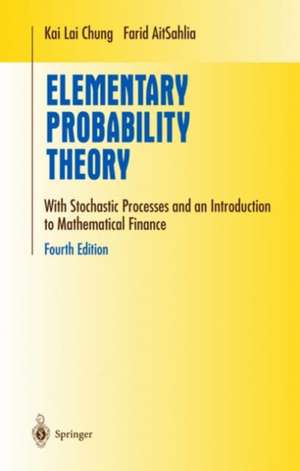
Elementary Probability Theory
Autor Kai Lai Chung, Farid Aitsahliaen Limba Engleză Hardback – 14 feb 2003
Evoluția teoriei probabilităților în ultimele decenii a fost marcată de o tranziție de la abstracția pură către aplicații complexe în economie, reflectând nevoia de a modela incertitudinea în piețele financiare globale. Descoperim aici ediția a patra a lucrării Elementary Probability Theory, un text care și-a păstrat relevanța în curricula universitară timp de peste treizeci de ani, adaptându-se acum prin integrarea matematicii financiare. Considerăm că această actualizare, realizată prin colaborarea dintre Kai Lai Chung și Farid AitSahlia, transformă un manual clasic într-un instrument contemporan indispensabil. Structura volumului urmează o progresie logică, pornind de la teoria mulțimilor și axiomele probabilității, trecând prin variabile aleatoare și condiționare, până la noile capitole dedicate finanțelor. Ceea ce distinge această ediție este rigoarea cu care vocabularul specific al piețelor de capital — opțiuni, acțiuni și așteptări — este tradus în termeni matematici preciși. Față de A Course in Probability Theory, unde accentul cade pe teoria măsurii, această lucrare rămâne accesibilă studenților din primii ani, oferind o punte directă între teorie și practica financiară. Reținem că, spre deosebire de One Thousand Exercises in Probability, care servește drept compendiu de probleme pentru antrenament, Elementary Probability Theory se concentrează pe construirea unei baze conceptuale solide. Este o alternativă la Probability for Finance pentru cursurile de statistică introductivă, cu avantajul că nu limitează expunerea doar la contextul economic, ci oferă o viziune panoramică asupra domeniului, incluzând modele genetice sau schemele Pólya.
Preț: 556.70 lei
Preț vechi: 654.93 lei
-15%
Carte tipărită la comandă
Livrare economică 26 noiembrie-10 decembrie
Specificații
ISBN-10: 038795578X
Pagini: 424
Ilustrații: XIV, 404 p.
Dimensiuni: 160 x 241 x 29 mm
Greutate: 0.75 kg
Ediția:Fourth Edition 2003
Editura: Springer
Locul publicării:New York, NY, United States
V-ar putea interesa
-
 A Course in Probability TheoryKai Lai Chung-35%Preț: 492.51 lei752.62 lei
 -
 How to Lie with StatisticsDarrell Huff-33%Preț: 61.38 lei91.39 lei
 -
 NonparametricsErich L. Lehmann-15%Preț: 709.99 lei835.28 lei
 -
 Probability-1Albert N. Shiryaev-19%Preț: 571.72 lei705.83 lei
 -
 Probability-2Albert N. Shiryaev-19%Preț: 531.63 lei656.34 lei
 -
 Clustering Methodology for Symbolic DataLynne Billard-8%Preț: 575.98 lei626.06 lei
 -
 Preț: 267.88 lei
 -
 Introduction to Statistical Analysis of LaboratoryDataAlfred Bartolucci-9%Preț: 773.55 lei850.05 lei
 -
 -23%Preț: 515.43 lei669.39 lei
 -
 A Panorama of StatisticsEric SoweyPreț: 371.55 lei
 -
 History Mathematical StatisticGorroochurn-9%Preț: 865.51 lei951.11 lei
 -
 A Course in Statistics with RPrabhanjan N Tattar-20%Preț: 690.29 lei862.86 lei
 -
 Statistics from A to ZJawlikPreț: 328.96 lei
 -
 Theory of Point EstimationErich L. Lehmann-15%Preț: 660.57 lei777.14 lei
 -
 Bayesian Essentials with RJean-Michel Marin-18%Preț: 867.14 lei1057.50 lei
 -
 Collected PapersPao-Lu HsuPreț: 510.00 lei
 -
 Preț: 270.74 lei
Public țintă
Lower undergraduateDe ce să citești această carte
Această lucrare este esențială pentru studenții la matematică sau economie care doresc o introducere riguroasă în probabilități, fără a sacrifica aplicabilitatea practică. Cititorul câștigă o înțelegere clară a modului în care incertitudinea guvernează piețele financiare, beneficiind de expertiza combinată a unui teoretician de renume și a unui specialist în cercetare industrială. Este un fundament solid pentru orice specializare ulterioară în procese stocastice.
Despre autor
Kai Lai Chung (1917–2009) a fost un matematician de talie mondială, considerat unul dintre arhitecții teoriei moderne a probabilităților. Profesor emerit la Universitatea Stanford, contribuțiile sale acoperă procesele Markov și mișcarea browniană, lucrările sale devenind texte de referință în bibliografia academică internațională. În această ediție, viziunea sa teoretică este completată de Farid AitSahlia, expert cu experiență în instituții financiare și de cercetare, care aduce perspectiva aplicată necesară pentru a conecta probabilitățile elementare de dinamica piețelor de capital moderne.
Descriere scurtă
Cuprins
Recenzii
Short Book Reviews, Vol. 23/3, Dec. 2003
"This edition is the third revision of a text on mathematical probability first published in 1974. The text is aimed at undergraduate mathematics students and is accessible to a general audience. The prose is accurate, entertaining, and dense with historical tidbits. Two concluding chapters on mathematical finance have been added to the eight chapters in the third edition by the second author." The American Statistician, May 2004
From the reviews of the fourth edition:
"The main novelty in the fourth edition of this well-written book is the addition of new chapters … . The new chapters share the friendly yet rigorous style of the former ones. They beginwith an account of the financial vocabulary, which is then expounded in probabilistic terms. … Almost thirty years after its first edition, this charming book continues to be an excellent text for teaching and for self study." (Ricardo Maronna, Statistical Papers, Vol. 45 (4), 2004)