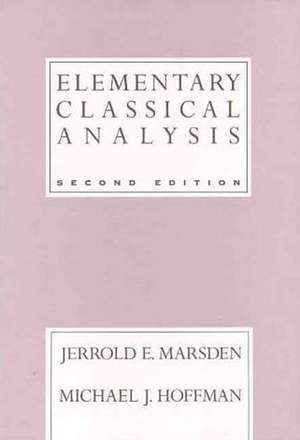
Elementary Classical Analysis
Autor Jerrold Marsden, Michael Hoffmanen Limba Engleză Hardback – 15 mar 1993
Structura lucrării Elementary Classical Analysis este concepută pentru a facilita tranziția de la calculul elementar la analiza reală riguroasă, fiind organizată metodologic pe o progresie logică a complexității. Materialul debutează cu fundamentele teoriei mulțimilor și funcțiilor, avansând către topologia spațiului euclidian și studiul mulțimilor compacte și conexe. Putem afirma că rigoarea este menținută constant pe parcursul celor zece capitole, care acoperă teme esențiale precum convergența uniformă, teoremele funcțiilor inverse și implicite, culminând cu teorema lui Fubini și bazele analizei Fourier. Ceea ce distinge această a doua ediție este echilibrul atent între abordarea abstractă și tehnicile specifice analizei clasice. Spre deosebire de alte manuale de profil, autorii Jerrold Marsden și Michael Hoffman au ales să excludă în mod deliberat calculul vectorial și analiza complexă din acest volum pentru a se concentra pe fundamentele analizei reale necesare în științele fizice. Volumul include 135 de ilustrații care sprijină intuiția geometrică și o secțiune de răspunsuri la exerciții selectate, facilitând studiul individual și verificarea progresului. Această lucrare reprezintă o alternativă la Foundations of Mathematical Analysis de Saminathan Ponnusamy pentru cursurile de analiză matematică de nivel licență, cu avantajul unei orientări mai pronunțate către aplicațiile practice în fizică și inginerie, fără a sacrifica demonstrațiile matematice formale. În contextul operei autorilor, Elementary Classical Analysis completează seria formată din Calculus I, Calculus II și Calculus III, oferind substratul teoretic necesar pentru competențele computaționale dezvoltate în acele volume. Dacă în Vector Calculus accentul cade pe intuiție și calcul, volumul de față consolidează structura logică necesară înțelegerii profunde a fenomenelor.
Preț: 573.76 lei
Preț vechi: 630.50 lei
-9%
Carte în stoc
Livrare din stoc 16 octombrie
Specificații
ISBN-10: 0716721058
Pagini: 752
Ilustrații: 135 illustrations
Dimensiuni: 174 x 242 x 40 mm
Greutate: 1.22 kg
Ediția:Nouă
Editura: W. H. Freeman
Locul publicării:New York, United States
V-ar putea interesa
-
 Principles of Mathematical Analysis (Int'l Ed)Walter Rudin-27%Preț: 375.39 lei516.26 lei
 -
 -18%Preț: 527.45 lei646.10 lei
 -
 -15%Preț: 1002.41 lei1179.30 lei
 -
 A Course in Calculus and Real AnalysisSudhir R. Ghorpade-19%Preț: 509.25 lei628.70 lei
 -
 A First Course in CalculusSerge LangPreț: 471.75 lei
 -
 Elements of the Theory of Functions and Functional AnalysisA. N. Kolmogorov-20%Preț: 120.10 lei149.46 lei
 -
 Counterexamples in AnalysisBernard R. GelbaumPreț: 121.20 lei
 -
 Mathematical PhysicsDonald H. MenzelPreț: 110.74 lei
 -
 Introductory Real AnalysisA. N. Kolmogorov-25%Preț: 141.37 lei188.28 lei
 -
 Advanced CalculusDavid V Widder-24%Preț: 169.76 lei224.02 lei
 -
 Fourier AnalysisElias M. Stein-16%Preț: 654.90 lei779.64 lei
 -
 Complex AnalysisElias M. Stein-16%Preț: 656.05 lei781.02 lei
 -
 -16%Preț: 656.32 lei781.33 lei
 -
 Mathematical BridgesTitu AndreescuPreț: 336.77 lei
 -
 Elementary AnalysisKenneth A. RossPreț: 392.71 lei
 -
 A Problems Based Course in Advanced CalculusJohn M. Erdman-19%Preț: 590.60 lei729.14 lei
 -
 Calculus and Analysis in Euclidean SpaceJerry ShurmanPreț: 397.74 lei
 -
 Introduction to AnalysisMaxwell RosenlichtPreț: 101.50 lei
De ce să citești această carte
Recomandăm Elementary Classical Analysis studenților de la facultățile de matematică, fizică și inginerie care au nevoie de o bază solidă în analiza reală. Cartea oferă claritate metodologică și rigoare, eliminând ambiguitățile din calculul elementar. Este un instrument de lucru esențial pentru pregătirea cursurilor avansate de ecuații diferențiale sau metode numerice, oferind o punte necesară între teoria pură și aplicațiile practice din științele exacte.
Despre autor
Jerrold Marsden și Michael Hoffman sunt recunoscuți pentru contribuțiile lor pedagogice la Universitatea Berkeley, unde au dezvoltat materiale didactice ce echilibrează teoria matematică riguroasă cu necesitățile practice ale studenților din științele aplicate. Jerrold Marsden a fost un matematician de renume, specializat în mecanică geometrică și sisteme dinamice, expertiză ce se reflectă în precizia și structura logică a lucrării Elementary Classical Analysis. Colaborarea lor a produs texte fundamentale, precum seria Calculus și Vector Calculus, care sunt utilizate pe scară largă în mediul universitar internațional pentru capacitatea de a face conceptele abstracte accesibile și relevante.
Cuprins
The Real Line and Euclidean Space
Topology of Euclidean Space
Compact and Connected Sets
Continuous Mappings
Uniform Convergence
Differentiable Mappings
The Inverse and Implicit Function Theorems and Related Topics
Fubini's Theorem and the Change of Variables Formula
Fourier Analysis
Answers to Selected Exercises
Index
Descriere
"Each chapter is organized to deal with mastering concepts before attempting technical proofs. Lots of exercises of varying degrees of difficulty. An excellent text." American Mathematical Monthly