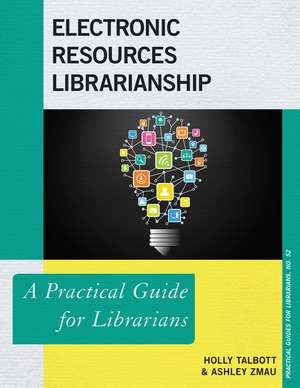
Electronic Resources Librarianship: A Practical Guide for Librarians: Practical Guides for Librarians
Autor Holly Talbott, Ashley Zmauen Limba Engleză Paperback – 31 aug 2018
În contextul programelor de studiu în biblioteconomie și știința informației, gestionarea resurselor digitale a devenit un pilon central, însă trecerea de la teorie la practica administrativă rămâne adesea o provocare. Volumul Electronic Resources Librarianship, publicat sub egida Bloomsbury Publishing în seria Practical Guides for Librarians, vine să umple acest gol procedural. Reținem că lucrarea este concepută special pentru bibliotecarii aflați la început de drum, oferind un cadru structurat pentru primele zile în funcție, de la diagnosticarea problemelor de acces până la fundamentarea deciziilor de reînnoire a abonamentelor.
Notăm cu interes pragmatismul abordării: autoarele Holly Talbott și Ashley Zmau nu se limitează la definiții, ci oferă instrumente concrete, precum scenarii de comunicare cu furnizorii și liste de verificare pentru triajul incidentelor tehnice. Structura cărții urmărește o progresie logică: primele capitole definesc ecosistemul resurselor electronice și terminologia tehnică (sisteme de management al cunoștințelor, metode de autentificare), în timp ce secțiunile ulterioare detaliază mecanismele financiare ale achizițiilor și complexitatea negocierii licențelor. Această abordare completează perspectiva oferită de The ABCs of ERM de Jessica Zellers, adăugând o componentă esențială de management de proiect și strategii pentru combaterea anxietății profesionale într-un mediu tehnologic volatil.
Această lucrare se înscrie în linia preocupărilor anterioare ale autoarei Holly Talbott, care în The Electronic Resources Troubleshooting Guide a explorat ineficiența metodelor de tip încercare și eroare. Aici, însă, perspectiva este lărgită, transformând depanarea într-o componentă a unui flux de lucru integrat. Stilul este direct, orientat spre soluții, facilitând o tranziție rapidă spre rolul de specialist în resurse electronice.
Din seria Practical Guides for Librarians
-
 Preț: 437.45 lei
 - 30%
 Preț: 426.84 lei
 - 29%
 Preț: 460.26 lei
 - 29%
 Preț: 460.26 lei
 - 30%
 Preț: 452.96 lei
 - 30%
 Preț: 416.69 lei
 - 26%
 Preț: 460.26 lei
 - 29%
 Preț: 459.36 lei
 - 32%
 Preț: 441.01 lei
 - 29%
 Preț: 456.18 lei
 - 28%
 Preț: 398.17 lei
 - 29%
 Preț: 456.14 lei
 - 30%
 Preț: 416.76 lei
 - 29%
 Preț: 367.84 lei
 - 28%
 Preț: 461.92 lei
 - 30%
 Preț: 418.14 lei
 - 29%
 Preț: 457.99 lei
 - 29%
 Preț: 434.27 lei
 - 30%
 Preț: 420.58 lei
 - 28%
 Preț: 399.64 lei
 - 31%
 Preț: 386.69 lei
 - 31%
 Preț: 385.06 lei
 - 29%
 Preț: 424.96 lei
 - 29%
 Preț: 458.91 lei
 - 29%
 Preț: 429.27 lei
 - 24%
 Preț: 383.55 lei
 - 29%
 Preț: 358.96 lei
 - 29%
 Preț: 459.36 lei
 - 29%
 Preț: 433.02 lei
 - 29%
 Preț: 457.53 lei
 - 30%
 Preț: 420.61 lei
 - 29%
 Preț: 459.36 lei
 - 30%
 Preț: 419.42 lei
 - 28%
 Preț: 528.39 lei
 - 29%
 Preț: 457.14 lei
 - 30%
 Preț: 418.96 lei
 - 28%
 Preț: 461.21 lei
 -
 Preț: 90.32 lei
 - 29%
 Preț: 459.36 lei
 - 30%
 Preț: 425.32 lei
 - 28%
 Preț: 463.94 lei
 - 18%
 Preț: 440.20 lei
 - 29%
 Preț: 429.71 lei
 - 29%
 Preț: 359.06 lei
 - 11%
 Preț: 416.51 lei
 - 11%
 Preț: 381.96 lei
Preț: 420.98 lei
Preț vechi: 599.02 lei
-30%
Carte tipărită la comandă
Livrare economică 27 noiembrie-11 decembrie
Specificații
ISBN-10: 1538107309
Pagini: 150
Ilustrații: 18 b/w photos; 8 tables
Dimensiuni: 213 x 280 x 12 mm
Greutate: 0.54 kg
Editura: Bloomsbury Publishing
Colecția Rowman & Littlefield
Seria Practical Guides for Librarians
Locul publicării:New York, United States
V-ar putea interesa
-
 -30%Preț: 317.59 lei452.45 lei
 -
 MeditationsMarcus AureliusPreț: 34.00 lei
 -
 Trauernicht, N: Human Resource Management for the Fire and ENathan Trauernicht-5%Preț: 432.72 lei457.23 lei
 -
 -9%Preț: 805.32 lei884.96 lei
 -
 Preț: 319.56 lei
 -
 The Leader's Guide to CollaborationGuy LubitshPreț: 120.92 lei
 -
 Streaming Video Collection Development and ManagementAmauri Serrano-26%Preț: 373.63 lei507.76 lei
 -
 The Work Smarter Guide for New Managers: Achieve Management MasteryMaria Morozova-Duthoit-29%Preț: 75.24 lei105.48 lei
 -
 Practical Project Management for LibrariansKirsten Clark-17%Preț: 167.45 lei201.07 lei
 -
 From Chaos to Order: Addressing Cognitive Overload in the Learning JourneyCourtney McAllister-17%Preț: 391.47 lei471.44 lei
 -
 Library Technical Services: Future ForwardMary Beth Weber-16%Preț: 169.43 lei202.23 lei
 -
 -26%Preț: 406.56 lei548.15 lei
 -
 -19%Preț: 534.28 lei659.61 lei
 -
 Preț: 97.90 lei
 -
 Collection Management BasicsG. Edward Evans-16%Preț: 393.13 lei469.05 lei
 -
 -21%Preț: 270.83 lei343.92 lei
 -
 Artificial Intelligence for LibrariesBrady D. Lund-11%Preț: 341.76 lei385.57 lei
 -
 -22%Preț: 195.89 lei250.80 lei
De ce să citești această carte
Această resursă este esențială pentru absolvenții de biblioteconomie și profesioniștii care preiau gestiunea colecțiilor digitale. Cititorul câștigă un set de instrumente gata de utilizat — de la modele de contracte la protocoale de comunicare — care reduc timpul de învățare. Este ghidul ideal pentru a transforma incertitudinea tehnică într-un flux de lucru eficient și organizat, asigurând accesul neîntrerupt al utilizatorilor la resursele instituției.
Cuprins
Contents
List of Figures and Tables
Preface
Part 1
Chapter 1. Electronic Resources in Libraries
What is an Electronic Resource?
What Does an Electronic Resources Librarian Do?
The Evolving Duties of Electronic Resources Librarians
Chapter 2. Let's Talk Tech
Basic Terminology
Access Tools
Methods of Authentication
Knowledge Management Systems
Chapter 3. Working with Vendors
Working with Vendors
Domestic and International Vendors
Types of Vendors
Initial Contact
Vendor Administration Portals
Chapter 4. Acquisitions
Pricing Options
Serials
Firm Orders
Databases
Budgeting and Renewals
Chapter 5. The Help Desk
Soliciting Help Tickets
Reporting Methods
Recreating and Diagnosing Problems
Following Up
Access Triage
Preventing Access Issues
Subscription Maintenance Checklist
Chapter 6. Licensing
What is a License?
Parts of a License
Clauses to Keep an Eye On
Evaluating a License
Negotiating a License
Physical and Electronic License Organization
Developing relationship between libraries and vendors
Chapter 7. Usage Statistics
Show Me the Numbers
Analyzing Your Data
Making Narratives for Your Data
Thinking Outside the Box
Chapter 8. Collection Development
What is Collection Development?
Bridging the Gap Between Collection Development Staff and Technical Services
Collection Development Maintenance Projects
Part 2
Chapter 9. Your First Ninety Days
Questions You Need Answered
People You Need to Meet
Tools for Your Toolkit
Chapter 10. Goal Setting and Time Management
Defining Goals
Developing Habits
Time Management Tips and Tricks
Time Logs: Moving Towards Your Ideal Work Week
Chapter 11. Training Others
Creating Effective Documentation
The Art of Delegation
How to Train Effectively
The Feedback Loop
Leading a Team of Specialists as an E-resources Librarian
Chapter 12. Support Systems
Vendor Support Centers and Training
Professional Groups, Conferences, and Listservs
Cold Calling Professional Colleagues
Appendix 1
License Review Checklist
Appendix 2
Worksheet: Questions You Need to Ask
Appendix 3
Worksheet: People You Need to Meet
Recenzii
Summing Up: Recommended for library professionals and graduate students.
Electronic Resources Librarianship provides the reader with the kind of on-th-job technical education that I only obtained through much trial and error, and the asking of many questions. Moreover, it provides essential guidance on the interpersonal skills - negotiating and working with vendors, for example - not to mention time management, that I received working side-by-side with my director.
The book is very well written and provides exactly what it promises. This book is highly recommended for new electronic resource librarians needing a solid guide to a very complicated position. It would also be useful to any librarian wanting to understand the relationship between electronic resources, library users, vendors, and librarians. I only wish I had access to this book a decade ago when I shifted into electronic resources from managing print serials!
Holly Talbott and Ashley Zmau have created an elemental text for the new electronic resources librarian. The most significant parts of this work are the sections providing advice on the initial 90 days of work along with the establishment of goals and time management strategies.
As stated by the authors, Electronic Resources Librarianship is targeted at newly minted electronic resource librarians-individuals straight out of library school, with no management experience and no experience with electronic resources beyond that of an end-user. By far the most unique feature of this book is the last section, which focuses on developing management skills within the context of an electronic resources position-effectively becoming a mentor-from-afar. [N]ew electronic resource librarians will be well-armed to meet the challenges of electronic resource management.