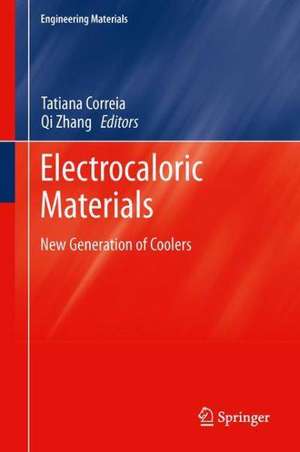
Electrocaloric Materials: Engineering Materials, cartea 34
Editat de Tatiana Correia, Qi Zhangen Limba Engleză Hardback – 16 dec 2013
Din seria Engineering Materials
- 20%
 Preț: 1046.16 lei
 - 18%
 Preț: 1343.43 lei
 - 18%
 Preț: 1071.75 lei
 - 18%
 Preț: 902.47 lei
 - 18%
 Preț: 893.36 lei
 - 18%
 Preț: 610.38 lei
 - 18%
 Preț: 948.50 lei
 - 18%
 Preț: 913.36 lei
 - 18%
 Preț: 1220.30 lei
 - 18%
 Preț: 896.57 lei
 - 18%
 Preț: 904.82 lei
 - 15%
 Preț: 620.20 lei
 - 13%
 Preț: 442.89 lei
 - 18%
 Preț: 773.36 lei
 - 24%
 Preț: 846.04 lei
 - 18%
 Preț: 1122.44 lei
 - 18%
 Preț: 953.03 lei
 - 18%
 Preț: 1405.02 lei
 - 18%
 Preț: 1110.89 lei
 - 18%
 Preț: 860.99 lei
 - 18%
 Preț: 1068.30 lei
 - 15%
 Preț: 681.12 lei
 - 15%
 Preț: 623.20 lei
 - 18%
 Preț: 1032.12 lei
 - 18%
 Preț: 1330.79 lei
 - 18%
 Preț: 1005.09 lei
 - 18%
 Preț: 1072.48 lei
 - 15%
 Preț: 631.51 lei
 - 15%
 Preț: 643.28 lei
 - 18%
 Preț: 1554.16 lei
 - 15%
 Preț: 614.19 lei
 - 18%
 Preț: 1130.80 lei
 - 18%
 Preț: 953.08 lei
 - 15%
 Preț: 633.39 lei
 - 15%
 Preț: 641.11 lei
 - 15%
 Preț: 634.35 lei
 - 18%
 Preț: 1176.89 lei
 - 18%
 Preț: 1184.45 lei
 -
 Preț: 340.61 lei
 - 18%
 Preț: 974.36 lei
 - 18%
 Preț: 1242.89 lei
 - 15%
 Preț: 647.70 lei
 - 15%
 Preț: 614.60 lei
 - 18%
 Preț: 933.52 lei
 - 18%
 Preț: 1071.02 lei
 - 15%
 Preț: 648.56 lei
 - 18%
 Preț: 1221.06 lei
 - 18%
 Preț: 934.66 lei
Preț: 647.73 lei
Preț vechi: 762.04 lei
-15%
Puncte Express: 972
Carte tipărită la comandă
Livrare economică 20 noiembrie-04 decembrie
Livrare prin curier în România Termenul estimat este afișat lângă disponibilitate.
Transport gratuit pentru acest produs Plată online sau ramburs, în funcție de opțiunile comenzii.
Retur gratuit în 14 zile Comandă securizată și suport în română.
Specificații
ISBN-13: 9783642402630
ISBN-10: 3642402631
Pagini: 264
Ilustrații: VIII, 253 p. 141 illus., 36 illus. in color.
Dimensiuni: 160 x 241 x 20 mm
Greutate: 0.57 kg
Ediția:2014
Editura: Springer
Colecția Engineering Materials
Seria Engineering Materials
Locul publicării:Berlin, Heidelberg, Germany
ISBN-10: 3642402631
Pagini: 264
Ilustrații: VIII, 253 p. 141 illus., 36 illus. in color.
Dimensiuni: 160 x 241 x 20 mm
Greutate: 0.57 kg
Ediția:2014
Editura: Springer
Colecția Engineering Materials
Seria Engineering Materials
Locul publicării:Berlin, Heidelberg, Germany
V-ar putea interesa
-
 Investigating Hong Kong EnglishQi Zhang-8%Preț: 464.70 lei505.11 lei
 -
 -23%Preț: 7524.72 lei9772.37 lei
 -
 Materials Handbook: A Concise Desktop ReferenceFrançois Cardarelli-18%Preț: 2718.93 lei3315.77 lei
 -
 Programming Phase-Field ModelingS. Bulent Biner-23%Preț: 1364.55 lei1772.14 lei
 -
 Materials Design and ApplicationsLucas F. M. Da Silva-18%Preț: 928.90 lei1132.81 lei
 -
 -18%Preț: 969.05 lei1181.77 lei
 -
 Mechanical and Creep Behavior of Advanced MaterialsIndrajit Charit-18%Preț: 981.86 lei1197.39 lei
 -
 Characterization of Minerals, Metals, and Materials 2017Shadia Ikhmayies-18%Preț: 1229.80 lei1499.77 lei
 -
 Friction Stir Welding and Processing IXYuri Hovanski-18%Preț: 1039.10 lei1267.20 lei
 -
 Advances in Shape Memory MaterialsQingping Sun-15%Preț: 647.09 lei761.27 lei
 -
 -15%Preț: 580.14 lei682.52 lei
 -
 Prüfung von Papier, Pappe, Zellstoff und HolzstoffThomas Krause-15%Preț: 533.62 lei627.79 lei
 -
 The Chemistry of the Catalyzed Hydrogenation of Carbon MonoxideG. Henrici-OlivéPreț: 375.57 lei
 -
 Methanol - Chemie- und EneigierohstoffFriedrich Asinger-15%Preț: 657.14 lei773.10 lei
 -
 Mesoscopic Physics and ElectronicsTsuneya Ando-15%Preț: 643.87 lei757.49 lei
 -
 Semiconductor SiliconGünther Harbeke-15%Preț: 649.38 lei763.98 lei
 -
 Thermodynamic Data on Oxides and SilicatesSurendra K. Saxena-15%Preț: 651.27 lei766.20 lei
 -
 -15%Preț: 611.89 lei719.87 lei
 -
 Preț: 404.43 lei
 -
 Field Emission Scanning Electron MicroscopyNicolas Brodusch-15%Preț: 448.63 lei527.79 lei
Public țintă
ResearchCuprins
Electrocaloric effect: An Introduction.- Constitutive Modeling of Electrothermal Properties in Polar Dielectric Materials and Thin Films.- Electrocaloric Effect in Relaxor Ferroelectric-based Materials.- Electrocaloric Effect in Multilayer Structures.- Electrocaloric Polymers.- Lead-free and exotic Electrocaloric Materials.- Indirect and Direct Measurements of the Electrocaloric Effect.- New Approaches to Electrocaloric-Based Multilayer Cooling.- Energy Harvesting from Temperature: use of Pyroelectric and Electrocaloric Properties.
Textul de pe ultima copertă
Since the 1997 Kyoto protocol of reduction of greenhouse gas emissions, the development of novel refrigerators has been a priority within the scientific community. Although magnetocaloric materials are promising candidates, they still need a large magnetic field to induce a giant ΔT as well as powerful and costly magnets. However, in electrocaloric materials (ECMs) a temperature change may be achieved by applying or removing an electric field. Since a giant electrocaloric effect on ferroelectric thin films was reported in Science in 2006, researchers have been inspired to explore such effect in different ferroelectric thin films. This book reviews electrocaloric effects observed in bulk materials as well as recent promising advances in thin films, with special emphasis on the ferroelectric, antiferroelectric and relaxor nature of ECMs. It reports a number of considerations about the future of ECMs as a means of achieving an efficient, ecologically sustainable and low cost refrigerator.
Caracteristici
First book on this subject Introduces a new generation of materials Written and edited by pioneers in the field