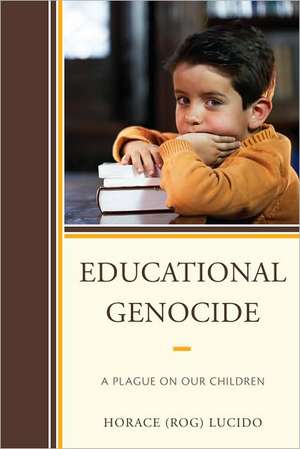
Educational Genocide: A Plague on Our Children
Autor Horace 'Rog' B. Lucidoen Limba Engleză Paperback – 16 aug 2010
Preț: 306.96 lei
Preț vechi: 388.88 lei
-21%
Puncte Express: 460
Carte tipărită la comandă
Livrare economică 26 noiembrie-10 decembrie
Livrare prin curier în România Termenul estimat este afișat lângă disponibilitate.
Transport gratuit de la 400.00 lei Plată online sau ramburs, în funcție de opțiunile comenzii.
Retur gratuit în 14 zile Comandă securizată și suport în română.
Specificații
ISBN-13: 9781607097181
ISBN-10: 1607097184
Pagini: 222
Dimensiuni: 156 x 232 x 17 mm
Greutate: 0.34 kg
Editura: Bloomsbury Publishing
Colecția R&L Education
Locul publicării:New York, United States
ISBN-10: 1607097184
Pagini: 222
Dimensiuni: 156 x 232 x 17 mm
Greutate: 0.34 kg
Editura: Bloomsbury Publishing
Colecția R&L Education
Locul publicării:New York, United States
V-ar putea interesa
-
 Confessions of a School NurseMichael AlexanderPreț: 115.48 lei
 -
 Nasty PeopleJay Carter-18%Preț: 92.93 lei113.92 lei
 -
 Preț: 362.39 lei
 -
 Educational Therapy in Action: Behind and Beyond the Office DoorDorothy Fink UngerleiderPreț: 366.22 lei
 -
 Bloomsbury CPD Library: Stretch and ChallengeDebbie Light-45%Preț: 123.35 lei224.51 lei
 -
 Preț: 248.37 lei
 -
 Handbook of Art Therapy, Second EditionCathy A. Malchiodi-9%Preț: 647.86 lei711.93 lei
 -
 -27%Preț: 1218.70 lei1660.32 lei
 -
 Social-Ecological Approach to CyberbullyingDr Michelle F Wright-27%Preț: 1991.84 lei2713.51 lei
 -
 -26%Preț: 206.67 lei278.22 lei
 -
 Preț: 109.34 lei
Cuprins
Chapter 1 Foreword
Chapter 2 Introduction
Chapter 3 Are All Things Measurable?
Chapter 4 Objectivity Is Subjective
Chapter 5 Test Score Addiction
Chapter 6 Accountability Is Corrupted
Chapter 7 Education for Profit
Chapter 8 Oppressing Freedom
Chapter 9 Student Anguish
Chapter 10 A Culture of Fear
Chapter 11 Student, Teacher, and Parent Redress
Chapter 12 No Excuses, Just Results
Chapter 13 Forgiving Learning
Chapter 2 Introduction
Chapter 3 Are All Things Measurable?
Chapter 4 Objectivity Is Subjective
Chapter 5 Test Score Addiction
Chapter 6 Accountability Is Corrupted
Chapter 7 Education for Profit
Chapter 8 Oppressing Freedom
Chapter 9 Student Anguish
Chapter 10 A Culture of Fear
Chapter 11 Student, Teacher, and Parent Redress
Chapter 12 No Excuses, Just Results
Chapter 13 Forgiving Learning
Recenzii
This insightful book dares to challenge the world we offer children when we trumpet 'No excuses!'-and offers a better way.
High-stakes testing appeals to politicians and bean counters. Real educators, like Lucido, use varying and creative methods to reach different kinds of children, and they judge their success by multiple measures. Which kind of students does America need-cookie cutter clones or critical thinkers? Educational Genocide describes the crisis in our public schools and offers remedies for parents, teachers, and administrators.
As a long time educator who has witnessed first hand the harmful effects of test score hysteria, I appreciate the very readable in-depth research Lucido has provided in Educational Genocide. As our government begins the 'Race to the Top,' this book is a must-read for anyone who has children, is a teacher, or is involved in education in any way. I wish every legislator would read this book before casting another vote on any test score related education bill!
This is not just a smart book. It is also a touchingly personal narrative. Don't be fooled by the fact that this work is vital and informative. It is far more than that. It's genius, and what makes it memorable is Lucido's gift to speak to us, not just from the head but from the heart as well.
Education Genocide is much more than a wake-up call . . . . Lucido's exhaustive research and first-hand experience should ignite outrage and a '60s era revolt against high stakes test abuse overtaking the nation's public schools under the punitive politics of No Child Left Behind. Mind-numbing testing can no longer be ignored as a major source of escalating drop-out of students and teachers.
Lucido (Assessment Reform Network) challenges the notion of standardized testing in schools, warning of the danger of basing educational accountability on superficial test scores. Using research-based evidence, as well as firsthand experience in the form of personal narratives that are easily accessible to his readers, he strongly criticizes the industrial model of schooling and cautions that the educational system is being pushed in the wrong direction as it stifles students' creativity and imagination by focusing on test preparation. Lucido's voice and passion shine through in the numerous examples he uses to illustrate the narrowing of curriculum and the way teaching has been redefined by the extreme concentration on high-stakes testing. Lucido reminds readers that education should be a forgiving process of pushing students to think and achieve; he explains that teaching should be analogous to coaching. His comprehensive knowledge of the literature on testing, as well as extensive experience working with students, is evident, and his presentation of alternative approaches to assessing students' learning makes this book a must read for teachers, administrators, teacher-educators, and even parents. Summing Up: Highly recommended. Graduate, research, and professional collections.
High-stakes testing appeals to politicians and bean counters. Real educators, like Lucido, use varying and creative methods to reach different kinds of children, and they judge their success by multiple measures. Which kind of students does America need-cookie cutter clones or critical thinkers? Educational Genocide describes the crisis in our public schools and offers remedies for parents, teachers, and administrators.
As a long time educator who has witnessed first hand the harmful effects of test score hysteria, I appreciate the very readable in-depth research Lucido has provided in Educational Genocide. As our government begins the 'Race to the Top,' this book is a must-read for anyone who has children, is a teacher, or is involved in education in any way. I wish every legislator would read this book before casting another vote on any test score related education bill!
This is not just a smart book. It is also a touchingly personal narrative. Don't be fooled by the fact that this work is vital and informative. It is far more than that. It's genius, and what makes it memorable is Lucido's gift to speak to us, not just from the head but from the heart as well.
Education Genocide is much more than a wake-up call . . . . Lucido's exhaustive research and first-hand experience should ignite outrage and a '60s era revolt against high stakes test abuse overtaking the nation's public schools under the punitive politics of No Child Left Behind. Mind-numbing testing can no longer be ignored as a major source of escalating drop-out of students and teachers.
Lucido (Assessment Reform Network) challenges the notion of standardized testing in schools, warning of the danger of basing educational accountability on superficial test scores. Using research-based evidence, as well as firsthand experience in the form of personal narratives that are easily accessible to his readers, he strongly criticizes the industrial model of schooling and cautions that the educational system is being pushed in the wrong direction as it stifles students' creativity and imagination by focusing on test preparation. Lucido's voice and passion shine through in the numerous examples he uses to illustrate the narrowing of curriculum and the way teaching has been redefined by the extreme concentration on high-stakes testing. Lucido reminds readers that education should be a forgiving process of pushing students to think and achieve; he explains that teaching should be analogous to coaching. His comprehensive knowledge of the literature on testing, as well as extensive experience working with students, is evident, and his presentation of alternative approaches to assessing students' learning makes this book a must read for teachers, administrators, teacher-educators, and even parents. Summing Up: Highly recommended. Graduate, research, and professional collections.