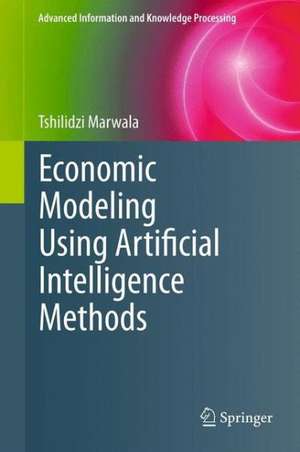
Economic Modeling Using Artificial Intelligence Methods: Advanced Information and Knowledge Processing
Autor Tshilidzi Marwalaen Limba Engleză Hardback – 16 apr 2013
The artificial intelligence techniques used to model economic data include:
- multi-layer perceptron neural networks
- radial basis functions
- support vector machines
- rough sets
- genetic algorithm
- particle swarm optimization
- simulated annealing
- multi-agent system
- incremental learning
- fuzzy networks
Economic Modeling Using Artificial Intelligence Methods makes an important contribution to the area of econometrics,and is a valuable source of reference for graduate students, researchers and financial practitioners.
Din seria Advanced Information and Knowledge Processing
- 20%
 Preț: 299.39 lei
 - 20%
 Preț: 1079.34 lei
 - 20%
 Preț: 625.78 lei
 -
 Preț: 458.06 lei
 - 20%
 Preț: 616.16 lei
 - 20%
 Preț: 1036.45 lei
 - 20%
 Preț: 958.31 lei
 - 20%
 Preț: 970.74 lei
 - 20%
 Preț: 670.94 lei
 - 45%
 Preț: 776.37 lei
 - 20%
 Preț: 991.87 lei
 - 20%
 Preț: 676.72 lei
 - 20%
 Preț: 649.61 lei
 - 20%
 Preț: 963.52 lei
 - 20%
 Preț: 955.83 lei
 - 20%
 Preț: 672.07 lei
 - 20%
 Preț: 992.32 lei
 - 20%
 Preț: 988.89 lei
 - 20%
 Preț: 661.65 lei
 - 20%
 Preț: 343.78 lei
 - 20%
 Preț: 632.39 lei
 - 20%
 Preț: 1003.15 lei
 - 20%
 Preț: 1030.71 lei
 - 20%
 Preț: 673.39 lei
 - 20%
 Preț: 960.69 lei
 - 20%
 Preț: 672.29 lei
 - 20%
 Preț: 623.93 lei
 - 20%
 Preț: 992.50 lei
 - 18%
 Preț: 695.76 lei
 - 20%
 Preț: 1035.80 lei
 - 20%
 Preț: 821.26 lei
 - 20%
 Preț: 648.73 lei
 - 20%
 Preț: 1035.12 lei
 - 18%
 Preț: 1081.73 lei
 - 15%
 Preț: 670.30 lei
 - 20%
 Preț: 999.31 lei
 - 20%
 Preț: 672.07 lei
 - 20%
 Preț: 962.18 lei
 - 20%
 Preț: 990.39 lei
 - 20%
 Preț: 986.77 lei
 - 20%
 Preț: 623.76 lei
 - 20%
 Preț: 900.28 lei
Preț: 674.03 lei
Preț vechi: 842.53 lei
-20%
Puncte Express: 1011
Carte tipărită la comandă
Livrare economică 28 noiembrie-12 decembrie
Livrare prin curier în România Termenul estimat este afișat lângă disponibilitate.
Transport gratuit pentru acest produs Plată online sau ramburs, în funcție de opțiunile comenzii.
Retur gratuit în 14 zile Comandă securizată și suport în română.
Specificații
ISBN-13: 9781447150091
ISBN-10: 1447150090
Pagini: 280
Ilustrații: XVI, 261 p.
Dimensiuni: 160 x 241 x 20 mm
Greutate: 0.54 kg
Ediția:2013
Editura: Springer
Colecția Advanced Information and Knowledge Processing
Seria Advanced Information and Knowledge Processing
Locul publicării:London, United Kingdom
ISBN-10: 1447150090
Pagini: 280
Ilustrații: XVI, 261 p.
Dimensiuni: 160 x 241 x 20 mm
Greutate: 0.54 kg
Ediția:2013
Editura: Springer
Colecția Advanced Information and Knowledge Processing
Seria Advanced Information and Knowledge Processing
Locul publicării:London, United Kingdom
V-ar putea interesa
-
 -20%Preț: 89.95 lei112.23 lei
 -
 Computer VisionSimon J. D. Prince-20%Preț: 582.72 lei728.39 lei
 -
 Machine LearningPeter Flach-20%Preț: 386.84 lei483.55 lei
 -
 Multi-Agent Machine LearningSchwartz-20%Preț: 675.81 lei844.77 lei
 -
 Wavelet Neural NetworksAntonis K Alexandridis-20%Preț: 634.18 lei792.72 lei
 -
 Practical Introduction to CompDawson-Howe-20%Preț: 518.21 lei647.76 lei
 -
 Militarized Conflict Modeling Using Computational IntelligenceTshilidzi Marwala-20%Preț: 837.10 lei1046.36 lei
 -
 Condition Monitoring Using Computational Intelligence MethodsTshilidzi Marwala-15%Preț: 617.05 lei725.94 lei
 -
 Machine Learning: An Algorithmic Perspective, Second EditionStephen Marsland-20%Preț: 625.22 lei781.53 lei
 -
 -18%Preț: 972.72 lei1186.23 lei
 -
 -20%Preț: 1225.91 lei1532.38 lei
 -
 -20%Preț: 957.24 lei1196.55 lei
 -
 -9%Preț: 987.33 lei1084.98 lei
 -
 -18%Preț: 980.13 lei1195.28 lei
 -
 -20%Preț: 626.87 lei783.59 lei
 -
 Artificial Intelligence Techniques for Rational Decision MakingTshilidzi Marwala-20%Preț: 344.00 lei430.00 lei
 -
 Machine Learning of Natural LanguageDavid M.W. Powers-20%Preț: 325.79 lei407.24 lei
 -
 Beyond InformationTom Stonier-20%Preț: 435.59 lei544.48 lei
 -
 -20%Preț: 335.43 lei419.29 lei
 -
 Digital Signal Processing in Telecommunications: European Project COST#229 Technical ContributionsAnibal R. Figueiras-Vidal-15%Preț: 621.34 lei730.99 lei
 -
 Long Term Human-Computer Interaction: An Exploratory PerspectiveRichard C. Thomas-20%Preț: 617.52 lei771.89 lei
 -
 Believable BotsPhilip Hingston-20%Preț: 676.70 lei845.88 lei
Public țintă
ResearchCuprins
Foreword.- Preface.- Acknowledgements.- Introduction to Economic Modeling.- Techniques for Economic Modeling: Unlocking the Character of Data.- Automatic Relevance Determination in Economic Modeling.- Neural Approaches to Economic Modeling.- Bayesian Support Vector Machines for Economic Modeling: Application to Option Pricing.- Rough Sets Approach to Economic Modeling: Unlocking Knowledge in Financial Data.- Missing Data Approaches to Economic Modeling: Optimization Approach.- Correlations versus Causality Approaches to Economic Modeling.- Evolutionary Approaches to Computational Economics: Application to Portfolio Optimization.- Real-time Approaches to Computational Economics: Self Adaptive Economic Systems.- Multi-Agent Approaches to Economic Modeling: Game Theory, Ensembles, Evolution and the Stock Market.- Control Approaches to Economic Modeling: Application to Inflation Targeting.- Modeling Interstate Conflict: The Role of Economic Interdependency for Maintaining Peace.- Conclusions and Further Work.- Index.
Recenzii
From the reviews:
“The book explores the application of artificial intelligence methods to economic data modelling. … the book is well addressed to graduate students as well as researchers and practitioners in the field of finance and economics.” (Vangelis Grigoroudis, zbMATH, Vol. 1269, 2013)
“The book explores the application of artificial intelligence methods to economic data modelling. … the book is well addressed to graduate students as well as researchers and practitioners in the field of finance and economics.” (Vangelis Grigoroudis, zbMATH, Vol. 1269, 2013)
Notă biografică
Tshilidzi Marwala is the Vice-Chancellor and Principal of the University of Johannesburg. He was previously the Deputy Vice Chancellor: Research and Internationalization and a Dean of the Faculty of Engineering at the University of Johannesburg. He was previously a full Professor of Electrical Engineering, the Carl and Emily Fuchs Chair of Systems and Control Engineering as well as the SARChI chair of Systems Engineering at the University of the Witwatersrand. Prior to this, he was an executive assistant to the technical director at the South African Breweries. He holds a Bachelor of Science in Mechanical Engineering (magna cum laude) from Case Western Reserve University (USA), a Master of Mechanical Engineering from the University of Pretoria, a PhD in Engineering from Cambridge University and was a post-doctoral research associate at the Imperial College (London). He is a registered professional engineer, a Fellow of TWAS, the World Academy of Sciences, the Academy of Science of South Africa (ASSAf), the African Academy of Sciences and the South African Academy of Engineering. He is a Senior Member of the IEEE (Institute of Electrical and Electronics Engineering) and a distinguished member of the ACM (Association for Computing Machinery). His research interests are multi-disciplinary and they include the theory and application of computational intelligence to engineering, computer science, finance, social science and medicine. He has supervised 47 Masters and 21 PhD students to completion. He has published 9 books (one translated into Mandarin), over 280 papers and holds three international patents. He is an associate editor of the International Journal of Systems Science (Taylor and Francis Publishers).
Evan Hurwitz is a South African computer scientist. He obtained his BSc Engineering (Electrical) (2004), his MSc Engineering (2006) from the University of the Witwatersrand and PhD from the University of Johannesburg in
2014 supervized by Tshilidzi Marwala. He is known for his work on teaching a computer how to bluff which was widely covered by the magazine New Scientist. Hurwitz together with Tshilidzi Marwala proposed that there is less level of information asymmetry between two artificial intelligent agents than between two human agents and that the more artificial intelligent there is in the market the less is the volume of trades in the market.Textul de pe ultima copertă
Economic Modeling Using Artificial Intelligence Methods examines the application of artificial intelligence methods to model economic data. Traditionally, economic modeling has been modeled in the linear domain where the principles of superposition are valid. The application of artificial intelligence for economic modeling allows for a flexible multi-order non-linear modeling. In addition, game theory has largely been applied in economic modeling. However, the inherent limitation of game theory when dealing with many player games encourages the use of multi-agent systems for modeling economic phenomena.
The artificial intelligence techniques used to model economic data include:
Economic Modeling Using Artificial Intelligence Methods makes an importantcontribution to the area of econometrics, and is a valuable source of reference for graduate students, researchers and financial practitioners.
The artificial intelligence techniques used to model economic data include:
- multi-layer perceptron neural networks
- radial basis functions
- support vector machines
- rough sets
- genetic algorithm
- particle swarm optimization
- simulated annealing
- multi-agent system
- incremental learning
- fuzzy networks
Economic Modeling Using Artificial Intelligence Methods makes an importantcontribution to the area of econometrics, and is a valuable source of reference for graduate students, researchers and financial practitioners.
Caracteristici
Presents new insights into the modeling of economic data Proposes a structure for evaluating economic strategies such as inflation targeting founded on artificial intelligence techniques Addresses causality and proposes new frameworks for dealing with this issue Applies evolutionary computing to model complex evolving economic environments in an accessible way