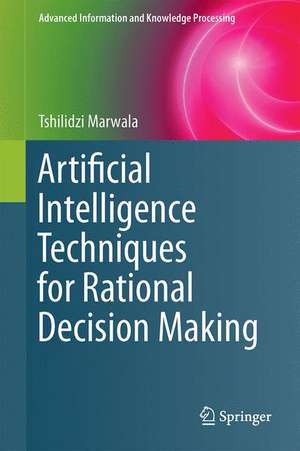
Artificial Intelligence Techniques for Rational Decision Making: Advanced Information and Knowledge Processing
Autor Tshilidzi Marwalaen Limba Engleză Hardback – 3 noi 2014
Artificial Intelligence Techniques for Rational Decision Making examines and defines the concepts of causal and correlation machines and applies the transmission theory of causality as a defining factor that distinguishes causality from correlation. It develops the theory of rational counterfactuals which are defined as counterfactuals that are intended to maximize theattainment of a particular goal within the context of a bounded rational decision making process. Furthermore, it studies four methods for dealing with irrelevant information in decision making:
- Theory of the marginalization of irrelevant information
- Principal component analysis
- Independent component analysis
- Automatic relevance determination method
Rich in methods of artificial intelligence including rough sets, neural networks, support vector machines, genetic algorithms, particle swarm optimization, simulated annealing, incremental learning and fuzzy networks, this book will be welcomed by researchers and students working in these areas.
Din seria Advanced Information and Knowledge Processing
- 20%
 Preț: 299.39 lei
- 20%
 Preț: 1079.34 lei
- 20%
 Preț: 625.78 lei
-
 Preț: 458.06 lei
- 20%
 Preț: 616.16 lei
- 20%
 Preț: 1036.45 lei
- 20%
 Preț: 958.31 lei
- 20%
 Preț: 970.74 lei
- 20%
 Preț: 670.94 lei
- 45%
 Preț: 776.37 lei
- 20%
 Preț: 991.87 lei
- 20%
 Preț: 676.72 lei
- 20%
 Preț: 649.61 lei
- 20%
 Preț: 963.52 lei
- 20%
 Preț: 955.83 lei
- 20%
 Preț: 672.07 lei
- 20%
 Preț: 992.32 lei
- 20%
 Preț: 988.89 lei
- 20%
 Preț: 661.65 lei
- 20%
 Preț: 343.78 lei
- 20%
 Preț: 632.39 lei
- 20%
 Preț: 1003.15 lei
- 20%
 Preț: 1030.71 lei
- 20%
 Preț: 673.39 lei
- 20%
 Preț: 960.69 lei
- 20%
 Preț: 672.29 lei
- 20%
 Preț: 623.93 lei
- 20%
 Preț: 992.50 lei
- 18%
 Preț: 695.76 lei
- 20%
 Preț: 1035.80 lei
- 20%
 Preț: 821.26 lei
- 20%
 Preț: 648.73 lei
- 20%
 Preț: 1035.12 lei
- 18%
 Preț: 1081.73 lei
- 15%
 Preț: 670.30 lei
- 20%
 Preț: 999.31 lei
- 20%
 Preț: 672.07 lei
- 20%
 Preț: 962.18 lei
- 20%
 Preț: 990.39 lei
- 20%
 Preț: 986.77 lei
- 20%
 Preț: 623.76 lei
- 20%
 Preț: 900.28 lei
Preț: 344.00 lei
Preț vechi: 430.00 lei
-20%
Puncte Express: 516
Carte tipărită la comandă
Livrare economică 04-18 decembrie
Livrare prin curier în România Termenul estimat este afișat lângă disponibilitate.
Transport gratuit de la 400.00 lei Plată online sau ramburs, în funcție de opțiunile comenzii.
Retur gratuit în 14 zile Comandă securizată și suport în română.
Specificații
ISBN-13: 9783319114231
ISBN-10: 3319114239
Pagini: 184
Ilustrații: XV, 168 p. 35 illus.
Dimensiuni: 160 x 241 x 16 mm
Greutate: 0.4 kg
Ediția:2014
Editura: Springer
Colecția Advanced Information and Knowledge Processing
Seria Advanced Information and Knowledge Processing
Locul publicării:Cham, Switzerland
ISBN-10: 3319114239
Pagini: 184
Ilustrații: XV, 168 p. 35 illus.
Dimensiuni: 160 x 241 x 16 mm
Greutate: 0.4 kg
Ediția:2014
Editura: Springer
Colecția Advanced Information and Knowledge Processing
Seria Advanced Information and Knowledge Processing
Locul publicării:Cham, Switzerland
V-ar putea interesa
-
 -19%Preț: 92.35 lei114.22 lei
-
 Computer VisionSimon J. D. Prince-20%Preț: 582.72 lei728.39 lei
-
 Machine LearningPeter Flach-20%Preț: 386.84 lei483.55 lei
-
 Multi-Agent Machine LearningH M Schwartz-20%Preț: 675.81 lei844.77 lei
-
 Wavelet Neural NetworksAntonios K Alexandridis-20%Preț: 634.18 lei792.72 lei
-
 Practical Introduction to CompDawson-Howe-20%Preț: 518.21 lei647.76 lei
-
 Militarized Conflict Modeling Using Computational IntelligenceTshilidzi Marwala-20%Preț: 837.10 lei1046.36 lei
-
 Economic Modeling Using Artificial Intelligence MethodsTshilidzi Marwala-20%Preț: 674.03 lei842.53 lei
-
 Condition Monitoring Using Computational Intelligence MethodsTshilidzi Marwala-15%Preț: 617.05 lei725.94 lei
-
 Machine Learning: An Algorithmic Perspective, Second EditionStephen Marsland-20%Preț: 625.22 lei781.53 lei
-
 -18%Preț: 972.72 lei1186.23 lei
-
 Natural Language Processing and Computational LinguisticsMohamed Zakaria Kurdi-9%Preț: 1021.06 lei1122.04 lei
-
 -18%Preț: 980.13 lei1195.28 lei
-
 Automated Reasoning with Analytic Tableaux and Related MethodsHans De Nivelle-20%Preț: 325.83 lei407.29 lei
-
 ICT Innovations 2015Suzana Loshkovska-20%Preț: 971.03 lei1213.79 lei
-
 AI 2015: Advances in Artificial IntelligenceBernhard Pfahringer-20%Preț: 341.19 lei426.48 lei
-
 Simulation and Modeling Methodologies, Technologies and ApplicationsMohammad S. Obaidat-20%Preț: 961.13 lei1201.41 lei
-
 Mobile, Ubiquitous, and Pervasive LearningAlejandro Peña Ayala-20%Preț: 319.15 lei398.93 lei
-
 Knowledge Representation for Health CareDavid Riaño-20%Preț: 271.33 lei339.16 lei
-
 Chinese Lexical SemanticsQin Lu-20%Preț: 344.70 lei430.87 lei
-
 Knowledge, Information and Creativity Support SystemsSusumu Kunifuji-20%Preț: 1251.95 lei1564.93 lei
-
 Believable BotsPhilip Hingston-20%Preț: 676.70 lei845.88 lei
-
 -20%Preț: 637.03 lei796.29 lei
Public țintă
ResearchCuprins
Introduction to Rational Decision Making.- Casual Function for Rational Decision Making: Application to Militarized Interstate Disputes.- Correlation Function for Rational Decision Making: Application to Epileptic Activity.- Missing Data Approaches for Rational Decision Making: Application to Anecdotal Data.- Rational Counterfactuals and Decision Making: Application to Interstate Conflict.- Flexibility-Bounded Rationality in Interstate Conflict.- Filtering Irrelevant Information for Rational Decision Making.- Group Decision Making.- Conclusion.- Appendix A: Fourier Transform, Wavelet Transform, Modal Properties and Pseudo-Modal Energies.- Appendix B: Committee of Networks.
Recenzii
“Each chapter introduces a topic, discusses thetheory for implementing it, and then describes a use case and the results ofits application. … This is an important book. … Copious references, severalpages per chapter, provide voluminous background material for the curiousreader.” (G. R. Mayforth, Computing Reviews, December, 2015)
Textul de pe ultima copertă
Develops insights into solving complex problems in engineering, biomedical sciences, social science and economics based on artificial intelligence. Some of the problems studied are in interstate conflict, credit scoring, breast cancer diagnosis, condition monitoring, wine testing, image processing and optical character recognition. The author discusses and applies the concept of flexibly-bounded rationality which prescribes that the bounds in Nobel Laureate Herbert Simon’s bounded rationality theory are flexible due to advanced signal processing techniques, Moore’s Law and artificial intelligence.
Artificial Intelligence Techniques for Rational Decision Making examines and defines the concepts of causal and correlation machines and applies the transmission theory of causality as a defining factor that distinguishes causality from correlation. It develops the theory of rational counterfactuals which are defined as counterfactuals that are intended to maximize theattainment of a particular goal within the context of a bounded rational decision making process. Furthermore, it studies four methods for dealing with irrelevant information in decision making:
Rich in methods of artificial intelligence including rough sets, neural networks, support vector machines, genetic algorithms, particle swarm optimization, simulated annealing, incremental learning and fuzzy networks, this book will be welcomed by researchers and students working in these areas.
Artificial Intelligence Techniques for Rational Decision Making examines and defines the concepts of causal and correlation machines and applies the transmission theory of causality as a defining factor that distinguishes causality from correlation. It develops the theory of rational counterfactuals which are defined as counterfactuals that are intended to maximize theattainment of a particular goal within the context of a bounded rational decision making process. Furthermore, it studies four methods for dealing with irrelevant information in decision making:
- Theory of the marginalization of irrelevant information
- Principal component analysis
- Independent component analysis
- Automatic relevance determination method
Rich in methods of artificial intelligence including rough sets, neural networks, support vector machines, genetic algorithms, particle swarm optimization, simulated annealing, incremental learning and fuzzy networks, this book will be welcomed by researchers and students working in these areas.
Caracteristici
Presents new insights into the theories of bounded rationality and counterfactuals Explains the theories and applications of artificial intelligence in biomedical sciences, engineering, economics and social sciences Proposes linkages between counterfactuals, rationality, causality, correlation and artificial intelligence Includes supplementary material: sn.pub/extras
Notă biografică
Tshilidzi Marwala is the Vice-Chancellor and Principal of the University of Johannesburg. He was previously the Deputy Vice Chancellor: Research and Internationalization and a Dean of the Faculty of Engineering at the University of Johannesburg. He was previously a full Professor of Electrical Engineering, the Carl and Emily Fuchs Chair of Systems and Control Engineering as well as the SARChI chair of Systems Engineering at the University of the Witwatersrand. Prior to this, he was an executive assistant to the technical director at the South African Breweries. He holds a Bachelor of Science in Mechanical Engineering (magna cum laude) from Case Western Reserve University (USA), a Master of Mechanical Engineering from the University of Pretoria, a PhD in Engineering from Cambridge University and was a post-doctoral research associate at the Imperial College (London). He is a registered professional engineer, a Fellow of TWAS, the World Academy of Sciences, the Academy of Science of South Africa (ASSAf), the African Academy of Sciences and the South African Academy of Engineering. He is a Senior Member of the IEEE (Institute of Electrical and Electronics Engineering) and a distinguished member of the ACM (Association for Computing Machinery). His research interests are multi-disciplinary and they include the theory and application of computational intelligence to engineering, computer science, finance, social science and medicine. He has supervised 47 Masters and 21 PhD students to completion. He has published 9 books (one translated into Mandarin), over 280 papers and holds three international patents. He is an associate editor of the International Journal of Systems Science (Taylor and Francis Publishers).
Evan Hurwitz is a South African computer scientist. He obtained his BSc Engineering (Electrical) (2004), his MSc Engineering (2006) from the University of the Witwatersrand and PhD from the University of Johannesburg in
2014 supervized by Tshilidzi Marwala. He is known for his work on teaching a computer how to bluff which was widely covered by the magazine New Scientist. Hurwitz together with Tshilidzi Marwala proposed that there is less level of information asymmetry between two artificial intelligent agents than between two human agents and that the more artificial intelligent there is in the market the less is the volume of trades in the market.