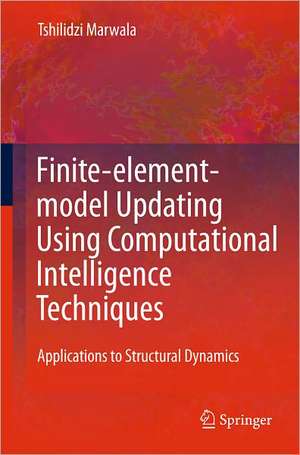
Finite Element Model Updating Using Computational Intelligence Techniques
Autor Tshilidzi Marwalaen Limba Engleză Hardback – 10 iun 2010
Preț: 980.13 lei
Preț vechi: 1195.28 lei
-18%
Puncte Express: 1470
Carte tipărită la comandă
Livrare economică 27 noiembrie-11 decembrie
Livrare prin curier în România Termenul estimat este afișat lângă disponibilitate.
Transport gratuit pentru acest produs Plată online sau ramburs, în funcție de opțiunile comenzii.
Retur gratuit în 14 zile Comandă securizată și suport în română.
Specificații
ISBN-13: 9781849963220
ISBN-10: 1849963223
Pagini: 268
Ilustrații: XV, 250 p.
Dimensiuni: 160 x 241 x 22 mm
Greutate: 0.57 kg
Ediția:2010
Editura: Springer
Locul publicării:London, United Kingdom
ISBN-10: 1849963223
Pagini: 268
Ilustrații: XV, 250 p.
Dimensiuni: 160 x 241 x 22 mm
Greutate: 0.57 kg
Ediția:2010
Editura: Springer
Locul publicării:London, United Kingdom
V-ar putea interesa
-
 Model Selection and Multimodel InferenceDavid R. Anderson-23%Preț: 1072.91 lei1393.39 lei
 -
 -18%Preț: 1325.12 lei1615.99 lei
 -
 Handbook in Monte Carlo SimulaBrandimarte-9%Preț: 993.76 lei1092.04 lei
 -
 -9%Preț: 715.91 lei786.71 lei
 -
 -14%Preț: 702.53 lei816.89 lei
 -
 -27%Preț: 833.31 lei1141.52 lei
 -
 Growth Curve ModelingMichael J Panik-9%Preț: 904.81 lei994.29 lei
 -
 Modeling and Simulation in Medicine and the Life SciencesFrank C. HoppensteadtPreț: 495.58 lei
 -
 Waves in Neural MediaPaul C. Bressloff-15%Preț: 709.30 lei834.48 lei
 -
 Nonlinear Physical SystemsOleg N Kirillov-23%Preț: 1172.19 lei1522.33 lei
 -
 Optimization with PDE ConstraintsRonald Hoppe-15%Preț: 676.61 lei796.01 lei
 -
 Mathematical ModellingMatti HeiliöPreț: 475.25 lei
 -
 Topology OptimizationMartin Philip Bendsoe-18%Preț: 898.67 lei1095.94 lei
 -
 Dispersal, Individual Movement and Spatial EcologyMark A. LewisPreț: 397.70 lei
 -
 METHODS & APPL OF WHITE NOISE ANALY IN INTERDISCIPLIN SCIBernido Christopher C-15%Preț: 558.77 lei657.38 lei
Public țintă
Professional/practitionerDescriere
Finite element models (FEMs) are widely used to understand the dynamic behaviour of various systems. FEM updating allows FEMs to be tuned better to reflect measured data and may be conducted using two different statistical frameworks: the maximum likelihood approach and Bayesian approaches. Finite Element Model Updating Using Computational Intelligence Techniques applies both strategies to the field of structural mechanics, an area vital for aerospace, civil and mechanical engineering. Vibration data is used for the updating process.
Following an introduction a number of computational intelligence techniques to facilitate the updating process are proposed; they include:
• multi-layer perceptron neural networks for real-time FEM updating;
• particle swarm and genetic-algorithm-based optimization methods to accommodate the demands of global versus local optimization models;
• simulated annealing to put the methodologies into a sound statistical basis; and
• response surface methods and expectation maximization algorithms to demonstrate how FEM updating can be performed in a cost-effective manner; and to help manage computational complexity.
Based on these methods, the most appropriate updated FEM is selected using the Bayesian approach, a problem that traditional FEM updating has not addressed. This is found to incorporate engineering judgment into finite elements systematically through the formulations of prior distributions. Throughout the text, case studies, specifically designed to demonstrate the special principles are included. These serve to test the viability of the new approaches in FEM updating.
Finite Element Model Updating Using Computational Intelligence Techniques analyses the state of the art in FEM updating critically and based on these findings, identifies new research directions, making it of interest to researchers in strucural dynamics and practising engineers using FEMs. Graduate students of mechanical, aerospace and civil engineering will also find the text instructive.
Following an introduction a number of computational intelligence techniques to facilitate the updating process are proposed; they include:
• multi-layer perceptron neural networks for real-time FEM updating;
• particle swarm and genetic-algorithm-based optimization methods to accommodate the demands of global versus local optimization models;
• simulated annealing to put the methodologies into a sound statistical basis; and
• response surface methods and expectation maximization algorithms to demonstrate how FEM updating can be performed in a cost-effective manner; and to help manage computational complexity.
Based on these methods, the most appropriate updated FEM is selected using the Bayesian approach, a problem that traditional FEM updating has not addressed. This is found to incorporate engineering judgment into finite elements systematically through the formulations of prior distributions. Throughout the text, case studies, specifically designed to demonstrate the special principles are included. These serve to test the viability of the new approaches in FEM updating.
Finite Element Model Updating Using Computational Intelligence Techniques analyses the state of the art in FEM updating critically and based on these findings, identifies new research directions, making it of interest to researchers in strucural dynamics and practising engineers using FEMs. Graduate students of mechanical, aerospace and civil engineering will also find the text instructive.
Cuprins
to Finite-element-model Updating.- Finite-element-model Updating Using Nelder–Mead Simplex and Newton Broyden–Fletcher–Goldfarb–Shanno Methods.- Finite-element-model Updating Using Genetic Algorithm.- Finite-element-model Updating Using Particle-swarm Optimization.- Finite-element-model Updating Using Simulated Annealing.- Finite-element-model Updating Using the Response-surface Method.- Finite-element-model Updating Using a Hybrid Optimization Method.- Finite-element-model Updating Using a Multi-criteria Method.- Finite-element-model Updating Using Artificial Neural Networks.- Finite-element-model Updating Using a Bayesian Approach.- Finite-element-model Updating Applied in Damage Detection.- Conclusions and Emerging State-of-the-art.
Recenzii
From the reviews:
“This book introduces the concepts of computational intelligence for finite-element-model updating. … This book opens new research directions in the field of computational intelligence applied in mathematical models that use finite-element updating method. I would warmly recommend this book for the under-graduated and graduated students, researchers and all the people interested in the fields of computational intelligence and the finite element method.” (Răzvan Răducanu, Zentralblatt MATH, Vol. 1197, 2010)
“This book introduces the concepts of computational intelligence for finite-element-model updating. … This book opens new research directions in the field of computational intelligence applied in mathematical models that use finite-element updating method. I would warmly recommend this book for the under-graduated and graduated students, researchers and all the people interested in the fields of computational intelligence and the finite element method.” (Răzvan Răducanu, Zentralblatt MATH, Vol. 1197, 2010)
Notă biografică
Tshilidzi Marwala is the Vice-Chancellor and Principal of the University of Johannesburg. He was previously the Deputy Vice Chancellor: Research and Internationalization and a Dean of the Faculty of Engineering at the University of Johannesburg. He was previously a full Professor of Electrical Engineering, the Carl and Emily Fuchs Chair of Systems and Control Engineering as well as the SARChI chair of Systems Engineering at the University of the Witwatersrand. Prior to this, he was an executive assistant to the technical director at the South African Breweries. He holds a Bachelor of Science in Mechanical Engineering (magna cum laude) from Case Western Reserve University (USA), a Master of Mechanical Engineering from the University of Pretoria, a PhD in Engineering from Cambridge University and was a post-doctoral research associate at the Imperial College (London). He is a registered professional engineer, a Fellow of TWAS, the World Academy of Sciences, the Academy of Science of South Africa (ASSAf), the African Academy of Sciences and the South African Academy of Engineering. He is a Senior Member of the IEEE (Institute of Electrical and Electronics Engineering) and a distinguished member of the ACM (Association for Computing Machinery). His research interests are multi-disciplinary and they include the theory and application of computational intelligence to engineering, computer science, finance, social science and medicine. He has supervised 47 Masters and 21 PhD students to completion. He has published 9 books (one translated into Mandarin), over 280 papers and holds three international patents. He is an associate editor of the International Journal of Systems Science (Taylor and Francis Publishers).
Evan Hurwitz is a South African computer scientist. He obtained his BSc Engineering (Electrical) (2004), his MSc Engineering (2006) from the University of the Witwatersrand and PhD from the University of Johannesburg in
2014 supervized by Tshilidzi Marwala. He is known for his work on teaching a computer how to bluff which was widely covered by the magazine New Scientist. Hurwitz together with Tshilidzi Marwala proposed that there is less level of information asymmetry between two artificial intelligent agents than between two human agents and that the more artificial intelligent there is in the market the less is the volume of trades in the market.Caracteristici
Shows the reader advanced methods for tuning finite element simulations to measured data Dual use of expectation maximization and response surface methods compensates for computational complexity Robust optimisation techniques reconcile local with global models
Includes supplementary material: sn.pub/extras
Includes supplementary material: sn.pub/extras