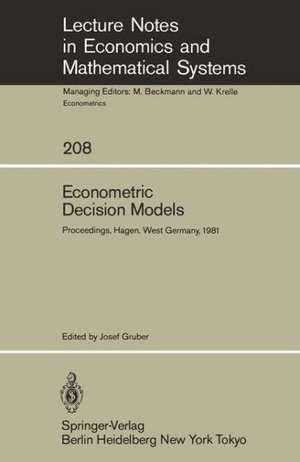
Econometric Decision Models: Lecture Notes in Economics and Mathematical Systems, cartea 208
Editat de J. Gruberen Limba Engleză Paperback – mai 1983
Din seria Lecture Notes in Economics and Mathematical Systems
-
 Preț: 368.38 lei
 -
 Preț: 365.65 lei
 -
 Preț: 428.35 lei
 -
 Preț: 478.67 lei
 -
 Preț: 365.90 lei
 -
 Preț: 398.93 lei
 -
 Preț: 384.48 lei
 - 15%
 Preț: 646.64 lei
 -
 Preț: 364.71 lei
 -
 Preț: 437.64 lei
 -
 Preț: 370.76 lei
 - 15%
 Preț: 618.65 lei
 -
 Preț: 363.99 lei
 -
 Preț: 331.98 lei
 -
 Preț: 409.58 lei
 -
 Preț: 363.18 lei
 - 18%
 Preț: 778.82 lei
 -
 Preț: 377.68 lei
 -
 Preț: 405.53 lei
 - 15%
 Preț: 620.72 lei
 -
 Preț: 367.23 lei
 -
 Preț: 363.18 lei
 - 15%
 Preț: 611.54 lei
 - 15%
 Preț: 621.61 lei
 -
 Preț: 363.41 lei
 -
 Preț: 430.76 lei
 - 15%
 Preț: 618.65 lei
 -
 Preț: 371.37 lei
 - 15%
 Preț: 629.18 lei
 -
 Preț: 399.23 lei
 -
 Preț: 395.12 lei
 -
 Preț: 383.75 lei
 -
 Preț: 383.75 lei
 -
 Preț: 377.40 lei
 - 15%
 Preț: 610.96 lei
 - 20%
 Preț: 628.32 lei
 -
 Preț: 365.45 lei
 -
 Preț: 476.60 lei
 -
 Preț: 363.14 lei
 - 15%
 Preț: 611.04 lei
 -
 Preț: 371.20 lei
 -
 Preț: 364.19 lei
 - 15%
 Preț: 640.81 lei
 -
 Preț: 364.48 lei
 - 15%
 Preț: 611.19 lei
 -
 Preț: 365.09 lei
 - 15%
 Preț: 613.62 lei
 - 15%
 Preț: 612.55 lei
 -
 Preț: 432.70 lei
Preț: 618.43 lei
Preț vechi: 727.56 lei
-15%
Puncte Express: 928
Carte tipărită la comandă
Livrare economică 18 noiembrie-02 decembrie
Livrare prin curier în România Termenul estimat este afișat lângă disponibilitate.
Transport gratuit pentru acest produs Plată online sau ramburs, în funcție de opțiunile comenzii.
Retur gratuit în 14 zile Comandă securizată și suport în română.
Specificații
ISBN-13: 9783540115540
ISBN-10: 3540115544
Pagini: 376
Ilustrații: VI, 368 p.
Dimensiuni: 155 x 235 x 21 mm
Greutate: 0.57 kg
Ediția:Softcover reprint of the original 1st ed. 1983
Editura: Springer
Colecția Lecture Notes in Economics and Mathematical Systems
Seria Lecture Notes in Economics and Mathematical Systems
Locul publicării:Berlin, Heidelberg, Germany
ISBN-10: 3540115544
Pagini: 376
Ilustrații: VI, 368 p.
Dimensiuni: 155 x 235 x 21 mm
Greutate: 0.57 kg
Ediția:Softcover reprint of the original 1st ed. 1983
Editura: Springer
Colecția Lecture Notes in Economics and Mathematical Systems
Seria Lecture Notes in Economics and Mathematical Systems
Locul publicării:Berlin, Heidelberg, Germany
V-ar putea interesa
-
 How Markets Fail: The Logic of Economic CalamitiesCassidy John-19%Preț: 75.16 lei92.53 lei
 -
 The Theory of Moral SentimentsAdam SmithPreț: 113.96 lei
 -
 A Course in Behavioral EconomicsErik AngnerPreț: 228.44 lei
 -
 Economics EvolvingAgnar SandmoPreț: 254.97 lei
 -
 Let Them Eat Junk: How Capitalism Creates Hunger and ObesityRobert AlbrittonPreț: 226.12 lei
 -
 Essays on Capital & Interest: An Austrian PerspectiveIsreal M KirznerPreț: 106.25 lei
 -
 On CompetitionMichael E. PorterPreț: 266.50 lei
 -
 Issues in FinanceSayerPreț: 231.38 lei
 -
 The Intelligent Woman's Guide to Socialism & CapitalismGeorge Bernard ShawPreț: 118.36 lei
 -
 False DawnJohn GrayPreț: 78.80 lei
 -
 Introducing KeynesPeter PughPreț: 63.48 lei
 -
 The Skeptical Economist: Revealing the Ethics Inside EconomicsJonathan AldredPreț: 278.38 lei
 -
 The Reformation in EconomicsPhilip PilkingtonPreț: 359.55 lei
 -
 Handbook of New Institutional EconomicsClaude Ménard-18%Preț: 728.59 lei888.52 lei
 -
 Economic DynamicsGiancarlo Gandolfo-18%Preț: 977.31 lei1191.84 lei
Public țintă
ResearchCuprins
Introduction: Towards observed preferences in econometric decision models.- Problem Area 1: Econometric decision models in theory and practice: experiences and problems in large-scale applications, recent developments in theory and methods (except those of problem areas 2 and 3 below).- The “optimal” control of the RWI-model.- Optimal stabilization with a quarterly model of the Federal Republic of Germany.- Some experiences with the control of a macroeconometric model with a scalarvalued objective function from the viewpoint of applied economic research.- An application of optimal control to a small model of politico-economic interaction.- Evaluating macroeconomic policy: Optimal control solutions versus suboptimal alternatives.- Adaptive control of macroeconomic models (abstract).- A fine-tuning scheme for economic decision rules.- A control-theoretic analysis for a small econometric model of the Federal Republic of Germany.- The asymptotic distribution of optimal policy feedback coefficients.- Conflict, cooperation and social preference functions.- Decentralized control strategies for large-scale discrete-time systems.- A recursive adaptive hybrid model for national and interregional analysis.- Problem Area 2: Methods for obtaining the weights and target values in the scalarvalued objective function of (e. g. ) the linea-quadratic econometric decision model.- A study of adaptive revision of target values in an econometric decision model.- The measurement of quadratic preference functions with small samples.- The determination of collective preferences in economic decision models: With an application to Soviet economic policy.- Problem Area 3: Methods for avoiding the necessity of explicitly specifying and quantifying a scalarvalued objective function beforesolving the econometric decision model.- Interactive solution of multiple objective, dynamic, macroeconomic stabilization problems: A comparative study.- A methodology for solving the multiple criteria macroeconomic policy problem.- The interactive multiobjective optimization method by Elemer E. Rosinger: A computer program and aspects of applications.